The Albaani Site

Translation from the Works of the Reviver of this Century

Tag: albani

The Reward for Reaching the Opening Takbir in the Congregational Prayer for Forty Days


مَنْ صَلَّى لِلهِ أَرْبَعِيْنَ يَوْمًا فِي جَمَاعَةٍ يُدْرِكُ التَّكْبِيْرَةَ الأُوْلَى كُتِبَتْ لَهُ بَرَاءَتَانِ: بَرَاءَةٌ مِنَ النَّارِ وَبَرَاءَةٌ مِنَ النِّفَاقِ


From Anas, may Allaah be pleased with him, that the Prophet صلى الله عليه وسلم said, “Whoever prays with the congregation reaching the opening takbir for forty days [sincerely] for [the sake of] Allaah, two types of freedom are written for him: freedom from the Fire, and freedom from hypocrisy.”

Silsilah | 2652 | Hasan

The Prophet’s favourite colour


كَانَ أَحَبُّ الْأَلْوَانِ إِلَى رَسُولِ اللهِ صَلَّى اللهُ عَلَيْهِ وَسَلَّمَ اَلْخُضْرَةُ

From Anas, may Allaah be pleased with him, who said, “The most beloved of colours to the Prophet صَلَّى اللهُ عَلَيْهِ وَسَلَّمَ was green.”

Silsilah | 2054 | Hasan

Let Whoever Eats Meat Perform Ablution [wudoo]


مَنْ أَكَلَ لَحْمًا فَلْيَتَوَضَّأْ

Al-Qaasim the freed slave of Mu’aawiyah said, “I entered Damascus and saw a group of people who had gathered and there was a Shaikh speaking to them. So I said, ‘Who is that?’ They said, ‘Sahl ibn Handhaliyyah.’ So I heard him say, ‘I heard the Messenger of Allaah صَلَّى اللهُ عَلَيْهِ وَسَلَّمَ say, ‘Let whoever eats meat perform ablution [wudoo].’’”

Shaikh al-Albaani said, “The matter mentioned in the hadith is a recommendation except if [that which is eaten] is camel meat, since then it is obligatory, due to the fact that differentiating between it and other meat has been established [in a hadith]. For they asked him about performing ablution after [eating] camel meat and he replied, “Perform ablution.” And [they asked him about performing ablution after eating] sheep’s meat, and he replied, “If you want.” Reported by Muslim and others.”

Silsilah | 2322 | Hasan

His dislike of fame


Translated by Ahmed Abu Turaab

One time a man saw the Shaikh while he, may Allaah have mercy on him, was sitting in his car, so the man rushed to him and said, ‘You’re Shaikh al-Albaani?’

So the Shaikh started to cry.

When he, may Allaah the Most High have mercy on him, was asked why he started to cry he replied, ‘It befits a person to strive against his own soul and not to become deceived by the people pointing to him.”

Al-Imaam al-Albaani, Duroos, wa Mawaaqif, wa Ibar, of Abdul-Aziz ibn Muhammad Abdullaah as-Sadhaan, p. 126.

The Breath of the People of the Fire


لَوْ كَانَ فِي هَذَا الْمَسْجِدِ مِائَةُ [أَلْفٍ] أَوْ يَزِيْدُوْنَ، وَفِيْهِ رَجُلٌ مِنْ أَهْلِ النَّارِ فَتَنَفَّسَ فَأَصَابَهُمْ نَفَسُهُ لَاحْتَرَقَ الْمَسْجِدُ وَمَنْ فِيْهِ

Abu Hurairah, may Allaah be pleased with him, said, “The Prophet of Allaah صلى الله عليه وسلم said, ‘If there were a hundred (thousand) or more in this mosque, and in it was a man from the People of the Fire who took a breath and whose breath came upon them, the mosque and those in it would burn.’”

Silsilah | 2509 | Saheeh

Clarification on Sending Salaah and Salaam upon the Prophet صلى الله عليه وسلم after the Call to Prayer


Some of you were asking for a clarification on the point made at the end of the post on saying, ‘Sadaqallaahul-Adheem,’ at the end of reciting the Quraan where Shaikh al-Albaani said, “… will be like the addition of sending salaah on the Prophet after the call to prayer [which is also an innovation] …”  That was all that was mentioned on the topic because it was taken from a tape, the following should clarify what is meant, inshaa Allaah.

In Ad-Da’eefah, vol. 2, p. 294, Shaikh al-Albaani mentions that the following hadith, “When Bilaal would want to call the Iqaamah he would say, “Peace be upon you, O Messenger, and the Mercy and Blessings of Allaah. May Allaah have mercy on you,” is fabricated and then says:

“And it is as though this [fabricated] hadith is the basis for that widespread innovation which we saw in Aleppo, Idlib and other cities in the north, and it is the sending of prayers and salutation upon the Prophet, صلى الله تعالى عليه وآله وسلم, loudly just before the iqaamah. And it is like that other innovation of reading it out aloud after the call to prayer as the verifying scholars have clarified …

Note: when the scholars reject innovations such as these then let it not occur to anyone that they are rejecting the basis of the legitimacy of sending prayers on the Prophet, صلى الله تعالى عليه وآله وسلم! Rather they are only rejecting placing it somewhere the Prophet صلى الله تعالى عليه وآله وسلم did not put it, or that it is accompanied by characteristics and forms that Allaah did not legislate on the tongue of His Prophet.

As has been authentically reported from Ibn Umar, may Allaah be pleased with him, that a man sneezed in front of him and said, “Alhamdulillaah, was-Salaatu was-Salaamu alaa Rasoolillaah sallallaahu alaihi wa sallam.”

So Ibn Umar said, “And I [too] say, ‘Alhamdulillaah, was-Salaatu was-Salaamu alaa Rasoolillaah sallallaahu alaihi wa sallam,’ but the Prophet of Allaah صلى الله عليه وسلم did not teach us [to say it] like this [in this situation]! Say, ‘Alhamdulillaahi rabbil-aalameen,’ or say, ‘Alaa kulli haal.’

So look at how Ibn Umar, may Allaah be pleased with him, rejected placing [the saying of] salaah next to the saying of Alhamdulillaah after sneezing based upon the proof that the Prophet صلى الله تعالى عليه وآله وسلم did not do that, along with his open declaration that he [also] does send prayers upon the Prophet صلى الله تعالى عليه وآله وسلم [and he mentioned this] in order to make sure that no one would think that he was making an [outright] general rejection of sending salaah upon the Prophet صلى الله تعالى عليه وآله وسلم, as some of the ignorant people do when they see those aiding the Sunnah rejecting this innovation and its like, accusing them of rejecting the sending of salaah upon the Prophet صلى الله تعالى عليه وآله وسلم, may Allaah the Most High guide them to following the Sunnah.”

And in Tamaamal-Minnah, vol. 1, p. 158, Shaikh al-Albaani said, “The saying of the author, ‘Saying the salaah and salaam on the Prophet صلى الله تعالى عليه وآله وسلم out aloud … is a newly-invented, hated affair …’ I [i.e., Shaikh al-Albaani] say: what is understood from this is that saying it quietly is the Sunnah.

And if it said: ‘Where is the proof for that?’

The reply is: it is his صلى الله تعالى عليه وآله وسلم saying, ‘When you hear the mu’adhin, then say the same as he says and then send prayers upon me …’ … so the people being addressed here are those who are listening to the adhaan and who have been ordered to respond to the mu’adhin [by saying what he says] and the mu’adhin himself is not included in this.

For if it is argued that he is included, then it would be binding to say that he himself should also respond to himself and no one has said this and such a thing is an innovation in the religion.

Then if it is said: is the mu’adhin prohibited from saying salaah upon the Prophet صلى الله تعالى عليه وآله وسلم quietly?

I [i.e., Shaikh al-Albaani] say: he is not prohibited to do so totally but he is prohibited from sticking to it after the call to prayer for fear of increasing upon the call to prayer and for fear of adding to it that which is not from it, and [for fear of] making equal those whom the Prophet صلى الله تعالى عليه وآله وسلم addressed in the text, i.e., those listening [to the call to prayer], and those who have not been addressed in the text, i.e., the mu’adhin …”

ِAnd in Fadlus-Salaati Alan-Nabiyy on pages 49-50 when explaining this hadith, “When you hear the mu’adhin then say the same as he says, then send salaat upon me, for whoever sends salaat upon me, Allaah will send salaat upon him tenfold.  Then ask Allaah to grant me Al-Waseelah, for it is a station in Paradise which only one of the slaves of Allaah will attain, and I hope to be the one. Whoever asks for al-Waseelah for me, (my) intercession will be permissible for him,” Bukhaari and Muslim (Eng. trans. vol., 1, p. 488, no. 849.) Shaikh al-Albaani said:

“I say: and in this hadith are three Sunnahs that most of the people have neglected: responding to the mu’adhin [i.e., saying what he say], sending salaah upon the Prophet صلى الله تعالى عليه وآله وسلم after finishing saying what he says and then asking for the waseelah for the Prophet صلى الله تعالى عليه وآله وسلم.

And from the strange things is that you will see that some of those who neglect these Sunnahs are the most bigoted of people in sticking to the innovation of the mu’adhin calling the salaah upon the Prophet صلى الله تعالى عليه وآله وسلم out loudly after the adhaan.  Even though it is unanimously regarded as an innovation.  So if they are doing that out of love for the Prophet صلى الله تعالى عليه وآله وسلم why couldn’t they follow him in this Sunnah, and leave that innovation?  We ask Allaah for guidance.”

Transl. note: So what is being referred to is the Mu’adhin himself saying it out loud and making it part of the adhaan or iqaamah, as is done in places in India, where the mu’adhin will send salaah on the Prophet صلى الله تعالى عليه وآله وسلم and then start the iqaamah straight away such that it basically becomes part of the iqaamah, or in Pakistan where it is read before the adhaan and even after on the speakers.

What is not meant is that the person who hears the adhaan can’t say it since such an individual has been told to say it in the hadith Shaikh al-Albaani mentioned above, ‘When you hear the mu’adhin, then say the same as he says and then send prayers upon me …’

The Encouragement to have Guests and the Prohibition of Overburdening Oneself in that …


لَا خَيْرَ فِيْمَنْ لَا يُضِيْفُ

From Uqbah in Aamir in marfoo form, “There is no good in a person who does not host [guests].”

Silsilah | 2434 | Saheeh

لَا يَتَكَلَّفَنَّ أَحَدٌ لِضَيْفِهِ مَا لَا يَقْدِرُ عَلَيْهِ

From Salmaan, may Allaah be pleased with him, that the Prophet صَلَّى اللهُ عَلَيْهِ وَسَلَّمَ said, “Let no-one overburden [himself] for his guest over and above what he is capable of doing.”

Silsilah | 2440 | Qawiyy

Al-Albaani wishing he was a millionaire …


“A man who was sick and whose treatment was by way of injections came [to the Shaikh], one of these injections would cost twenty dinars and he needed fifteen of them.  So the Shaikh asked me [Muhammad al-Khateeb] to go to his house and confirm the veracity of what he had said. When we came to know that what he had said was true, the Shaikh gave me some money and we bought the injections for him.

When I had intended to build a house I needed [to borrow] some money. So I knocked many doors [i.e., asked a lot of people], but I did not come across anything. Then I remembered a rich man who the Shaikh knew so I said to the Shaikh’s wife, ‘Maybe you could ask the Shaikh to intercede on my behalf with the man so that he might lend me [what I need].’

The next day while I was sitting at my desk the Shaikh said to me, ‘O Muhammad! You want me to intercede on your behalf with so and so to lend you some money?’

So I said, ‘Yes.’

He said, ‘I am closer to you than him. I will give you what you want.’ So I cried and said, ‘Our Shaikh! May Allaah reward you with good.’ But, by Allaah, it never occurred to me that I would get what I needed from the Shaikh …

Then when he gave the money he said, ‘This is a gift of a thousand dinars which are not included [in the loan].’ So I cried a second time, may Allaah reward him with abundant good and may He, the Most High, have mercy on him.

Another story that occurred recently was when the Shaikh was in hospital and a woman came to him complaining about the fact that she had fallen prey to the banks. She had borrowed nine thousand dinars from one of them and then the amount she owed began to multiply due to interest.  She came to the Shaikh appealing to him to help rid herself of this problem.

So the Shaikh, as was usual, asked me to verify the facts. After I did so and was sure of the truthfulness of the woman he agreed to loan her seven thousand dinars.

The lady came along with her children and the Shaikh said, ‘Here is a thousand dinars as a gift, and here is the other amount that you requested.’ So the lady was delighted as were her children and they supplicated for the Shaikh and I did too. The lady asked Allaah to reward the Shaikh with good.

Then the Shaikh looked at us and said, ‘O brothers, by Allaah, truly I wish that I become a millionaire so that I can take thousands more women like this one out of the shackles of interest.’”

Al-Imaam, al-Mujaddid, al-Allaamah, al-Muhaddith, Muhammad Naasirud-Deen al-Albaani, pp. 62-63.

Receive the Glad-tidings …


مَا أَهَلَّ مُهِلٌّ قَط إِلَّا بُشِّرَ، وَلَا كَبَّرَ مُكَبِّرٌ قَط إِلَّا بُشَّرَ، قِيْلَ: بِالْجَنَّةِ؟ قَالَ:نَعَمْ

The Prophet صَلَّى اللهُ عَلَيْهِ وَسَلَّمَ said, “No one ever said the talbiyyah except that he was given glad-tidings. And no one ever said Allaahu Akbar except that he was given glad tidings.”

It was said, “Of Paradise?”

He said, “Yes.”

Silsilah | 1621 | Saheeh

The Reward for Lying upon the Prophet صَلَّى اللهُ عَلَيْهِ وَسَلَّمَ


إِنَّ الَّذِي يَكْذِبُ عَلَيَّ يُبْنَى لَهُ بَيْتٌ فِي النَّارِ

The Prophet صَلَّى اللهُ عَلَيْهِ وَسَلَّمَ said, “Indeed a house in the Fire is built for the one who lies upon me.”

Silsilah | 1618 | Saheeh

Shaikh al-Albaani’s independence from the rulers …


Shaikh Muhammad Musa Nasr said, “We do not know from the life of our Shaikh and through the times we accompanied him which spanned over twenty years that he ever entered upon a ruler, or those in authority or a judge, or ever fawned on one, or was ever appointed in a religious position under one, or ever ate at the table of one: which was the thing that made him independent in the stances he took; and his religious verdicts were not issued due to political or religious pressure …

So his religious verdicts were never to please Zaid or Amr.  Allaah had made him free of having a need of the people, and provided for him through what his own hands earned where he worked repairing watches for many long years, “The best of what a man eats is that which his own hands have earned …”

And I took his hand one day and said to him, “Our Shaikh! Have you ever shaken hands with any of the tyrants of this world?”

He replied, “No.”

I said to him, “And have you ever eaten at their tables or entered upon them?”

He said, “No.”

So I took his hand to kiss it and he prevented me from doing so, but I overcame him and kissed it. After which he severely reprimanded me, so I said, “And why shouldn’t I kiss a hand that has never shaken that of a tyrant? And which has served the Sunnah of the Messenger صَلَّى اللهُ عَلَيْهِ وَسَلَّمَ for more than half a century?”

And the Shaikh would reprimand me many times for my exaggeration in the love and honour for him, and in my view this was less than what he deserved.

But this did not prevent us from opposing him, sometimes, in some of the independent judgements [ijtihaad] he would come to, may Allaah have mercy on him. For everyone’s saying is accepted and rejected except for the companion of this grave [i.e., the Prophet صَلَّى اللهُ عَلَيْهِ وَسَلَّمَ] as Imaam Maalik, may Allaah have mercy on him, said …”

Al-Imaam, al-Mujaddid, al-Allaamah, al-Muhaddith, Muhammad Naasirud-Deen al-Albaani, pp. 63-64.

Al-Albaani’s Finances: Writing Ad-Da’eefah on Gift Paper and Red Paper Bags Used to Weigh Rice and Sugar In


Shaikh Mashoor Hasan said, “Our Shaikh, may Allaah have mercy on him, charged me with reviewing some of the volumes of As-Silsilah ad-Da’eefah before it was printed … he gave me the fifth volume of Ad-Da’eefah. So I took the volume from him [which was written] in his own handwriting before it was printed.

When I took it out of the bag [it was in] and saw it I started to cry.

The Shaikh asked me, “What is wrong with you?”

So I didn’t say anything, and the Shaikh saw the tears in my eyes—the Shaikh, may Allaah have mercy on him, had written the fifth volume of Ad-Da’eefah on gift paper, and on the paper bags used for sugar and rice, the red [paper] bags which the people would weigh sugar and rice in.

So the Shaikh said to me, “I used to have thread which I would place in ink. Then I would place this thread on the paper and so the paper would become lined.”  And he said, “I didn’t have any money to buy paper with.””

Transl. note: The fifth volume of Ad-Da’eefah which is printed is 524 pages long.

Taken from this lecture of Shaikh Mashhoor in Arabic, at the 67th minute:

Writing on gift paper …

Shaikh al-Albaani when he was beaten


Translated by Ahmed Abu Turaab

As-Sadhaan said, “Shaikh Muhammad Ziyaad at-Tuklah, may Allaah reward him, wrote to me stating that Shaikh Abdullah Aloosh said, ‘One time we came along with Shaikh Naasir to pray in one of the Jaami mosques in the Maidaat district, and the Imaam was ‘so and so’ (one of the bigots and he named him for us). So when the Imaam turned around and was about to say Allaahu Akbar to start the prayer, he saw Shaikh al-Albaani and so in a loud voice in front of all the people he said, “Come on! Get out! Get out! Get out!’”

And he also wrote to me narrating from one of the students of Shaikh al-Albaani that Shaikh Naasir was once assaulted in Damascus by being beaten in a street by a fool who had been paid to do so.”

Al-Imaam al-Albaani, Duroos, wa Mawaaqif, wa Ibar, of Abdul-Aziz ibn Muhammad Abdullah as-Sadhaan, p. 47.

When Hajj will be no more


لاَ تَقُوْمُ السَّاعَةُ حَتَّى لَا يُحَجَّ الْبَيْتُ

From Abu Sa’eed al-Khudri, may Allaah be pleased with him, in marfoo form, “The Hour will not be established until pilgrimage [Hajj] to the House is no more.”

Silsilah | 2430 | Saheeh

The Amount of Rain that falls Every Year is the Same


مَا مِنْ عَامٍ بِأَكْثَرَ مَطَرًا مِنْ عَامٍ وَلَكِنَّ اللهَ يُصَرِّفُهُ بَيْنَ خَلْقِهِ [حَيْثُ يَشَاءُ] . ثُمَّ قَرَأَ: وَلَقَدْ صَرَّفْنَاهُ بَيْنَهُمْ لِيَذَّكَّرُوا

From Ibn Abbaas who said, “‘No year has more rain than another, but Allaah distributes it between His Creation wherever He wishes.’  Then he recited, “And We have distributed it amongst them, in order that they may remember [the Grace of Allaah] …”

Shaikh al-Albaani said, “So it is apparent from what has preceded that even if the hadith is mawquf it has the ruling of being marfoo – because such a thing cannot be said based upon opinion and ijtihaad, and because it has been reported in marfoo form [in another narration].”

Silsilah | 2461 | Saheeh

Here’s a scientific explanation:  www.quranandscience.com/sunnah-a-science/170-every-year-draws-the-same-amount-of-rain.html

What to Say to Jesus, peace be upon him, If You Meet Him


مَنْ أَدْرَكَ مِنْكُمْ عِيْسَى ابْنَ مَرْيَمَ، فَلْيَقْرَئْهُ مِنِّي السَّلَامَ

Anas, may Allaah be pleased with him, said that the Prophet صَلَّى اللهُ عَلَيْهِ وَسَلَّمَ said, “Whoever amongst you meets Jesus the son of Mary, then convey [the greeting of] salaam to him from me.”

Silsilah 2308 | Jayyid

His Worship and how many times he performed Hajj


Translated by Ahmed Abu Turaab

As-Sadhaan said, “The Shaikh, may Allaah have mercy on him, was from the most eager of people in ensuring that his worship was in accordance with the Sunnah, in its form, its amount and its time.  He was eager to implement the Sunnah in what he ate, drank and wore, and in his dealings [with the people].

Those who sat with him, visited him, or attended his lectures or gatherings which were full [of people] bear witness to that.  Such that Shaikh Muhammad ibn Saalih al-Uthaymeen, may Allaah have mercy on him, said, “That which I know about the Shaikh through the times I met him, and they were few, is that he was extremely eager to act upon the Sunnah, and to fight innovations, whether they were in matters of creed or action.”

And he would pray a lot of optional prayers and fast a lot also.

He would be affected very quickly and would cry easily, especially when listening to the Quraan or reciting it, or when listening to Prophetic sayings which contained a mention of a promise or threat, or when he would hear about the death of a scholar of hadith and the Sunnah, or when a good dream which someone saw about him would be mentioned to him, or when he would be praised or complemented.

He, may Allaah have mercy on him, would be eager to fast Mondays and Thursdays in summer and winter, except if he was travelling or ill.

When he would enter the mosque on Fridays he would continue to pray two units of prayer, followed by another two and so on [continually] until the Imaam would ascend onto the minbar.

He would perform Hajj and umrah every year if he was able to, and would sometimes perform umrah twice in one year.

He performed Hajj more than thirty times.

I was told that there was a man who was a worshipper who lived in close proximity to the Prophet’s Mosque, he was well-known for his righteousness, his abstinence, and was a person of the Sunnah who would very often give advice [to the people].

One time he saw some people who were doing a great deal of talking in the Prophet’s Mosque so he advised them to seize the opportunity to benefit from their time by reading the Quraan or remembering Allaah.

The people found his sincere speech to be pleasant and agreeable and he continued to speak to them. Those around him heard what he was saying and [heard] his pleasant words such that the number of people increased and he was speaking in a way which, inshaa Allaah, showed the truthfulness of his intention.

Then all of a sudden while he was speaking he fell totally silent and started to stare at one of the people present in the gathering and started to apologise [saying] that he did not know he was present.

But that person who had been affected by this man’s advice did nothing except ask this man to continue giving his reminder and advice–but the man sat down [instead].

The person who had asked him to continue in his advice was none other than Shaikh al-Albaani, may Allaah have mercy on him, [this was] when he was in Medinah as a teacher at the Islamic University.

Shaikh Muhammad Ziyaad at-Tuklah, may Allaah reward him, wrote to me saying, “I asked Shaikh Muhammad Eed al-Abbaasee about the worship of Shaikh al-Albaani so he said, ‘We would pray the night prayer [taraaweeh in Ramadaan] with some brothers. Shaikh al-Albaani would get up and lead us in a long prayer which would be almost three hours long. During it he would implement [even] the smallest of Sunnahs. He would make the bowing and prostration long.

The bowing [rukoo’] would be about eight to nine minutes long.

And when he would sit he would ask Allaah for forgiveness and praise him between every two rak’ahs. And one time Shaikh Ali Khashaan went up to him while he was in that state and asked him about an issue, so he replied, ‘Now is the time for worship, the time for knowledge is other than this.’

And because of how long the Shaikh would make the night prayer we would fear, as occurs in the hadith, that we might miss the suhoor meal. And when praying behind him we would feel tranquillity, devoutness [khushoo], and calmness.””

Al-Imaam al-Albaani, Duroos, wa Mawaaqif, wa Ibar, of Abdul-Aziz ibn Muhammad Abdullaah as-Sadhaan, pp. 88-89.

Saying, “Sadaqallaahul-Adheem,” after reciting the Quraan


Translated by Ahmed Abu Turaab

What do you say about those who conclude their recitation of the Quraan by saying, “Allaah, the Almighty, has spoken the Truth [Sadaqallaahul-adheem]?” And does this sentence have an origin in the Sharee’ah? And is the one who says it called an innovator?

Al-Albaani: We do not doubt that the habitual reading of this sentence after every instance of recitation is from the newly-invented innovations which was not around at the time of the Salaf as-Saalih.

And it is befitting that you take note of the fact that innovating in the religion is not because the innovation–in and of itself–is something condemned, for the innovation maybe be something acceptable, something amiable, yet along with that it is called an innovation and misguidance. As Abdullaah ibn Umar indicated when he said, “Every single innovation is misguidance even if the people hold it to be something good.”

So the saying, “Allaah, the Almighty, has spoken the Truth,” is a beautiful phrase just as Allaah the Most High said, “And who is more truthful than Allaah in statement,” [Nisaa 4:122].

But for us to say, “Allaah, the Almighty, has spoken the Truth,” every time we read ten aayahs [for example], … then I fear that a day will come when this sentence in relation to the aayahs recited [before it] will be like the addition of sending salaah on the Prophet after the call to prayer [which is also an innovation].

As for the fact that some of them use the saying of Allaah the Most High, “Say Allaah has spoken the Truth,” [Aali Imraan 3:85] as a proof for the legitimacy of saying it, then it is like those who claim that the proof for saying, “Allaah … Allaah … Allaah …” to remember Him [i.e., during dhikr] is His Saying, “Say Allaah …”

So His Saying, “Say Allaah has spoken the Truth,” has another occasion [for which it is appropriate].

Al-Masaa’il al-‘Ilmiyyah wal-Fataawaa ash-Shar’iyyah, Fataawaa ash-Shaikh al-Allaamah Muhammad Naasirud-Deen al-Albaani, fil-Madeenah wal-Imaaraat, of Amr Abdul-Mun’im Saleem, pp. 162-163.

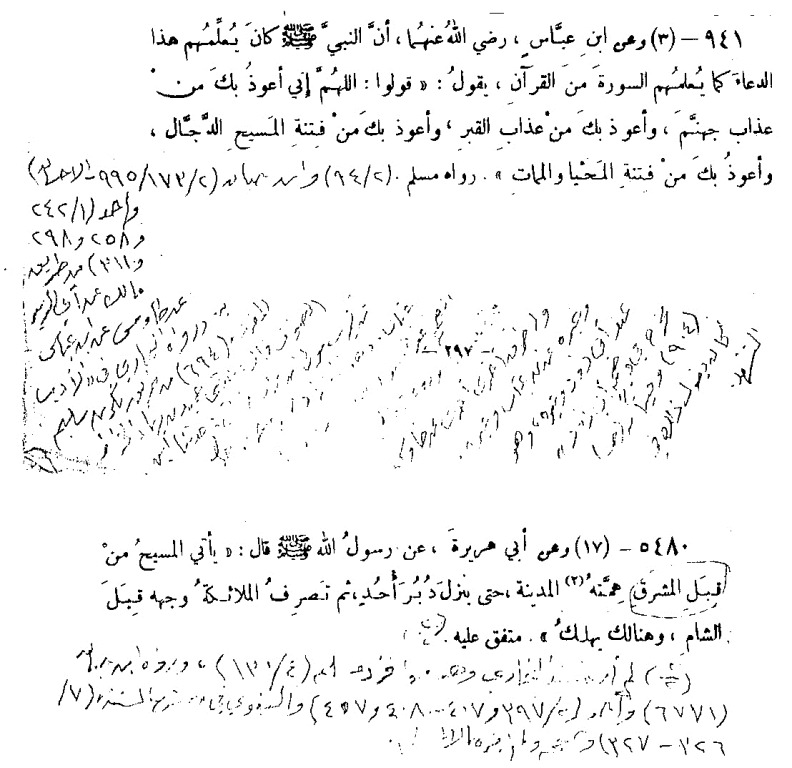
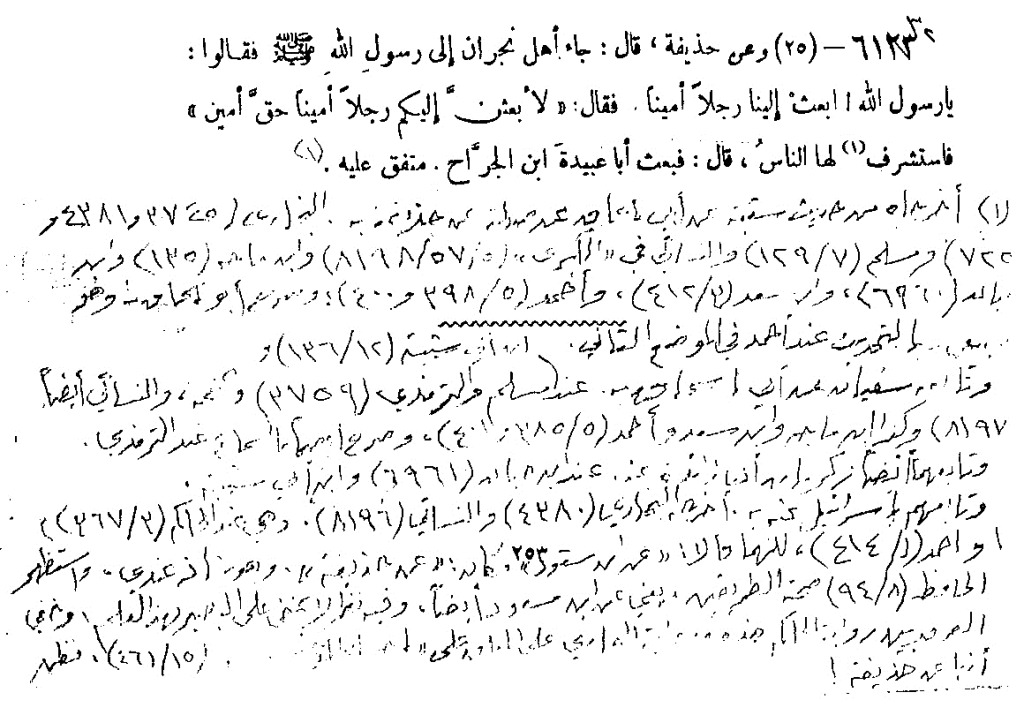
Examples of Shaikh al-Albaani’s handwriting …


Click on an image to see a larger version

A line of poetry

Zamakhsharee

Example of his hadith checking from the book Hidaayatur-Ruwaah

Hidaayatur-Ruwaah 1

Another example of his hadith checking from the same book

Hidaayatur-Ruwaah 2

The following are examples of some of the Shaikh’s commentary, corrections and checking on one of the prints of Ibn Hibbaan …

IH 2

IH 3

IH 4

Shaikh Ibn Baaz: Shaikh al-Albaani was not Infallible but that Does Not Mean He Can be Slandered …


As-Sadhaan said, “In one of the lessons of our Shaikh, Abdullah ibn Humayyid, a person brought a book in which there was some repugnant slander concerning the status of Shaikh al-Albaani. So while the person was reading the book out aloud–and I was present in the lesson–his eminence, Shaikh Ibn Humayyid cut him off and signs of annoyance and displeasure were visible on him, then he said words to the effect of, “This is disgraceful speech and its like is not permissible–and refuting the people of knowledge should be done with manners.”

Then Shaikh Ibn Humayyid mentioned the status of Shaikh al-Albaani and his aid and service to the Sunnah and then said, “Shaikh al-Albaani had [certain] opinions that we do not agree with him on, but slandering him is not allowed.”

And at that very time news reached me that a short while before, Shaikh Ibn Baaz had summoned the author of that book which was being read out aloud and advised him and [admonished him by] reminding him of Allaah, but when the author insisted on [his views of] his book, Shaikh Ibn Baaz spoke to King Faisal, may Allaah have mercy on him, or Khaalid, may Allaah have mercy on him, to ban the book, and so the King issued a directive for it to be banned.

And His Eminence Shaikh Ibn Baaz was asked in his tent in Minaa [during Hajj] after fajr on Friday 13/12/1418ah [April 1998ce] about some speech about Al-Albaani which slandered him, so part of his answer was, “Al-Albaani is well-known to be from Ahlus-Sunnah wal-Jamaa’ah and from the helpers of the Sunnah, and those who speak against him have erred and are mistaken. He is from our good brothers and from the helpers of the Sunnah, and he has blessed efforts in regards to the Sunnah–and he is not infallible. Everyone makes mistakes and errs.

Imaam Maalik, may Allaah have mercy on him, said, “There is none among us except that he rejects and has his speech rejected, except for the person of this grave, i.e., the Prophet (صلى الله عليه وسلم).”

Every scholar has mistakes: ash-Shaafi’ee, Maalik, Abu Hanifah, Ahmad, ath-Thawri, al-Awzaa’ee, and those after them right up to this day of ours–not a single one is safe from making mistakes. All of the children of Aadam err.

But what is important is that he is well-known as being from the helpers of the Sunnah [Ansaarus-Sunnah], and from the callers to the Sunnah, and from the preservers of the Sunnah, and from the mujaahids striving to preserve the Sunnah. May Allaah grant him success and increase his good.””

Al-Imaam al-Albaani, Duroos, wa Mawaaqif, wa Ibar, of Abdul-Aziz ibn Muhammad Abdullaah as-Sadhaan, pp. 243-244.

Should You Complete Your Sunnah Prayer if You Hear the Iqaamah for the Prescribed Prayer?


When a person is praying the [the two units of] Sunnah prayers before fajr or [any prayer] other than fajr, and while doing so the iqaamah for the prayer is announced while he has still not yet finished praying his sunnahs, should he break his prayer in order to pray with the Imaam or should he complete his Sunnah [prayers first]?

Al-Albaani: The principle in this issue is the Prophet’s saying (صلى الله عليه وسلم), “When the iqaamh for prayer is called, there is no prayer except the prescribed prayer.” [Muslim, no. 1644].

So from this hadith it is clear that the [sunnah] prayer is nullified just by the fact that the prescribed prayer has been established–but the scholars differed as to whether the hadith is general without exception and whether it can be understood that a person can continue [to pray] in some circumstances to complete his sunnah prayer and then join the congregational prayer.

What appears to me [to be the answer] based upon what I have read from Imaam An-Nawawee’s book [called] Al-Majmoo’, is that what is intended by this hadith is to encourage the Muslim who prays the optional prayers to catch the [prescribed] prayer with the Imaam from the very start, i.e., that he should not miss the first saying of Allaahu Akbar which begins the prayer [takbeeratul-Ihraam].

So if the iqaamah for the [prescribed] prayer is called and the person is praying the optional prayer in the final sitting before giving salaam [i.e., tashahhud], and all that remains [for him to complete his optional prayer] is to give salaam, and that he thinks it is more than likely that he will be able to catch the first takbeer–then in this case he can complete his prayer, and finish it even if only with the first salaam [to the right] at the very least.

In contrast, if he said the takbeer to start praying his sunnah for fajr for example, and at the same time the iqaamah for the prescribed prayer is called such that if he were to continue until he completed his optional prayer it would mean that, at the very least, he would miss the first takbeer which begins the prayer with the Imaam [takbeeratul-Ihraam], then in this situation he should break his prayer, i.e., without giving salaam. And between these two situations are many others.

In summary, the person who is praying optional prayers when the iqaamah is called should make an effort to consider whether or not by continuing the optional prayer he will catch the initial, first takbeer which starts the prescribed prayer.

If he thinks it more than likely that he will catch it, he complete his prayer and keeps it short, and if he thinks it more likely that he will miss the first takbeer that commences the [prescribed] prayer, he breaks off his optional prayer and joins the row.

Al-Masaa’il al-‘Ilmiyyah wal-Fataawaa ash-Shar’iyyah, Fataawaa ash-Shaikh al-Allaamah Muhammad Naasirud-Deen al-Albaani, fil-Madeenah wal-Imaaraat, of Amr Abdul-Mun’im Saleem, pp. 100-101.

Air Traffic Control and Combining Prayers at Work


A man works in an air traffic control tower at an airport, and sometimes [while] at work prayer time comes round, if he were to leave his post to pray he would place the lives of the passengers at risk, so what is the solution?

Al-Albaani: Such a person should prepare for this [situation] by combining two prayers and not taking them out of their prescribed times, since a resident combining the prayers is something which Allaah has facilitated for the Muslims as occurs in the hadeeth of Abdullaah ibn Abbaas, may Allaah be pleased with him, that he said, “The Messenger of Allaah (صلى الله عليه وسلم) joined dhuhr with asr, and maghrib with ishaa in Medinah when there was no fear and no rain.”  They asked, “Why did he do that?”  He replied, “So that his Ummah would not be subjected to hardship.” [Muslim, no. 1633]

And he can [also] lighten his prayer to get back to work [more quickly].

The important thing is that a person is a witness over himself. So he has to preserve the orders of Allaah on one hand, and carry out his job faithfully/with integrity on the other. So he must try to reconcile between the implementation of both issues: issues relating to the shar’iyyah, and those relating to his job.

You mentioned in your checking of [the book] Al-Aayaat al-Bayyinaat of al-Allaamah al-Aloosee that the attribution of the book called, Ar-Rooh [The Soul], to Ibn al-Qayyim al-Jawziyyah is doubtful, what’s the validity of that?

Al-Albaani:  Yes, I doubt the ascription of this book to Ibn al-Qayyim due to the large number of stories and erroneous narrations in it. In addition to the fact that I have not come across a manuscript copy which can be relied upon to unequivocally attribute the book to him.

What is your opinion about the book called Al-Jamaa’aat al-Islaamiyyah [The Islamic Groups] by Saleem al-Hilaalee, and the book Tableeghee Nisaab of Muhammad Zakariyya?

Al-Albaani:  I do not know anything except good about [Saleem al-Hilaalee’s] book Al-Jamaa’aat al-Islaamiyyah [The Islamic Groups].

As for the book called Tableeghee Nisaab, then I have not read it, but it has reached me from someone I trust that it contains that which opposes the Sunnah.

Al-Masaa’il al-‘Ilmiyyah wal-Fataawaa ash-Shar’iyyah, Fataawaa ash-Shaikh al-Allaamah Muhammad Naasirud-Deen al-Albaani, fil-Madeenah wal-Imaaraat, of Amr Abdul-Mun’im Saleem, p. 102, and pp. 170-171.

Why Al-Albaani almost felt like wishing for death …


As-Sadhaan said, quoting from Saheeh Mawaarid adh-Dham’aan, “And he, may Allaah have mercy on him, said concerning the hadith, “The life spans of my Ummah are between sixty and seventy. Few of them pass that,” Ibn Arafah said, “And I am from those few.”

So Shaikh al-Albaani said commenting on the saying of Ibn Arafah, “And I too am from those few. For I have passed eighty-four years in age, all the while asking the Protector [mawlaa], far removed be He from all defects, that I be from those whose lives are prolonged and whose actions get better.

And yet along with that I almost wish for death due to the deviation from the religion that has afflicted the Muslims.

But far be it that I wish for death when the hadith of Anas has been before me since childhood, so it is not for me but to say as my Prophet (صلى الله عليه وسلم) ordered me to, “O Allaah, give me life as long as life is better for me. And take my soul if death is better for me,’” [also] supplicating with that which he (صلى الله عليه وسلم) taught me, “O Allaah! Let us enjoy our hearing and vision and strength for as long as You grant us life and make it our legacy.”

And He, the One free of all defects, has favoured me and responded, allowing me to enjoy all of that. So here I am still researching and verifying, still writing actively the like of which is rarely seen, and I pray the optional prayers standing, and I drive my car for long distances by myself, and at a speed which some of those dear to me advise me to reduce, and I have an elaboration for that which some of them know!

And I say all of this by way of, “And as for the favour of your Lord, then proclaim [it] …” [Ad-Duhaa 93:11], hoping that the Protector, free is He from all defects and the Most High, increases the Bounty He has bestowed upon me, and that He makes all of it my legacy. And that He takes my soul as a Muslim upon the Sunnah which I dedicated my life to, calling to it and writing about it. And that He gathers me with the martyrs and the righteous, and what an excellent company that is. Indeed He is the All-Hearer, the One who answers supplications.””

Al-Imaam al-Albaani, Duroos, wa Mawaaqif, wa Ibar, of Abdul-Aziz ibn Muhammad Abdullaah as-Sadhaan, pp. 286-287.

Sit with the Scholars for 30 Years Before You Write … or 15 if in a Haste—but Even Then Don’t Spread it


As-Sadhaan said, “And Shaikh al-Albaani also said, ‘I do not see it fit for the student of knowledge to rush into writing, meaning that he spreads what he writes amongst the people.

Rather, he should do that after thirty years of seeking knowledge from the scholars.  And if he is in a haste to write, then after fifteen years.

And there is no harm if he writes [something] before that and consults those who are more able than him in this regard—but he should not spread it.  Especially when it is something which happens to be in vogue in this day and age: the science of hadith.’”

Al-Imaam al-Albaani, Duroos, wa Mawaaqif, wa Ibar, of Abdul-Aziz ibn Muhammad Abdullaah as-Sadhaan, p. 164.

Conceited, Deluded, Self-Amazed, ‘Students of Knowledge’, Smitten by Their Own Opinions, Making Their Own ‘Ijtihaad’, Misguided and Misguiding Others


Shaikh al-Albaani said, “I advise you and myself firstly to fear Allaah, then [I also advise you and myself] with some of those things which branch off from the fear of Allaah, the Blessed and Most High. The first of which is that you seek knowledge purely for the Face of Allaah, that you do not want any reward nor thanks [for doing so], nor to be at the head of gatherings, only to the extent which Allaah the Most High specified the scholars with when He said, “Allaah will exalt in degree those of you who believe and those who have been granted knowledge.” [Mujaadilah 58:11].

And secondly that you keep away from the pitfalls that some of the students of knowledge fall into, from them being: how quickly one of them is dominated by self-importance [ujb] and conceitedness [ghuroor] such that he will dart forward, obstinate, issuing religious verdicts for himself and others based upon whatever is apparent to him without seeking the aid of the people of knowledge from the Salaf as-Saalih of this nation who bequeathed a great heritage to us illuminated with Islamic learning. [A heritage they left] so that we could seek its help in putting an end to many of the calamities that have accumulated through the ages; some of which we have lived through and which were [like] pitch-black darkness.

Seeking aid through the sayings of the Salaf and their opinions helps us to eliminate this darkness and to return to [take from] the spring of the Book and the authentic Sunnah.

And I will not conceal from you the fact that I lived in a time where I saw two opposing matters.

The first was when all of the Muslims, the Shaikhs and the students, the general masses and the scholars, lived in the centre of blind-following, not just of the madhhabs, but also of their fathers and forefathers, and in the midst of that we would call to the Book of Allaah and the Sunnah of the Messenger of Allaah (صلى الله عليه وسلم), at this location and that.

And in various Islamic countries there were individuals doing the same as us, so all of us were living like the strangers which the Prophet (صلى الله عليه وسلم) described in some of his well-known hadiths from which is, “Indeed Islaam started as something strange, and it will soon return to being something strange [just] as it began, so glad tidings for the strangers.” And in some narrations there occurs that he (صلى الله عليه وسلم) said, “They are righteous people, few amongst many. Those who disobey them are more than those who obey them.” And in another narration there occurs, “They are the ones who correct that which the people have corrupted from my Sunnah after me.”

I say: We lived through that time. Then we started to see a pleasant impact of the call of the rectifying strangers upon the believing youth. And we saw these youth stand upright in all earnestness in many of the Islamic countries, being keen to cling to the Book and the Sunnah when they knew it to be authentic.

But this happiness of ours at this awakening which we felt in these last years did not last until we were taken by surprise by a transformation which occurred in these youth in some of the countries, and which almost wiped out the effects of this good awakening.

And what was the cause of that?

Herein lies the lesson. [It was nothing] except for the fact that they were afflicted with self-importance and conceitedness due to them seeing that they now were upon something of correct knowledge. And [they did] not [see themselves as such] amongst the group of lost Muslim youth only, but even amongst many of the Shaikhs of knowledge, and this was when they felt that they had risen above the people of Sheikhdom [or people who truly were Shaikhs] and the people of knowledge spread-out throughout the world.

Just as they didn’t thank Allaah, the Mighty and Majestic, for the success [tawfeeq] He granted them [in guiding them] to this correct knowledge and its manners. Instead they deceived themselves and [falsely] thought that they had something to stand upon.

So they took to issuing crude religious verdicts [fatwas] not based upon an understanding of the Book and the Sunnah. So these religious verdicts came from [people with] immature opinions, [whereas] they thought it was knowledge taken from the Book and the Sunnah—and thus they were misguided due to those opinions as well as misguiding others.

And the effects of that seen in the existence of a group in some of the Islamic countries will not be hidden from you, [a group] who took to openly declaring all other Islamic groups to be disbelievers using philosophical arguments which there is no time to delve into now in this brief word, especially when we are in the middle of advising and reminding the students of knowledge and the callers.

For this reason I advise our brothers, the people of the Sunnah and the Hadith, in all the Islamic lands to be patient in seeking knowledge and not to be deceived by the knowledge they may have acquired. They should only follow the path and not just rely on their own understanding or what they call their ‘ijtihaad’!

And I have heard many of our brothers saying with the utmost ease, with total unaffectedness and without any concern, “I made ijtihaad [in this issue] … I think it is like this …” or, “I don’t hold that to be correct!” And when you ask them, “What is it that you have based your ‘ijtihaad’ upon such that your opinion is such and such? Did you rely upon the understanding of the Book and the Sunnah and the unanimous consensus [ijmaa’] of the scholars from the Companions and other than them? What did you use to help you? Did you use the books of fiqh and hadith and the understanding of the scholars to help you in that? Or is it [nothing but] desire and understanding deficient in its outlook and its derivations [of rulings from the proofs]?

[And] indeed, it is.

In my opinion, this is the cause of that self-importance and conceitedness. And it is due to this that in the Islamic world I find a very strange phenomenon becoming apparent in some of the books [being written], and it is: that you will find someone who is an enemy of the hadith authoring works in the field of the science of hadith! Only so that it may be said, “He has written [a book] on the science of hadith.”

And if you were to go back to that which he has written in this noble [branch of] knowledge you will find that it is nothing but the mere reporting of quotes which he has gathered and collected from here and there and from which he authored this book of his! What is the impetus behind that do you think? It is the love of showing-off and prominence. And he who said the following spoke the truth, “The love of showing off will be the end of you/your downfall.” [lit.: “will break the backs.”]

For this reason I repeat what I said to my brothers, the students of knowledge: that they distance themselves from every mannerism that is not Islamic, part of which is that they do not become deceived by the knowledge they have been given and that [they do not let] self-importance overcome them, and that lastly they advise the people with that which is best.

And that they distance themselves from having a harsh and severe manner in calling [to Allaah], since all of us believe that when Allaah the Mighty and Majestic said, “Invite to the Way of your Lord with wisdom and fair preaching, and argue with them in a way that is better,” [An-Nahl 16:125] He only did so because the Truth in and of itself is [already] heavy on the people, it is heavy on the souls of mankind and that is why they become arrogant and don’t accept it, except for those upon whom your Lord has mercy. So when another thing and another weight, i.e., harshness in calling to Allaah [da’wah], is added to the weightiness of the truth on the human soul, it will result in driving the people away from the call. And you know the saying of the Prophet (صلى الله عليه وسلم), “Indeed from among you are those who drive people away.” He said it three times.

In conclusion, I ask Allaah the Mighty and Majestic that He does not make us from those who drive the people away, but rather that He makes us from those wise people who act upon the Book and the Sunnah.

And I entrust you to Allaah.

Was-salaamu alaikum wa rahmatullaahi wa barakaatuhu.”

Al-Imaam al-Albaani, Duroos, wa Mawaaqif, wa Ibar, of Abdul-Aziz ibn Muhammad Abdullaah as-Sadhaan, pp. 161-164.

Al-Albaani Debating with Takfeeri Youths for Three Nights and What Happened to Some of Them Later …


As-Sadhaan said, “Shaikh Baasim Faisal al-Jawaabirah, may Allaah the Most High protect him, said, ‘… I was a student at secondary school, and in those days I was part of a group of youths who would declare the Muslims to be disbelievers and would not pray in their mosques arguing that they were [from] a society of ignorance!

The people who would oppose us in Jordan would always threaten us with Shaikh Muhammad Naasirud-Deen al-Albaani, [saying] that he was the only one who would be able to debate with us and convince us [of the Truth] and bring us back to the Straight Path. When Shaikh Naasir came to Jordan from Damascus he was told about a group of youths who declare the Muslims to be disbelievers and so he wanted to meet us. So he sent his son in law, Nidhaam Sakkajhaa, to us who informed us of the Shaikh’s desire to meet us.

We replied, ‘Whoever wants to meet us, then let him come to us, we won’t go to him!’ But [the person who was] our Shaikh in declaring people to be disbelievers [takfeer] told us that Shaikh Naasir was from the scholars of the Muslims who had excellence due to his knowledge and old age and that we had to go to him.

So we went to him in the house of his son in law, Nidhaam, just before ishaa prayer. One of us made the call to prayer and then we stood to pray and Shaikh Naasir said, ‘Shall we pray behind you or will you pray behind us?’ So our takfeeri Shaikh said, ‘We believe that you are a disbeliever!’ So Shaikh Naasir said, ‘As for me, then I hold that you have faith [i.e., that you are Muslims].’ Then our [takfeeri] Shaikh led us all in prayer [including Shaikh al-Albaani].

Then Shaikh Naasir sat down debating with us continually until late at night, most of it being with our Shaikh. As for us youth, we would stand and then sit, stretch out our legs and then lie down on our sides, as for Shaikh Naasir, he sat in the same position from the start of the gathering until its end, never once changing. Always debating with this [person], and this [person] and then that [person], I was amazed at his patience and fortitude. Then [when it ended] we promised to meet the next day. We went back to our houses gathering the evidences which, so we believed, proved [our stance] in declaring Muslims to be disbelievers [takfeer].

On the second day Shaikh Naasir came to the house of one of our brothers, and we had prepared the books and replies to his proofs. The debate continued from after ishaa [prayer] until morning prayer [fajr]. Then [when it ended] we promised to go to his house [the next day], and so we went there after ishaa on [this] the third day.

The discussion continued until the mu’addhin made the call to prayer for fajr, and we were continually debating mentioning many aayahs [from the Quraan] which apparently proved [our stance of] declaring Muslims to be disbelievers [takfeer], and likewise we would mention hadiths which [again], apparently, proved [the stance we had taken of] declaring those people who had committed major sins to be disbelievers. And Shaikh Naasir was like a towering mountain answering this proof, and [explaining] the objective of other proofs, and reconciling between those which on the surface seemed to be contradictory, quoting the sayings of the Salaf and Imaams who are relied upon from Ahlus-Sunnah wal-Jamaa’ah.

And then after the call to prayer for fajr nearly all of us went with Shaikh Naasirud-Deen to the mosque to perform the morning prayer, after Shaikh Naasir had convinced us of the error and deviation from the [correct] methodology that we had been continuing upon.

We turned back from our takfeeri thinking, and all praise is due to Allaah.

Except for a small group [of us]—who ended up apostatising from Islaam a few years after that.

We ask Allaah for well-being.’”

Al-Imaam al-Albaani, Duroos, wa Mawaaqif, wa Ibar, of Abdul-Aziz ibn Muhammad Abdullaah as-Sadhaan, pp. 157-158.

So Al-Albaani said, ‘… Forgive me if I have wronged you …,’ and started to cry


As-Sadhaan said, “Shaikh Sameer az-Zuhairee who is among the students of the Shaikh, may Allaah have mercy on him, said, ‘I met up with some of the students of knowledge in Jordan one day. As was the norm in such gatherings, the Shaikh was mentioned and one of the people there started a sweeping attack on him due to the difference in methodology [between the two].

I saw no point in debating with this man due, firstly, to his lack of fairness, and secondly, his severe anger which took him beyond the limits of moderation. So I said to him, ‘If this is the image you have of the Shaikh—and he is not as you imagine him to be—then why don’t you give him some advice directly, because he is better than your backbiting and slander of him?’

He replied, ‘Al-Albaani does not accept advice.’

So I said, ‘Have you tried?’

‘I’ve never seen him, but this is unanimous about him,’ he said.

So I said to myself, ‘Subhaanallaah! This man has been affected to such an extent due to his Shaikhs without ever having searched for the truth himself or [without ever] having met the Shaikh even though they live in the same city and have been doing so for years!’

Later I organised a gathering of knowledge in the evening with the Shaikh [held] at my house and I called a whole group of students of knowledge. [I also called] this person who had spoken against the Shaikh—but I didn’t tell the Shaikh anything about that [incident].

Most of the gathering was monopolised by that man who argued with the Shaikh, raised his voice and was infuriated [at Shaikh Al-Albaani], to such an extent that it became apparent that I was angry and embarrassed [on behalf of the Shaikh]. When the Shaikh saw that on my face he turned to me smiling and said, ‘Don’t worry about it/don’t take it upon yourself.’

By Allaah, that smile never left the Shaikh’s face and he continued answering him with proofs from the Book and the Sunnah with great patience and an open heart, as was his habit, may Allaah have mercy on him.

At the end of the gathering the man stood up and said to the Shaikh, ‘I thank Allaah, the Mighty and Majestic, that you had [already] changed and that I met you after it!’

The Shaikh said, ‘And have you ever met me before today?’

‘No,’ he replied.

So the Shaikh pointed to one of the brothers from Syria who had accompanied him in [his call to] the Salafi da’wah, and who was, at that time, a guest of the Shaikh in Amman [Jordan], and said, ‘I have not changed. And this brother has accompanied me for more than twenty years in da’wah, and he knows that about me.  Either way, may Allaah reward you with good, and as for me, then I ask you to forgive me if I have wronged you in anything.  And I ask Allaah, the Mighty and Majestic, to forgive me if I have wronged any of the Muslims.’

Then he started crying, may Allaah have mercy on him.

And then that person [who had been angry at the Shaikh] could do nothing except cry too, and he started to kiss the Shaikh’s hand and head.

And I never knew him after that to be anything except a Salafi, following [the proofs], who loved the Shaikh and honoured him greatly.’”

Al-Imaam al-Albaani, Duroos, wa Mawaaqif, wa Ibar, of Abdul-Aziz ibn Muhammad Abdullaah as-Sadhaan, pp. 158-159.

The Criterion for the Excuse of Ignorance | 1


Those of our fathers and grandfathers who have passed away and who used to recite the Quraan but were ignorant of its meaning, and who used to be upon the belief that it was ok to call upon the dead and things similar to that which occur [nowadays], and then they passed away and it became clear to us [later] that this thing is not permissible, so what is the situation as regards to supplicating [du’aa] [for them], shall we supplicate for them or not? [Bearing in mind] that they didn’t know, they didn’t know the reality, the scholars who were present with them were the ones who directed them to this thing, that this is religion and nothing other than it.

Al-Albaani: As long as they upheld the pillars of Islaam [Arkaan al-Islaam] then you should supplicate for them, because you do not know what was in their hearts.

What is the criterion as regards the excuse of ignorance concerning tawheed and is reading and reciting the Quraan enough to take away this excuse?

Al-Albaani: The criterion, whether he can recite the Quraan firstly and understand it secondly, or he reads it but does not understand it, or he can neither understand nor read it– then the criterion concerning [all] this is that the Muslim lives in a true Islamic environment in which the [correct Islamic] creed be widespread such that it becomes what the scholars of usool call ‘that which is necessarily known about the religion [it being so common].’

And maybe all of those present [in this gathering] remember the hadith of the slave girl who used to herd sheep for a man in Uhud, and the [time when a] wolf attacked the sheep … so when news reached him [i.e., the Prophet (صلى الله عليه وسلم)] the man said, “I get angry like [any] man does and so I struck her once.”

So the Prophet (صلى الله عليه وسلم) said–and it was upon this that he freed her … he
(صلى الله عليه وسلم) ordered him to bring her and asked her–“Where is Allaah?”  She replied, “Above the heavens.” He said, “Who am I?”  She said, “You are the Messenger of Allaah.”  To which he replied, “Free her, for verily she is a believer.”

So the point taken from this hadith is [that this fact, i.e.,] that Allaah, the Mighty and Majestic, is above the Heavens is a Quranic creed, taken from the text of the Quraan in more than one unequivocal aayah and is a prophetic, sunni creed which occurs in very many hadiths.

But nowadays many Islamic societies do not have the correct Islamic creed and thus a man living in such an environment is excused/has an excuse, because the proof has not reached him as opposed to someone living in a different society in which the creed of monotheism [tawheed] is widespread and prevalent and which resembles the first prophetic society; one in which that slave girl who was a shepherdess was and she knew this Islamic creed.

Did she study the Quraan? Did she study the hadith of the Prophet (صلى الله عليه وسلم)?  That is something which is normally far-fetched for a shepherd[ess] to do. But she lived in a house in which she could hear and gain understanding at the hands of her master and his wife, and so she learnt that which she did not know beforehand.

And when we add the Saying of Allaah, the Blessed and Most High, to this hadith and this meaning, [which is], “And We never punish until until We have sent a Messenger [to warn],” [Al-Israa 17:15], and we understand this noble aayah correctly, not with a rigid understanding [based solely] upon its wording without looking at its objective and meaning … and what I mean is that this aayah, i.e., “… until We have sent a Messenger …” does not just mean that a Messenger will come to every group or sect in all ages. [But rather that] maybe a Messenger would come or the call of the Messenger will come.

The important thing is [to know] that the aayah does not only refer to the Messenger himself in person but is referring to his call. From the proofs of this is that a Messenger may go to a nation in which there is an insane person, or someone possessed, or someone who hasn’t reached puberty, or a deaf person and so on … so [if that happened then] a Messenger would have come to these people [physically] but his call would not have.

And the opposite of that is our example, the followers of Muhammad (صلى الله عليه وسلم), Prophet Muhammad (صلى الله عليه وسلم) didn’t come to us directly but his call did and so whoever this call reached in its purity and upon its reality then the proof would have reached him and he would not have the excuse of ignorance based upon what I just explained now.

Upon this I have said more than once that many of the Europeans and Americans have been tried and tested with callers who have deviated from the Book and the Sunnah, such as the Qadiyanis for example, because this is a group which is extremely active in calling to that which they believe in from their religion. And only because of that were they able to influence thousands of English people, Germans, Americans and so on.

You see, and here is the point, did the proof of Islaam reach these people who followed the call of the Qadiyanis?

The answer is no, the proof of the Qadiyanis reached them and not that of Islaam. So with Allaah is the perfect proof and argument and [the establishment of this perfect proof and argument] is the condition upon which someone is counted as being from amongst those who have the obligation to respond to the message, whether that be positive or negative.

Thus the criterion is that the correct call reach the people: so whoever it does reach then the proof has been established against him and whoever it doesn’t reach then it hasn’t been established.

But that which regulates this subject is to pay attention to the society which these individuals live in. So if the society is one of the Ahlus-Sunnah wal-Jamaa’ah as they would say in the past [with the old meaning of this term]–because we do not [agree with the way] this term is used in modern times, because in the usage of the blind-followers it only means the Ash’arees and the Maaturidees–whereas we mean those whom the Salafi call, and that which the Salaf as-Saalih were upon, has reached; it would be against such a person that the proof would have been established.

But I believe that there are few such people in the entire Islamic world, and I think that this suffices for an answer.

Mawsoo’atul-Allaamah, al-Imaam, Mujaddidil-Asr, Muhammad Naasirid-Deen al-Albaani, of Shaikh Shady Noaman, vol. 5, pp. 735-737 and the first question is from p. 772.

Dreams People saw about Shaikh al-Albaani


Shaikh Muhammad Moosaa Nasr said, “I saw a dream in which there was a group of people who had swarmed together before some steps which led up to a balcony in front of which there was a door. No one was climbing up the steps, they only looked at the balcony and the door.

So I said to them, “Who are you looking for? And what are you looking at?” So they said, “The Messenger of Allaah (صلى الله عليه وسلم).”

So I broke through the rows and went up the stairs until I came to the terrace before the door so that I could have the honour of seeing the Messenger of Allaah (صلى الله عليه وسلم). And the people were below the steps looking towards the door. Then the door opened and Shaikh al-Albaani came out, may Allaah have mercy on him.

So I interpreted it to mean that he is [someone] who has the greatest share of the Prophet (صلى الله عليه وسلم), for standing up for his Sunnah and acutely following his guidance (صلى الله عليه وسلم). And I told the Shaikh, may Allaah have mercy upon him, about this dream. And it is as though the dream is saying that whoever wants the way of the Messenger of Allaah (صلى الله عليه وسلم) then he should pay heed to the one coming out of the balcony door who will guide him to the methodology of the Prophet (صلى الله عليه وسلم).

[Shaikh Moosaa continued] another dream was seen by an Algerian sister who is a reader of the Asaalah magazine [which this piece was taken from], and from those who held the Shaikh and his methodology in great esteem. [This sister] told me in a letter which she had sent to Asaalah that she saw Abu Ubaidah Aamir ibn al-Jarraah, may Allaah be pleased with him, the venerable Companion and the trustee of this Ummah in a dream she had before daybreak, and he was saying to her, “Convey my salaam to Shaikh Muhammad Naasirud-Deen al-Albaani.” Then she woke up and was crying out of joy saying, “I’m not worthy of that. I’m not worthy of that.”

So I interpreted it to mean that the Shaikh, may Allaah have mercy upon him, was a trustee over this Ummah, for the scholars are the trustees of the Sharee’ah, and our Shaikh al-Albaani was from those few who were trustees of Allaah’s Religion, advising His Servants, this is what we think, and Allaah knows best.”

As-Sadlaan said, “And the noble Shaikh Ihsaan al-Utaibi said, “And the last time I met him I told him about a dream a brother of ours had seen. And it was that this brother saw the Prophet (صلى الله عليه وسلم) and asked him, “When I find something difficult [to understand] in hadith who should I ask?” So the Prophet (صلى الله عليه وسلم) said, “Ask Muhammad Naasirud-Deen al-Albaani.” And I hardly finished telling him the dream when he started to cry profusely, and was saying [the supplication of Abu Bakr, may Allaah be pleased with him], “O Allaah!  Do not hold me to account for what they say.  And make me better than what they think.  And forgive me that which they do not know.””

And Shaikh Muhammad Ibrahim Shaqrah, may Allaah protect him, said, “One of our good brothers here in Syria saw a dream a short while before the death of Shaikh Ibn Baaz in which there were two stars in the sky which had started to head towards the earth with force. One of them reached the earth and the other remained close to the earth [but did not actually reach it].

But the one that did caused a terrifying boom which horrified the people and made them ask what the news was. Then this person [who saw the dream] woke up and asked someone who interpreted dreams about it and he replied, “This is something which will shake society when it happens and will have a drastic effect [on it]. Then a similar event will follow it, and that is the second star.”

So this person who told me the dream said, “So hardly a few days had passed when the news of the death of Shaikh Ibn Baaz came, may Allah have mercy on him, and then Shaikh al-Albaani died a short while after him, may Allaah have mercy on him, and that is the interpretation of the second star which fell a short while after the first.””

And Abu Muhammad Abdullaah ibn Rasheed al-Inazi who is the Imaam of the Hishaam ibn al-Aas mosque in Hafr al-Baatin told me in a fax he sent to me that he saw a dream in which there were four snow-white birds in the sky flying in from the north, i.e., from the direction of Syria, carrying a body. When they passed by over our heads we saw that it was the body of Imaam al-Albaani, may Allaah have mercy on him. Abu Muhammad said, “By Him besides whom there is none worthy of worship, I saw him covered in a very modest shroud the closest thing it resembled being the gauze used to cover wounds, such that I saw through it [seeing that] he had placed his right hand on his left and had raised his right index finger to the sky.  Then the birds took him in the direction of the horizon until he disappeared from our sight.

This dream occurred after Asr prayer, and then after maghrib one of the brothers called me and informed me that Shaikh al-Albaani had passed away, so I said, ‘Truly, to Allaah we belong and truly, to Him shall we return.’”

And in tape number five hundred an Algerian sister phoned the Shaikh and mentioned a dream in which she saw the Prophet (صلى الله عليه وسلم) on a path. Then a Shaikh came asking about the Prophet (صلى الله عليه وسلم) and so he was shown which way he went. Then she said that her friend who was on the balcony of the house [in the dream] asked her, “Who is this Shaikh that is walking behind the Prophet (صلى الله عليه وسلم)?” So I said to her, “This is Shaikh al-Albaani.” So the Shaikh, may Allaah have mercy on him, was overcome and started to cry.”

And you can hear this audio clip here:

Al-Imaam, al-Mujaddid, al-Allaamah, al-Muhaddith, Muhammad Naasirud-Deen al-Albaani, of Umar Abu Bakr, pp. 67-68, [Al-Asaalah, 32/26] and Al-Imaam al-Albaani, Hayaatuhu, Da’watuhu, Juhooduhoo fee Khidmatis-Sunnah, of Muhammad Bayyoomi, p. 293-295, with slight editing.

Al-Albaani when told about a visit to Spain …


Translated by Ahmed Abu Turaab

As-Sadhaan mentioned that, “Shaikh Esaam Haadi, may Allaah the Most High protect him, said, ‘When I came back from Spain I spoke to the Shaikh about the condition of the Muslims there. And from the things that I told him about was the justice the Muslims receive in the lands of kufr in terms of freedom in their worship and [the freedom] to gather. Such that, for example, they can make a request to the municipality to [allow them to] pray the Eed prayer in an open place outside [musalla], [as a result of which] the municipality will prepare a place for them and send a patrol officer to facilitate their parking and passing safely, and things such as this.

So the Shaikh started crying and said, “Allaahu Akbar. The Muslims receive justice and freedom in the lands of kufr which they don’t even get in the lands of Islaam! So Allaah’s Aid is sought, and there is neither movement or power except by the Will of Allaah.”

Al-Imaam al-Albaani, Duroos, wa Mawaaqif, wa Ibar, of Abdul-Aziz ibn Muhammad Abdullaah as-Sadhaan, p. 138.