The Albaani Site

Translation from the Works of the Reviver of this Century

Tag: albaany

Shaikh al-Albaani’s independence from the rulers …


Shaikh Muhammad Musa Nasr said, “We do not know from the life of our Shaikh and through the times we accompanied him which spanned over twenty years that he ever entered upon a ruler, or those in authority or a judge, or ever fawned on one, or was ever appointed in a religious position under one, or ever ate at the table of one: which was the thing that made him independent in the stances he took; and his religious verdicts were not issued due to political or religious pressure …

So his religious verdicts were never to please Zaid or Amr.  Allaah had made him free of having a need of the people, and provided for him through what his own hands earned where he worked repairing watches for many long years, “The best of what a man eats is that which his own hands have earned …”

And I took his hand one day and said to him, “Our Shaikh! Have you ever shaken hands with any of the tyrants of this world?”

He replied, “No.”

I said to him, “And have you ever eaten at their tables or entered upon them?”

He said, “No.”

So I took his hand to kiss it and he prevented me from doing so, but I overcame him and kissed it. After which he severely reprimanded me, so I said, “And why shouldn’t I kiss a hand that has never shaken that of a tyrant? And which has served the Sunnah of the Messenger صَلَّى اللهُ عَلَيْهِ وَسَلَّمَ for more than half a century?”

And the Shaikh would reprimand me many times for my exaggeration in the love and honour for him, and in my view this was less than what he deserved.

But this did not prevent us from opposing him, sometimes, in some of the independent judgements [ijtihaad] he would come to, may Allaah have mercy on him. For everyone’s saying is accepted and rejected except for the companion of this grave [i.e., the Prophet صَلَّى اللهُ عَلَيْهِ وَسَلَّمَ] as Imaam Maalik, may Allaah have mercy on him, said …”

Al-Imaam, al-Mujaddid, al-Allaamah, al-Muhaddith, Muhammad Naasirud-Deen al-Albaani, pp. 63-64.

Al-Albaani’s Finances: Writing Ad-Da’eefah on Gift Paper and Red Paper Bags Used to Weigh Rice and Sugar In


Shaikh Mashoor Hasan said, “Our Shaikh, may Allaah have mercy on him, charged me with reviewing some of the volumes of As-Silsilah ad-Da’eefah before it was printed … he gave me the fifth volume of Ad-Da’eefah. So I took the volume from him [which was written] in his own handwriting before it was printed.

When I took it out of the bag [it was in] and saw it I started to cry.

The Shaikh asked me, “What is wrong with you?”

So I didn’t say anything, and the Shaikh saw the tears in my eyes—the Shaikh, may Allaah have mercy on him, had written the fifth volume of Ad-Da’eefah on gift paper, and on the paper bags used for sugar and rice, the red [paper] bags which the people would weigh sugar and rice in.

So the Shaikh said to me, “I used to have thread which I would place in ink. Then I would place this thread on the paper and so the paper would become lined.”  And he said, “I didn’t have any money to buy paper with.””

Transl. note: The fifth volume of Ad-Da’eefah which is printed is 524 pages long.

Taken from this lecture of Shaikh Mashhoor in Arabic, at the 67th minute:

Writing on gift paper …

Shaikh al-Albaani when he was beaten


Translated by Ahmed Abu Turaab

As-Sadhaan said, “Shaikh Muhammad Ziyaad at-Tuklah, may Allaah reward him, wrote to me stating that Shaikh Abdullah Aloosh said, ‘One time we came along with Shaikh Naasir to pray in one of the Jaami mosques in the Maidaat district, and the Imaam was ‘so and so’ (one of the bigots and he named him for us). So when the Imaam turned around and was about to say Allaahu Akbar to start the prayer, he saw Shaikh al-Albaani and so in a loud voice in front of all the people he said, “Come on! Get out! Get out! Get out!’”

And he also wrote to me narrating from one of the students of Shaikh al-Albaani that Shaikh Naasir was once assaulted in Damascus by being beaten in a street by a fool who had been paid to do so.”

Al-Imaam al-Albaani, Duroos, wa Mawaaqif, wa Ibar, of Abdul-Aziz ibn Muhammad Abdullah as-Sadhaan, p. 47.

When Hajj will be no more


لاَ تَقُوْمُ السَّاعَةُ حَتَّى لَا يُحَجَّ الْبَيْتُ

From Abu Sa’eed al-Khudri, may Allaah be pleased with him, in marfoo form, “The Hour will not be established until pilgrimage [Hajj] to the House is no more.”

Silsilah | 2430 | Saheeh

The Amount of Rain that falls Every Year is the Same


مَا مِنْ عَامٍ بِأَكْثَرَ مَطَرًا مِنْ عَامٍ وَلَكِنَّ اللهَ يُصَرِّفُهُ بَيْنَ خَلْقِهِ [حَيْثُ يَشَاءُ] . ثُمَّ قَرَأَ: وَلَقَدْ صَرَّفْنَاهُ بَيْنَهُمْ لِيَذَّكَّرُوا

From Ibn Abbaas who said, “‘No year has more rain than another, but Allaah distributes it between His Creation wherever He wishes.’  Then he recited, “And We have distributed it amongst them, in order that they may remember [the Grace of Allaah] …”

Shaikh al-Albaani said, “So it is apparent from what has preceded that even if the hadith is mawquf it has the ruling of being marfoo – because such a thing cannot be said based upon opinion and ijtihaad, and because it has been reported in marfoo form [in another narration].”

Silsilah | 2461 | Saheeh

Here’s a scientific explanation:  www.quranandscience.com/sunnah-a-science/170-every-year-draws-the-same-amount-of-rain.html

What to Say to Jesus, peace be upon him, If You Meet Him


مَنْ أَدْرَكَ مِنْكُمْ عِيْسَى ابْنَ مَرْيَمَ، فَلْيَقْرَئْهُ مِنِّي السَّلَامَ

Anas, may Allaah be pleased with him, said that the Prophet صَلَّى اللهُ عَلَيْهِ وَسَلَّمَ said, “Whoever amongst you meets Jesus the son of Mary, then convey [the greeting of] salaam to him from me.”

Silsilah 2308 | Jayyid

His Worship and how many times he performed Hajj


Translated by Ahmed Abu Turaab

As-Sadhaan said, “The Shaikh, may Allaah have mercy on him, was from the most eager of people in ensuring that his worship was in accordance with the Sunnah, in its form, its amount and its time.  He was eager to implement the Sunnah in what he ate, drank and wore, and in his dealings [with the people].

Those who sat with him, visited him, or attended his lectures or gatherings which were full [of people] bear witness to that.  Such that Shaikh Muhammad ibn Saalih al-Uthaymeen, may Allaah have mercy on him, said, “That which I know about the Shaikh through the times I met him, and they were few, is that he was extremely eager to act upon the Sunnah, and to fight innovations, whether they were in matters of creed or action.”

And he would pray a lot of optional prayers and fast a lot also.

He would be affected very quickly and would cry easily, especially when listening to the Quraan or reciting it, or when listening to Prophetic sayings which contained a mention of a promise or threat, or when he would hear about the death of a scholar of hadith and the Sunnah, or when a good dream which someone saw about him would be mentioned to him, or when he would be praised or complemented.

He, may Allaah have mercy on him, would be eager to fast Mondays and Thursdays in summer and winter, except if he was travelling or ill.

When he would enter the mosque on Fridays he would continue to pray two units of prayer, followed by another two and so on [continually] until the Imaam would ascend onto the minbar.

He would perform Hajj and umrah every year if he was able to, and would sometimes perform umrah twice in one year.

He performed Hajj more than thirty times.

I was told that there was a man who was a worshipper who lived in close proximity to the Prophet’s Mosque, he was well-known for his righteousness, his abstinence, and was a person of the Sunnah who would very often give advice [to the people].

One time he saw some people who were doing a great deal of talking in the Prophet’s Mosque so he advised them to seize the opportunity to benefit from their time by reading the Quraan or remembering Allaah.

The people found his sincere speech to be pleasant and agreeable and he continued to speak to them. Those around him heard what he was saying and [heard] his pleasant words such that the number of people increased and he was speaking in a way which, inshaa Allaah, showed the truthfulness of his intention.

Then all of a sudden while he was speaking he fell totally silent and started to stare at one of the people present in the gathering and started to apologise [saying] that he did not know he was present.

But that person who had been affected by this man’s advice did nothing except ask this man to continue giving his reminder and advice–but the man sat down [instead].

The person who had asked him to continue in his advice was none other than Shaikh al-Albaani, may Allaah have mercy on him, [this was] when he was in Medinah as a teacher at the Islamic University.

Shaikh Muhammad Ziyaad at-Tuklah, may Allaah reward him, wrote to me saying, “I asked Shaikh Muhammad Eed al-Abbaasee about the worship of Shaikh al-Albaani so he said, ‘We would pray the night prayer [taraaweeh in Ramadaan] with some brothers. Shaikh al-Albaani would get up and lead us in a long prayer which would be almost three hours long. During it he would implement [even] the smallest of Sunnahs. He would make the bowing and prostration long.

The bowing [rukoo’] would be about eight to nine minutes long.

And when he would sit he would ask Allaah for forgiveness and praise him between every two rak’ahs. And one time Shaikh Ali Khashaan went up to him while he was in that state and asked him about an issue, so he replied, ‘Now is the time for worship, the time for knowledge is other than this.’

And because of how long the Shaikh would make the night prayer we would fear, as occurs in the hadith, that we might miss the suhoor meal. And when praying behind him we would feel tranquillity, devoutness [khushoo], and calmness.””

Al-Imaam al-Albaani, Duroos, wa Mawaaqif, wa Ibar, of Abdul-Aziz ibn Muhammad Abdullaah as-Sadhaan, pp. 88-89.

Saying, “Sadaqallaahul-Adheem,” after reciting the Quraan


Translated by Ahmed Abu Turaab

What do you say about those who conclude their recitation of the Quraan by saying, “Allaah, the Almighty, has spoken the Truth [Sadaqallaahul-adheem]?” And does this sentence have an origin in the Sharee’ah? And is the one who says it called an innovator?

Al-Albaani: We do not doubt that the habitual reading of this sentence after every instance of recitation is from the newly-invented innovations which was not around at the time of the Salaf as-Saalih.

And it is befitting that you take note of the fact that innovating in the religion is not because the innovation–in and of itself–is something condemned, for the innovation maybe be something acceptable, something amiable, yet along with that it is called an innovation and misguidance. As Abdullaah ibn Umar indicated when he said, “Every single innovation is misguidance even if the people hold it to be something good.”

So the saying, “Allaah, the Almighty, has spoken the Truth,” is a beautiful phrase just as Allaah the Most High said, “And who is more truthful than Allaah in statement,” [Nisaa 4:122].

But for us to say, “Allaah, the Almighty, has spoken the Truth,” every time we read ten aayahs [for example], … then I fear that a day will come when this sentence in relation to the aayahs recited [before it] will be like the addition of sending salaah on the Prophet after the call to prayer [which is also an innovation].

As for the fact that some of them use the saying of Allaah the Most High, “Say Allaah has spoken the Truth,” [Aali Imraan 3:85] as a proof for the legitimacy of saying it, then it is like those who claim that the proof for saying, “Allaah … Allaah … Allaah …” to remember Him [i.e., during dhikr] is His Saying, “Say Allaah …”

So His Saying, “Say Allaah has spoken the Truth,” has another occasion [for which it is appropriate].

Al-Masaa’il al-‘Ilmiyyah wal-Fataawaa ash-Shar’iyyah, Fataawaa ash-Shaikh al-Allaamah Muhammad Naasirud-Deen al-Albaani, fil-Madeenah wal-Imaaraat, of Amr Abdul-Mun’im Saleem, pp. 162-163.

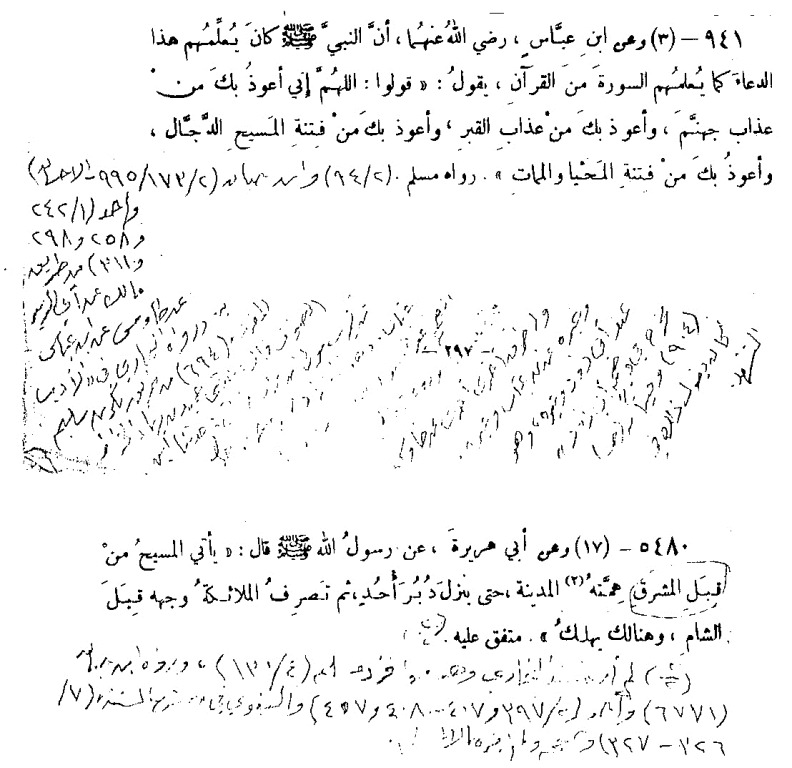
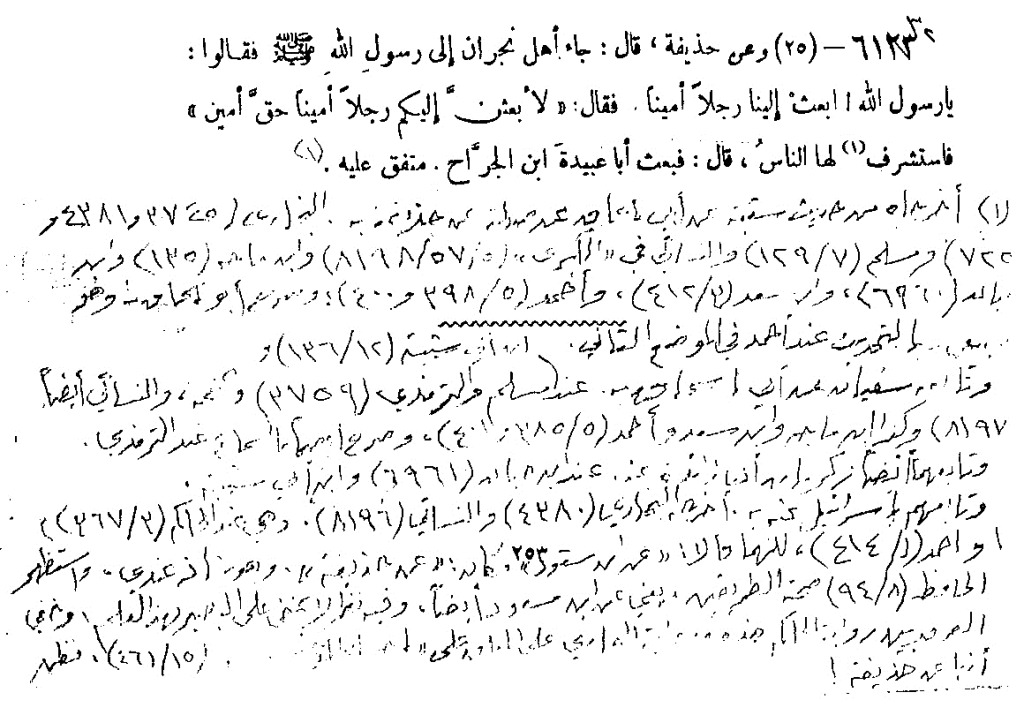
Examples of Shaikh al-Albaani’s handwriting …


Click on an image to see a larger version

A line of poetry

Zamakhsharee

Example of his hadith checking from the book Hidaayatur-Ruwaah

Hidaayatur-Ruwaah 1

Another example of his hadith checking from the same book

Hidaayatur-Ruwaah 2

The following are examples of some of the Shaikh’s commentary, corrections and checking on one of the prints of Ibn Hibbaan …

IH 2

IH 3

IH 4

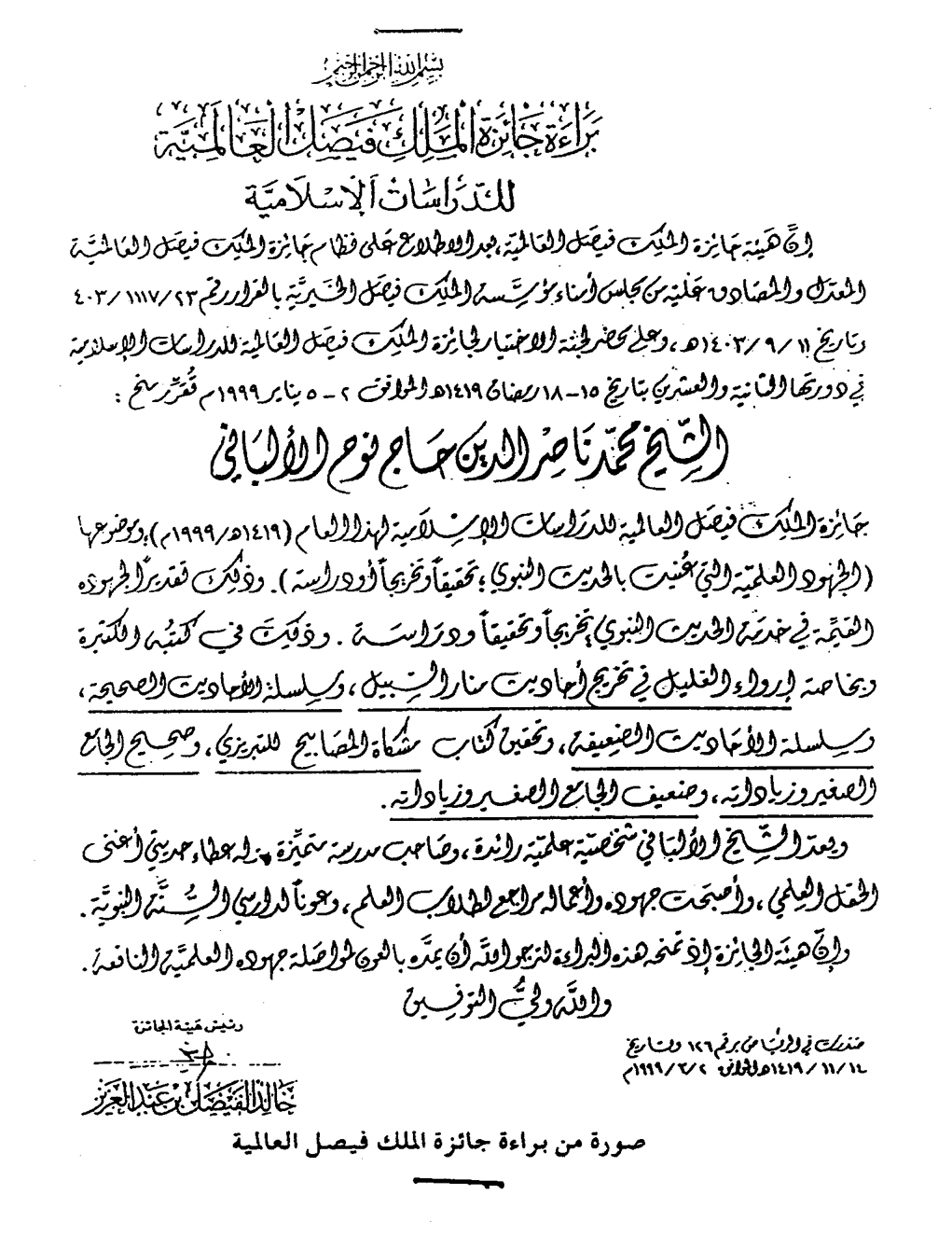
Shaikh Ibn Baaz: Shaikh al-Albaani was not Infallible but that Does Not Mean He Can be Slandered …


As-Sadhaan said, “In one of the lessons of our Shaikh, Abdullah ibn Humayyid, a person brought a book in which there was some repugnant slander concerning the status of Shaikh al-Albaani. So while the person was reading the book out aloud–and I was present in the lesson–his eminence, Shaikh Ibn Humayyid cut him off and signs of annoyance and displeasure were visible on him, then he said words to the effect of, “This is disgraceful speech and its like is not permissible–and refuting the people of knowledge should be done with manners.”

Then Shaikh Ibn Humayyid mentioned the status of Shaikh al-Albaani and his aid and service to the Sunnah and then said, “Shaikh al-Albaani had [certain] opinions that we do not agree with him on, but slandering him is not allowed.”

And at that very time news reached me that a short while before, Shaikh Ibn Baaz had summoned the author of that book which was being read out aloud and advised him and [admonished him by] reminding him of Allaah, but when the author insisted on [his views of] his book, Shaikh Ibn Baaz spoke to King Faisal, may Allaah have mercy on him, or Khaalid, may Allaah have mercy on him, to ban the book, and so the King issued a directive for it to be banned.

And His Eminence Shaikh Ibn Baaz was asked in his tent in Minaa [during Hajj] after fajr on Friday 13/12/1418ah [April 1998ce] about some speech about Al-Albaani which slandered him, so part of his answer was, “Al-Albaani is well-known to be from Ahlus-Sunnah wal-Jamaa’ah and from the helpers of the Sunnah, and those who speak against him have erred and are mistaken. He is from our good brothers and from the helpers of the Sunnah, and he has blessed efforts in regards to the Sunnah–and he is not infallible. Everyone makes mistakes and errs.

Imaam Maalik, may Allaah have mercy on him, said, “There is none among us except that he rejects and has his speech rejected, except for the person of this grave, i.e., the Prophet (صلى الله عليه وسلم).”

Every scholar has mistakes: ash-Shaafi’ee, Maalik, Abu Hanifah, Ahmad, ath-Thawri, al-Awzaa’ee, and those after them right up to this day of ours–not a single one is safe from making mistakes. All of the children of Aadam err.

But what is important is that he is well-known as being from the helpers of the Sunnah [Ansaarus-Sunnah], and from the callers to the Sunnah, and from the preservers of the Sunnah, and from the mujaahids striving to preserve the Sunnah. May Allaah grant him success and increase his good.””

Al-Imaam al-Albaani, Duroos, wa Mawaaqif, wa Ibar, of Abdul-Aziz ibn Muhammad Abdullaah as-Sadhaan, pp. 243-244.

Should You Complete Your Sunnah Prayer if You Hear the Iqaamah for the Prescribed Prayer?


When a person is praying the [the two units of] Sunnah prayers before fajr or [any prayer] other than fajr, and while doing so the iqaamah for the prayer is announced while he has still not yet finished praying his sunnahs, should he break his prayer in order to pray with the Imaam or should he complete his Sunnah [prayers first]?

Al-Albaani: The principle in this issue is the Prophet’s saying (صلى الله عليه وسلم), “When the iqaamh for prayer is called, there is no prayer except the prescribed prayer.” [Muslim, no. 1644].

So from this hadith it is clear that the [sunnah] prayer is nullified just by the fact that the prescribed prayer has been established–but the scholars differed as to whether the hadith is general without exception and whether it can be understood that a person can continue [to pray] in some circumstances to complete his sunnah prayer and then join the congregational prayer.

What appears to me [to be the answer] based upon what I have read from Imaam An-Nawawee’s book [called] Al-Majmoo’, is that what is intended by this hadith is to encourage the Muslim who prays the optional prayers to catch the [prescribed] prayer with the Imaam from the very start, i.e., that he should not miss the first saying of Allaahu Akbar which begins the prayer [takbeeratul-Ihraam].

So if the iqaamah for the [prescribed] prayer is called and the person is praying the optional prayer in the final sitting before giving salaam [i.e., tashahhud], and all that remains [for him to complete his optional prayer] is to give salaam, and that he thinks it is more than likely that he will be able to catch the first takbeer–then in this case he can complete his prayer, and finish it even if only with the first salaam [to the right] at the very least.

In contrast, if he said the takbeer to start praying his sunnah for fajr for example, and at the same time the iqaamah for the prescribed prayer is called such that if he were to continue until he completed his optional prayer it would mean that, at the very least, he would miss the first takbeer which begins the prayer with the Imaam [takbeeratul-Ihraam], then in this situation he should break his prayer, i.e., without giving salaam. And between these two situations are many others.

In summary, the person who is praying optional prayers when the iqaamah is called should make an effort to consider whether or not by continuing the optional prayer he will catch the initial, first takbeer which starts the prescribed prayer.

If he thinks it more than likely that he will catch it, he complete his prayer and keeps it short, and if he thinks it more likely that he will miss the first takbeer that commences the [prescribed] prayer, he breaks off his optional prayer and joins the row.

Al-Masaa’il al-‘Ilmiyyah wal-Fataawaa ash-Shar’iyyah, Fataawaa ash-Shaikh al-Allaamah Muhammad Naasirud-Deen al-Albaani, fil-Madeenah wal-Imaaraat, of Amr Abdul-Mun’im Saleem, pp. 100-101.

Air Traffic Control and Combining Prayers at Work


A man works in an air traffic control tower at an airport, and sometimes [while] at work prayer time comes round, if he were to leave his post to pray he would place the lives of the passengers at risk, so what is the solution?

Al-Albaani: Such a person should prepare for this [situation] by combining two prayers and not taking them out of their prescribed times, since a resident combining the prayers is something which Allaah has facilitated for the Muslims as occurs in the hadeeth of Abdullaah ibn Abbaas, may Allaah be pleased with him, that he said, “The Messenger of Allaah (صلى الله عليه وسلم) joined dhuhr with asr, and maghrib with ishaa in Medinah when there was no fear and no rain.”  They asked, “Why did he do that?”  He replied, “So that his Ummah would not be subjected to hardship.” [Muslim, no. 1633]

And he can [also] lighten his prayer to get back to work [more quickly].

The important thing is that a person is a witness over himself. So he has to preserve the orders of Allaah on one hand, and carry out his job faithfully/with integrity on the other. So he must try to reconcile between the implementation of both issues: issues relating to the shar’iyyah, and those relating to his job.

You mentioned in your checking of [the book] Al-Aayaat al-Bayyinaat of al-Allaamah al-Aloosee that the attribution of the book called, Ar-Rooh [The Soul], to Ibn al-Qayyim al-Jawziyyah is doubtful, what’s the validity of that?

Al-Albaani:  Yes, I doubt the ascription of this book to Ibn al-Qayyim due to the large number of stories and erroneous narrations in it. In addition to the fact that I have not come across a manuscript copy which can be relied upon to unequivocally attribute the book to him.

What is your opinion about the book called Al-Jamaa’aat al-Islaamiyyah [The Islamic Groups] by Saleem al-Hilaalee, and the book Tableeghee Nisaab of Muhammad Zakariyya?

Al-Albaani:  I do not know anything except good about [Saleem al-Hilaalee’s] book Al-Jamaa’aat al-Islaamiyyah [The Islamic Groups].

As for the book called Tableeghee Nisaab, then I have not read it, but it has reached me from someone I trust that it contains that which opposes the Sunnah.

Al-Masaa’il al-‘Ilmiyyah wal-Fataawaa ash-Shar’iyyah, Fataawaa ash-Shaikh al-Allaamah Muhammad Naasirud-Deen al-Albaani, fil-Madeenah wal-Imaaraat, of Amr Abdul-Mun’im Saleem, p. 102, and pp. 170-171.

Why Al-Albaani almost felt like wishing for death …


As-Sadhaan said, quoting from Saheeh Mawaarid adh-Dham’aan, “And he, may Allaah have mercy on him, said concerning the hadith, “The life spans of my Ummah are between sixty and seventy. Few of them pass that,” Ibn Arafah said, “And I am from those few.”

So Shaikh al-Albaani said commenting on the saying of Ibn Arafah, “And I too am from those few. For I have passed eighty-four years in age, all the while asking the Protector [mawlaa], far removed be He from all defects, that I be from those whose lives are prolonged and whose actions get better.

And yet along with that I almost wish for death due to the deviation from the religion that has afflicted the Muslims.

But far be it that I wish for death when the hadith of Anas has been before me since childhood, so it is not for me but to say as my Prophet (صلى الله عليه وسلم) ordered me to, “O Allaah, give me life as long as life is better for me. And take my soul if death is better for me,’” [also] supplicating with that which he (صلى الله عليه وسلم) taught me, “O Allaah! Let us enjoy our hearing and vision and strength for as long as You grant us life and make it our legacy.”

And He, the One free of all defects, has favoured me and responded, allowing me to enjoy all of that. So here I am still researching and verifying, still writing actively the like of which is rarely seen, and I pray the optional prayers standing, and I drive my car for long distances by myself, and at a speed which some of those dear to me advise me to reduce, and I have an elaboration for that which some of them know!

And I say all of this by way of, “And as for the favour of your Lord, then proclaim [it] …” [Ad-Duhaa 93:11], hoping that the Protector, free is He from all defects and the Most High, increases the Bounty He has bestowed upon me, and that He makes all of it my legacy. And that He takes my soul as a Muslim upon the Sunnah which I dedicated my life to, calling to it and writing about it. And that He gathers me with the martyrs and the righteous, and what an excellent company that is. Indeed He is the All-Hearer, the One who answers supplications.””

Al-Imaam al-Albaani, Duroos, wa Mawaaqif, wa Ibar, of Abdul-Aziz ibn Muhammad Abdullaah as-Sadhaan, pp. 286-287.

Sit with the Scholars for 30 Years Before You Write … or 15 if in a Haste—but Even Then Don’t Spread it


As-Sadhaan said, “And Shaikh al-Albaani also said, ‘I do not see it fit for the student of knowledge to rush into writing, meaning that he spreads what he writes amongst the people.

Rather, he should do that after thirty years of seeking knowledge from the scholars.  And if he is in a haste to write, then after fifteen years.

And there is no harm if he writes [something] before that and consults those who are more able than him in this regard—but he should not spread it.  Especially when it is something which happens to be in vogue in this day and age: the science of hadith.’”

Al-Imaam al-Albaani, Duroos, wa Mawaaqif, wa Ibar, of Abdul-Aziz ibn Muhammad Abdullaah as-Sadhaan, p. 164.

Conceited, Deluded, Self-Amazed, ‘Students of Knowledge’, Smitten by Their Own Opinions, Making Their Own ‘Ijtihaad’, Misguided and Misguiding Others


Shaikh al-Albaani said, “I advise you and myself firstly to fear Allaah, then [I also advise you and myself] with some of those things which branch off from the fear of Allaah, the Blessed and Most High. The first of which is that you seek knowledge purely for the Face of Allaah, that you do not want any reward nor thanks [for doing so], nor to be at the head of gatherings, only to the extent which Allaah the Most High specified the scholars with when He said, “Allaah will exalt in degree those of you who believe and those who have been granted knowledge.” [Mujaadilah 58:11].

And secondly that you keep away from the pitfalls that some of the students of knowledge fall into, from them being: how quickly one of them is dominated by self-importance [ujb] and conceitedness [ghuroor] such that he will dart forward, obstinate, issuing religious verdicts for himself and others based upon whatever is apparent to him without seeking the aid of the people of knowledge from the Salaf as-Saalih of this nation who bequeathed a great heritage to us illuminated with Islamic learning. [A heritage they left] so that we could seek its help in putting an end to many of the calamities that have accumulated through the ages; some of which we have lived through and which were [like] pitch-black darkness.

Seeking aid through the sayings of the Salaf and their opinions helps us to eliminate this darkness and to return to [take from] the spring of the Book and the authentic Sunnah.

And I will not conceal from you the fact that I lived in a time where I saw two opposing matters.

The first was when all of the Muslims, the Shaikhs and the students, the general masses and the scholars, lived in the centre of blind-following, not just of the madhhabs, but also of their fathers and forefathers, and in the midst of that we would call to the Book of Allaah and the Sunnah of the Messenger of Allaah (صلى الله عليه وسلم), at this location and that.

And in various Islamic countries there were individuals doing the same as us, so all of us were living like the strangers which the Prophet (صلى الله عليه وسلم) described in some of his well-known hadiths from which is, “Indeed Islaam started as something strange, and it will soon return to being something strange [just] as it began, so glad tidings for the strangers.” And in some narrations there occurs that he (صلى الله عليه وسلم) said, “They are righteous people, few amongst many. Those who disobey them are more than those who obey them.” And in another narration there occurs, “They are the ones who correct that which the people have corrupted from my Sunnah after me.”

I say: We lived through that time. Then we started to see a pleasant impact of the call of the rectifying strangers upon the believing youth. And we saw these youth stand upright in all earnestness in many of the Islamic countries, being keen to cling to the Book and the Sunnah when they knew it to be authentic.

But this happiness of ours at this awakening which we felt in these last years did not last until we were taken by surprise by a transformation which occurred in these youth in some of the countries, and which almost wiped out the effects of this good awakening.

And what was the cause of that?

Herein lies the lesson. [It was nothing] except for the fact that they were afflicted with self-importance and conceitedness due to them seeing that they now were upon something of correct knowledge. And [they did] not [see themselves as such] amongst the group of lost Muslim youth only, but even amongst many of the Shaikhs of knowledge, and this was when they felt that they had risen above the people of Sheikhdom [or people who truly were Shaikhs] and the people of knowledge spread-out throughout the world.

Just as they didn’t thank Allaah, the Mighty and Majestic, for the success [tawfeeq] He granted them [in guiding them] to this correct knowledge and its manners. Instead they deceived themselves and [falsely] thought that they had something to stand upon.

So they took to issuing crude religious verdicts [fatwas] not based upon an understanding of the Book and the Sunnah. So these religious verdicts came from [people with] immature opinions, [whereas] they thought it was knowledge taken from the Book and the Sunnah—and thus they were misguided due to those opinions as well as misguiding others.

And the effects of that seen in the existence of a group in some of the Islamic countries will not be hidden from you, [a group] who took to openly declaring all other Islamic groups to be disbelievers using philosophical arguments which there is no time to delve into now in this brief word, especially when we are in the middle of advising and reminding the students of knowledge and the callers.

For this reason I advise our brothers, the people of the Sunnah and the Hadith, in all the Islamic lands to be patient in seeking knowledge and not to be deceived by the knowledge they may have acquired. They should only follow the path and not just rely on their own understanding or what they call their ‘ijtihaad’!

And I have heard many of our brothers saying with the utmost ease, with total unaffectedness and without any concern, “I made ijtihaad [in this issue] … I think it is like this …” or, “I don’t hold that to be correct!” And when you ask them, “What is it that you have based your ‘ijtihaad’ upon such that your opinion is such and such? Did you rely upon the understanding of the Book and the Sunnah and the unanimous consensus [ijmaa’] of the scholars from the Companions and other than them? What did you use to help you? Did you use the books of fiqh and hadith and the understanding of the scholars to help you in that? Or is it [nothing but] desire and understanding deficient in its outlook and its derivations [of rulings from the proofs]?

[And] indeed, it is.

In my opinion, this is the cause of that self-importance and conceitedness. And it is due to this that in the Islamic world I find a very strange phenomenon becoming apparent in some of the books [being written], and it is: that you will find someone who is an enemy of the hadith authoring works in the field of the science of hadith! Only so that it may be said, “He has written [a book] on the science of hadith.”

And if you were to go back to that which he has written in this noble [branch of] knowledge you will find that it is nothing but the mere reporting of quotes which he has gathered and collected from here and there and from which he authored this book of his! What is the impetus behind that do you think? It is the love of showing-off and prominence. And he who said the following spoke the truth, “The love of showing off will be the end of you/your downfall.” [lit.: “will break the backs.”]

For this reason I repeat what I said to my brothers, the students of knowledge: that they distance themselves from every mannerism that is not Islamic, part of which is that they do not become deceived by the knowledge they have been given and that [they do not let] self-importance overcome them, and that lastly they advise the people with that which is best.

And that they distance themselves from having a harsh and severe manner in calling [to Allaah], since all of us believe that when Allaah the Mighty and Majestic said, “Invite to the Way of your Lord with wisdom and fair preaching, and argue with them in a way that is better,” [An-Nahl 16:125] He only did so because the Truth in and of itself is [already] heavy on the people, it is heavy on the souls of mankind and that is why they become arrogant and don’t accept it, except for those upon whom your Lord has mercy. So when another thing and another weight, i.e., harshness in calling to Allaah [da’wah], is added to the weightiness of the truth on the human soul, it will result in driving the people away from the call. And you know the saying of the Prophet (صلى الله عليه وسلم), “Indeed from among you are those who drive people away.” He said it three times.

In conclusion, I ask Allaah the Mighty and Majestic that He does not make us from those who drive the people away, but rather that He makes us from those wise people who act upon the Book and the Sunnah.

And I entrust you to Allaah.

Was-salaamu alaikum wa rahmatullaahi wa barakaatuhu.”

Al-Imaam al-Albaani, Duroos, wa Mawaaqif, wa Ibar, of Abdul-Aziz ibn Muhammad Abdullaah as-Sadhaan, pp. 161-164.

Al-Albaani Debating with Takfeeri Youths for Three Nights and What Happened to Some of Them Later …


As-Sadhaan said, “Shaikh Baasim Faisal al-Jawaabirah, may Allaah the Most High protect him, said, ‘… I was a student at secondary school, and in those days I was part of a group of youths who would declare the Muslims to be disbelievers and would not pray in their mosques arguing that they were [from] a society of ignorance!

The people who would oppose us in Jordan would always threaten us with Shaikh Muhammad Naasirud-Deen al-Albaani, [saying] that he was the only one who would be able to debate with us and convince us [of the Truth] and bring us back to the Straight Path. When Shaikh Naasir came to Jordan from Damascus he was told about a group of youths who declare the Muslims to be disbelievers and so he wanted to meet us. So he sent his son in law, Nidhaam Sakkajhaa, to us who informed us of the Shaikh’s desire to meet us.

We replied, ‘Whoever wants to meet us, then let him come to us, we won’t go to him!’ But [the person who was] our Shaikh in declaring people to be disbelievers [takfeer] told us that Shaikh Naasir was from the scholars of the Muslims who had excellence due to his knowledge and old age and that we had to go to him.

So we went to him in the house of his son in law, Nidhaam, just before ishaa prayer. One of us made the call to prayer and then we stood to pray and Shaikh Naasir said, ‘Shall we pray behind you or will you pray behind us?’ So our takfeeri Shaikh said, ‘We believe that you are a disbeliever!’ So Shaikh Naasir said, ‘As for me, then I hold that you have faith [i.e., that you are Muslims].’ Then our [takfeeri] Shaikh led us all in prayer [including Shaikh al-Albaani].

Then Shaikh Naasir sat down debating with us continually until late at night, most of it being with our Shaikh. As for us youth, we would stand and then sit, stretch out our legs and then lie down on our sides, as for Shaikh Naasir, he sat in the same position from the start of the gathering until its end, never once changing. Always debating with this [person], and this [person] and then that [person], I was amazed at his patience and fortitude. Then [when it ended] we promised to meet the next day. We went back to our houses gathering the evidences which, so we believed, proved [our stance] in declaring Muslims to be disbelievers [takfeer].

On the second day Shaikh Naasir came to the house of one of our brothers, and we had prepared the books and replies to his proofs. The debate continued from after ishaa [prayer] until morning prayer [fajr]. Then [when it ended] we promised to go to his house [the next day], and so we went there after ishaa on [this] the third day.

The discussion continued until the mu’addhin made the call to prayer for fajr, and we were continually debating mentioning many aayahs [from the Quraan] which apparently proved [our stance of] declaring Muslims to be disbelievers [takfeer], and likewise we would mention hadiths which [again], apparently, proved [the stance we had taken of] declaring those people who had committed major sins to be disbelievers. And Shaikh Naasir was like a towering mountain answering this proof, and [explaining] the objective of other proofs, and reconciling between those which on the surface seemed to be contradictory, quoting the sayings of the Salaf and Imaams who are relied upon from Ahlus-Sunnah wal-Jamaa’ah.

And then after the call to prayer for fajr nearly all of us went with Shaikh Naasirud-Deen to the mosque to perform the morning prayer, after Shaikh Naasir had convinced us of the error and deviation from the [correct] methodology that we had been continuing upon.

We turned back from our takfeeri thinking, and all praise is due to Allaah.

Except for a small group [of us]—who ended up apostatising from Islaam a few years after that.

We ask Allaah for well-being.’”

Al-Imaam al-Albaani, Duroos, wa Mawaaqif, wa Ibar, of Abdul-Aziz ibn Muhammad Abdullaah as-Sadhaan, pp. 157-158.

So Al-Albaani said, ‘… Forgive me if I have wronged you …,’ and started to cry


As-Sadhaan said, “Shaikh Sameer az-Zuhairee who is among the students of the Shaikh, may Allaah have mercy on him, said, ‘I met up with some of the students of knowledge in Jordan one day. As was the norm in such gatherings, the Shaikh was mentioned and one of the people there started a sweeping attack on him due to the difference in methodology [between the two].

I saw no point in debating with this man due, firstly, to his lack of fairness, and secondly, his severe anger which took him beyond the limits of moderation. So I said to him, ‘If this is the image you have of the Shaikh—and he is not as you imagine him to be—then why don’t you give him some advice directly, because he is better than your backbiting and slander of him?’

He replied, ‘Al-Albaani does not accept advice.’

So I said, ‘Have you tried?’

‘I’ve never seen him, but this is unanimous about him,’ he said.

So I said to myself, ‘Subhaanallaah! This man has been affected to such an extent due to his Shaikhs without ever having searched for the truth himself or [without ever] having met the Shaikh even though they live in the same city and have been doing so for years!’

Later I organised a gathering of knowledge in the evening with the Shaikh [held] at my house and I called a whole group of students of knowledge. [I also called] this person who had spoken against the Shaikh—but I didn’t tell the Shaikh anything about that [incident].

Most of the gathering was monopolised by that man who argued with the Shaikh, raised his voice and was infuriated [at Shaikh Al-Albaani], to such an extent that it became apparent that I was angry and embarrassed [on behalf of the Shaikh]. When the Shaikh saw that on my face he turned to me smiling and said, ‘Don’t worry about it/don’t take it upon yourself.’

By Allaah, that smile never left the Shaikh’s face and he continued answering him with proofs from the Book and the Sunnah with great patience and an open heart, as was his habit, may Allaah have mercy on him.

At the end of the gathering the man stood up and said to the Shaikh, ‘I thank Allaah, the Mighty and Majestic, that you had [already] changed and that I met you after it!’

The Shaikh said, ‘And have you ever met me before today?’

‘No,’ he replied.

So the Shaikh pointed to one of the brothers from Syria who had accompanied him in [his call to] the Salafi da’wah, and who was, at that time, a guest of the Shaikh in Amman [Jordan], and said, ‘I have not changed. And this brother has accompanied me for more than twenty years in da’wah, and he knows that about me.  Either way, may Allaah reward you with good, and as for me, then I ask you to forgive me if I have wronged you in anything.  And I ask Allaah, the Mighty and Majestic, to forgive me if I have wronged any of the Muslims.’

Then he started crying, may Allaah have mercy on him.

And then that person [who had been angry at the Shaikh] could do nothing except cry too, and he started to kiss the Shaikh’s hand and head.

And I never knew him after that to be anything except a Salafi, following [the proofs], who loved the Shaikh and honoured him greatly.’”

Al-Imaam al-Albaani, Duroos, wa Mawaaqif, wa Ibar, of Abdul-Aziz ibn Muhammad Abdullaah as-Sadhaan, pp. 158-159.

The Criterion for the Excuse of Ignorance | 1


Those of our fathers and grandfathers who have passed away and who used to recite the Quraan but were ignorant of its meaning, and who used to be upon the belief that it was ok to call upon the dead and things similar to that which occur [nowadays], and then they passed away and it became clear to us [later] that this thing is not permissible, so what is the situation as regards to supplicating [du’aa] [for them], shall we supplicate for them or not? [Bearing in mind] that they didn’t know, they didn’t know the reality, the scholars who were present with them were the ones who directed them to this thing, that this is religion and nothing other than it.

Al-Albaani: As long as they upheld the pillars of Islaam [Arkaan al-Islaam] then you should supplicate for them, because you do not know what was in their hearts.

What is the criterion as regards the excuse of ignorance concerning tawheed and is reading and reciting the Quraan enough to take away this excuse?

Al-Albaani: The criterion, whether he can recite the Quraan firstly and understand it secondly, or he reads it but does not understand it, or he can neither understand nor read it– then the criterion concerning [all] this is that the Muslim lives in a true Islamic environment in which the [correct Islamic] creed be widespread such that it becomes what the scholars of usool call ‘that which is necessarily known about the religion [it being so common].’

And maybe all of those present [in this gathering] remember the hadith of the slave girl who used to herd sheep for a man in Uhud, and the [time when a] wolf attacked the sheep … so when news reached him [i.e., the Prophet (صلى الله عليه وسلم)] the man said, “I get angry like [any] man does and so I struck her once.”

So the Prophet (صلى الله عليه وسلم) said–and it was upon this that he freed her … he
(صلى الله عليه وسلم) ordered him to bring her and asked her–“Where is Allaah?”  She replied, “Above the heavens.” He said, “Who am I?”  She said, “You are the Messenger of Allaah.”  To which he replied, “Free her, for verily she is a believer.”

So the point taken from this hadith is [that this fact, i.e.,] that Allaah, the Mighty and Majestic, is above the Heavens is a Quranic creed, taken from the text of the Quraan in more than one unequivocal aayah and is a prophetic, sunni creed which occurs in very many hadiths.

But nowadays many Islamic societies do not have the correct Islamic creed and thus a man living in such an environment is excused/has an excuse, because the proof has not reached him as opposed to someone living in a different society in which the creed of monotheism [tawheed] is widespread and prevalent and which resembles the first prophetic society; one in which that slave girl who was a shepherdess was and she knew this Islamic creed.

Did she study the Quraan? Did she study the hadith of the Prophet (صلى الله عليه وسلم)?  That is something which is normally far-fetched for a shepherd[ess] to do. But she lived in a house in which she could hear and gain understanding at the hands of her master and his wife, and so she learnt that which she did not know beforehand.

And when we add the Saying of Allaah, the Blessed and Most High, to this hadith and this meaning, [which is], “And We never punish until until We have sent a Messenger [to warn],” [Al-Israa 17:15], and we understand this noble aayah correctly, not with a rigid understanding [based solely] upon its wording without looking at its objective and meaning … and what I mean is that this aayah, i.e., “… until We have sent a Messenger …” does not just mean that a Messenger will come to every group or sect in all ages. [But rather that] maybe a Messenger would come or the call of the Messenger will come.

The important thing is [to know] that the aayah does not only refer to the Messenger himself in person but is referring to his call. From the proofs of this is that a Messenger may go to a nation in which there is an insane person, or someone possessed, or someone who hasn’t reached puberty, or a deaf person and so on … so [if that happened then] a Messenger would have come to these people [physically] but his call would not have.

And the opposite of that is our example, the followers of Muhammad (صلى الله عليه وسلم), Prophet Muhammad (صلى الله عليه وسلم) didn’t come to us directly but his call did and so whoever this call reached in its purity and upon its reality then the proof would have reached him and he would not have the excuse of ignorance based upon what I just explained now.

Upon this I have said more than once that many of the Europeans and Americans have been tried and tested with callers who have deviated from the Book and the Sunnah, such as the Qadiyanis for example, because this is a group which is extremely active in calling to that which they believe in from their religion. And only because of that were they able to influence thousands of English people, Germans, Americans and so on.

You see, and here is the point, did the proof of Islaam reach these people who followed the call of the Qadiyanis?

The answer is no, the proof of the Qadiyanis reached them and not that of Islaam. So with Allaah is the perfect proof and argument and [the establishment of this perfect proof and argument] is the condition upon which someone is counted as being from amongst those who have the obligation to respond to the message, whether that be positive or negative.

Thus the criterion is that the correct call reach the people: so whoever it does reach then the proof has been established against him and whoever it doesn’t reach then it hasn’t been established.

But that which regulates this subject is to pay attention to the society which these individuals live in. So if the society is one of the Ahlus-Sunnah wal-Jamaa’ah as they would say in the past [with the old meaning of this term]–because we do not [agree with the way] this term is used in modern times, because in the usage of the blind-followers it only means the Ash’arees and the Maaturidees–whereas we mean those whom the Salafi call, and that which the Salaf as-Saalih were upon, has reached; it would be against such a person that the proof would have been established.

But I believe that there are few such people in the entire Islamic world, and I think that this suffices for an answer.

Mawsoo’atul-Allaamah, al-Imaam, Mujaddidil-Asr, Muhammad Naasirid-Deen al-Albaani, of Shaikh Shady Noaman, vol. 5, pp. 735-737 and the first question is from p. 772.

Dreams People saw about Shaikh al-Albaani


Shaikh Muhammad Moosaa Nasr said, “I saw a dream in which there was a group of people who had swarmed together before some steps which led up to a balcony in front of which there was a door. No one was climbing up the steps, they only looked at the balcony and the door.

So I said to them, “Who are you looking for? And what are you looking at?” So they said, “The Messenger of Allaah (صلى الله عليه وسلم).”

So I broke through the rows and went up the stairs until I came to the terrace before the door so that I could have the honour of seeing the Messenger of Allaah (صلى الله عليه وسلم). And the people were below the steps looking towards the door. Then the door opened and Shaikh al-Albaani came out, may Allaah have mercy on him.

So I interpreted it to mean that he is [someone] who has the greatest share of the Prophet (صلى الله عليه وسلم), for standing up for his Sunnah and acutely following his guidance (صلى الله عليه وسلم). And I told the Shaikh, may Allaah have mercy upon him, about this dream. And it is as though the dream is saying that whoever wants the way of the Messenger of Allaah (صلى الله عليه وسلم) then he should pay heed to the one coming out of the balcony door who will guide him to the methodology of the Prophet (صلى الله عليه وسلم).

[Shaikh Moosaa continued] another dream was seen by an Algerian sister who is a reader of the Asaalah magazine [which this piece was taken from], and from those who held the Shaikh and his methodology in great esteem. [This sister] told me in a letter which she had sent to Asaalah that she saw Abu Ubaidah Aamir ibn al-Jarraah, may Allaah be pleased with him, the venerable Companion and the trustee of this Ummah in a dream she had before daybreak, and he was saying to her, “Convey my salaam to Shaikh Muhammad Naasirud-Deen al-Albaani.” Then she woke up and was crying out of joy saying, “I’m not worthy of that. I’m not worthy of that.”

So I interpreted it to mean that the Shaikh, may Allaah have mercy upon him, was a trustee over this Ummah, for the scholars are the trustees of the Sharee’ah, and our Shaikh al-Albaani was from those few who were trustees of Allaah’s Religion, advising His Servants, this is what we think, and Allaah knows best.”

As-Sadlaan said, “And the noble Shaikh Ihsaan al-Utaibi said, “And the last time I met him I told him about a dream a brother of ours had seen. And it was that this brother saw the Prophet (صلى الله عليه وسلم) and asked him, “When I find something difficult [to understand] in hadith who should I ask?” So the Prophet (صلى الله عليه وسلم) said, “Ask Muhammad Naasirud-Deen al-Albaani.” And I hardly finished telling him the dream when he started to cry profusely, and was saying [the supplication of Abu Bakr, may Allaah be pleased with him], “O Allaah!  Do not hold me to account for what they say.  And make me better than what they think.  And forgive me that which they do not know.””

And Shaikh Muhammad Ibrahim Shaqrah, may Allaah protect him, said, “One of our good brothers here in Syria saw a dream a short while before the death of Shaikh Ibn Baaz in which there were two stars in the sky which had started to head towards the earth with force. One of them reached the earth and the other remained close to the earth [but did not actually reach it].

But the one that did caused a terrifying boom which horrified the people and made them ask what the news was. Then this person [who saw the dream] woke up and asked someone who interpreted dreams about it and he replied, “This is something which will shake society when it happens and will have a drastic effect [on it]. Then a similar event will follow it, and that is the second star.”

So this person who told me the dream said, “So hardly a few days had passed when the news of the death of Shaikh Ibn Baaz came, may Allah have mercy on him, and then Shaikh al-Albaani died a short while after him, may Allaah have mercy on him, and that is the interpretation of the second star which fell a short while after the first.””

And Abu Muhammad Abdullaah ibn Rasheed al-Inazi who is the Imaam of the Hishaam ibn al-Aas mosque in Hafr al-Baatin told me in a fax he sent to me that he saw a dream in which there were four snow-white birds in the sky flying in from the north, i.e., from the direction of Syria, carrying a body. When they passed by over our heads we saw that it was the body of Imaam al-Albaani, may Allaah have mercy on him. Abu Muhammad said, “By Him besides whom there is none worthy of worship, I saw him covered in a very modest shroud the closest thing it resembled being the gauze used to cover wounds, such that I saw through it [seeing that] he had placed his right hand on his left and had raised his right index finger to the sky.  Then the birds took him in the direction of the horizon until he disappeared from our sight.

This dream occurred after Asr prayer, and then after maghrib one of the brothers called me and informed me that Shaikh al-Albaani had passed away, so I said, ‘Truly, to Allaah we belong and truly, to Him shall we return.’”

And in tape number five hundred an Algerian sister phoned the Shaikh and mentioned a dream in which she saw the Prophet (صلى الله عليه وسلم) on a path. Then a Shaikh came asking about the Prophet (صلى الله عليه وسلم) and so he was shown which way he went. Then she said that her friend who was on the balcony of the house [in the dream] asked her, “Who is this Shaikh that is walking behind the Prophet (صلى الله عليه وسلم)?” So I said to her, “This is Shaikh al-Albaani.” So the Shaikh, may Allaah have mercy on him, was overcome and started to cry.”

And you can hear this audio clip here:

Al-Imaam, al-Mujaddid, al-Allaamah, al-Muhaddith, Muhammad Naasirud-Deen al-Albaani, of Umar Abu Bakr, pp. 67-68, [Al-Asaalah, 32/26] and Al-Imaam al-Albaani, Hayaatuhu, Da’watuhu, Juhooduhoo fee Khidmatis-Sunnah, of Muhammad Bayyoomi, p. 293-295, with slight editing.

Al-Albaani when told about a visit to Spain …


Translated by Ahmed Abu Turaab

As-Sadhaan mentioned that, “Shaikh Esaam Haadi, may Allaah the Most High protect him, said, ‘When I came back from Spain I spoke to the Shaikh about the condition of the Muslims there. And from the things that I told him about was the justice the Muslims receive in the lands of kufr in terms of freedom in their worship and [the freedom] to gather. Such that, for example, they can make a request to the municipality to [allow them to] pray the Eed prayer in an open place outside [musalla], [as a result of which] the municipality will prepare a place for them and send a patrol officer to facilitate their parking and passing safely, and things such as this.

So the Shaikh started crying and said, “Allaahu Akbar. The Muslims receive justice and freedom in the lands of kufr which they don’t even get in the lands of Islaam! So Allaah’s Aid is sought, and there is neither movement or power except by the Will of Allaah.”

Al-Imaam al-Albaani, Duroos, wa Mawaaqif, wa Ibar, of Abdul-Aziz ibn Muhammad Abdullaah as-Sadhaan, p. 138.

Al-Albaani on Ahmed Deedat


With regard to Shaikh Ahmed Deedat, some people say, and we asked about his methodology, and, inshaa Allaah naturally it will be from the good methodologies, so some people say, the methodology is not important, the important thing is that he is a Muslim … so if you could clarify this for us O Shaikh, and may Allaah reward you with good.

Shaikh al-Albaani: We truly hope that Shaikh Ahmed is on the Salafi methodology of old, who believe in Allaah and worship Him as He truly ought to be worshipped.

But we need to always remember [generally] that just because a person believes in the presence of a creator of this universe this does not mean that he has become a believer. Two fundamental conditions must be met:

The first: that he bear witness that none has the right to be worshipped except Allaah.
The second: that Muhammad is the Messenger of Allaah.

The first condition, that none has the right to be worshipped except Allaah does not only mean that the Creator of the universe is One, because it is possible that faith and disbelief come together in one person, faith and disbelief may come together in one person. The one who says, ‘None has the right to be worshipped except Allaah and Muhammad is the Messenger of Allaah,’ [then] naturally this saying has prerequisites, these prerequisites being connected to these two testimonies.

So if we were to picture a person who bears witness that, ‘None has the right to be worshipped except Allaah and Muhammad is the Messenger of Allaah,’ but [at the same time] he says that the Quraan is deficient … if we were to picture a person who bears witness that, ‘None has the right to be worshipped except Allaah and Muhammad is the Messenger of Allaah,’ but [at the same time] he says that the Quraan is deficient, then the testimony of Laa ilaaha illallaah has not benefitted this person, because it is like honey poured on to something bitter, ruining it.

And in the same way belief and disbelief gathers in a person, for this reason He, the Most High, said about the early polytheists, “And most of them believe not in Allah except that they attribute partners unto Him.” [Yusuf 12:106]. This aayah shows us that these people are believers but that at the same time they are polytheists, and most of them believe not in Allaah except that their condition is this, that they are polytheists.

So, faith and disbelief can be present in a person, I gave you an example of a person who testifies that none has the right to be worshipped except Allaah and that Muhammad is the Messenger of Allaah but [he says], “The Quraan is deficient,” this is shirk, but [the person who said this] believes in Allaah and believes in the Messenger of Allaah, so His Saying, the Most High, applies to him, “And most of them believe not in Allah except that they attribute partners unto Him.”

To be precise in this topic, i.e., that it is possible that faith and disbelief be present in a person, faith and tawheed and shirk, the Saying of our Lord, “And most of them believe not in Allah except that they attribute partners unto Him,” applies to most of the people even in this time [of ours].

Let us take a look at the reality, those Muslims who pray, fast, perform Hajj and give charity, they go to a certain place, or to a grave of the Allies of Allaah [Awliyaa], to seek intercession from them, to seek well-being from them, these people [are from those to whom the Saying of Allaah applies], “And most of them believe not in Allah except that they attribute partners unto Him.”

They know that Allaah exists, but they worshipped others along with Him, whereas Allaah had said [in the Quraan], “You (Alone) we worship, and You (Alone) we ask for help (for each and everything),” [Al-Faatihah 1:5], so they sought the aid of other than Him, the Most High.

For this reason, the verifying scholars categorised tawhid into three types:

1 Tawhid ar-Ruboobiyyah (Maintaining the Unity of Lordship)
2 Tawhid al-Uluhiyyah (Singling out Allaah with worship)
3 Tawhid al-Asmaa was-Sifaat (Maintaining the Unity of Allaah’s Names and Attributes)

Namely that Allaah is One in His Essence, One in the fact that He is the only One who deserves to be worshipped, none other than Him is to be worshipped, and that He is One in His Attributes, “There is nothing like unto Him,” [Ash-Shuraa 42:11]. This does not mean that Allaah exists and that’s it! No, [but rather that] Allaah exists and nothing from His Creation resembles Him.

So for example, in their celebrations the Christians spread these pictures, you will see pictures of their lord, an old Shaikh, with a long white beard, is that the Lord of all Creation whom nothing resembles?

The Jews and the Christians believe that this universe has a creator, so they believe in the first type of tawhid, what is it called? Tawhid ar-Ruboobiyyah (Maintaining the Unity of Lordship), i.e., that this universe has a creator.

Questioner: Is the one who says this an atheist?

Shaikh al-Albaani: They differ from the atheists or naturalists, those who say there is no creator and no creation, the Jews and the Christians say that Allaah is the One who created the universe so they are monotheists in Tawhid ar-Ruboobiyyah, but when it comes to tawhid al-uluhiyyah, the tawhid of worship, then the Jews worshipped Uzair and the Christians worshipped Jesus.

These people disbelieved in the tawhid of worship, so they do not say, ‘None has the right to be worshipped except Allaah,’ and if they have said it, then it is either out of hypocrisy or ignorance as to its true meaning, for if not, if they said it believing in it, they would not have worshipped Jesus, nor would they have submitted to him, or prostrated to him and so on, nor would they have placed his image and that of his mother Maryam in the churches.

These people are believers from one angle, and disbelievers from another since they are not like the atheists who say there is no god, no, they do say that Allaah exists, but look what is the benefit of that saying when they liken Allaah to His Creation?

Questioner: Or when they worship others alongside Him?

Shaikh al-Albaani: Or when they worship others alongside Him, ah, here is the [main] point from [all of] this talk–many of the Muslims, and I do not only mean their general masses, but many of their scholars or students of knowledge too, say, ‘None has the right to be worshipped except Allaah,’ but they worship other than Allaah, and they disbelieve in Him as regards His Attributes.

Now for example, we know that many of them other than those we just pointed to, [we know that] they call on the dead and the righteous, submitting to them, praying by them and so on, they say that Allaah exists in all places, [but indeed] Allaah is greater than all things, and He was in existence when there was nothing other than Him, so what/how is it that you went and put Him and the universe together [as one]? To such an extent that some of them said, “And Allaah in relation to these Shaikhs …  is but as a snowflake in water.”

Can you differentiate between snow and water? This is Allaah in the eyes of these people, this is disbelief.  In the Noble Quraan it says that Allaah is Self-sufficent and in no need whatsoever of His Creation, [but] these [people] have gathered Him [in the same category as] the creation like a silkworm which harms itself, it digs itself in and becomes strangulated and dies–[but the reality is that] Allaah is in no need of the worlds whatsoever, so these people have believed from one angle and disbelieved from the other.

For this reason, and in reality it matters to us that Shaikh Ahmed [Deedat], may Allaah reward him with good, has fulfilled a great obligatory action, but this undertaking and this exertion [jihaad] will only benefit him if he believes in Allaah as one Lord, as [the only] One who is worshipped, [i.e., fulfilling all requirements of tawhid like all Muslims should] and what is not meant by [this saying], ‘that He is the only One worshipped,’ [is to restrict it to only mean] that he prays just to Him, no, for if he called upon Khidr in a time of need then he would not have worshipped Allaah alone, since supplication is part of worship, he (صلى الله عليه وسلم) said, “Du’aa is worship.”

So we hope that he [i.e., Deedat] has studied the correct tawhid in his land so that he is a muwahhid [monotheist, who] singles Allaah out solely in His Essence, in His worship, a muwahhid of Allaah, the Mighty and Majestic, in relation to His Attributes, [i.e., the] three [categories of tawhid], and then his jihaad would be something about which we could say that he has performed an obligatory duty that all of the [other] Shaikhs did not carry out.

Questioner: Allaahu Akbar.

Shaikh al-Albaani: Yes, by Allaah.  May Allaah reward him with good.

Questioner: May Allaah bless you, our Shaikh, may Allaah bless us by [allowing us to benefit from] your life, inshaa Allaah.

Shaikh al-Albaani: May Allaah protect you.

Questioner: Please carry on, our Shaikh.

Shaikh al-Albaani: What is meant byTawheed ar-Rububiyyah is that the Muslim decisively believes that the Creator of this universe and all that it contains is one in His Essence, having no equal/opponent, no partner.

The Magians believe that there are two gods, a god of evil and a god of good, they committed shirk in [the first category] Tawhid ar-Rububiyyah, do you understand?

So if the Muslim, Allaah forbid, were to believe that there are Allies of Allaah [Awliyaa] and righteous people who can harm and benefit along with Allaah, and who can give life and death, and who can feed and give provisions, [then] he would have disbelieved in tawhid, tawhid ar-Rububiyyah, and would have associated partners with Him, because [through this belief of his] he would have held there to be two creators: [he would have held that] Allaah creates the good and evil and that likewise the Allies of Allaah [Awliyaa] and the righteous people give provisions, give life and death, and for this reason he [such a Muslim] goes to them, seeking blessings from them.

Question: There are many women who cannot get pregnant who take themselves and go to a tree under which there is the grave of a wali and so she will tie things above [the grave on the tree] and so on, yes.

Shaikh al-Albaani: Allaahu Akbar, this is shirk in rububiyyah. Shirk in Lordship [uluhiyyah] is shirk in worship, and it is that someone worships other than Allaah while believing that Allaah is One in His Essence but [at the same time] he slaughters for such and such wali, this is shirk in worship, he calls upon so and so the wali, [even though] that wali has become dust in his grave, a man from mankind, [but this Muslim] believes that he can hear and save him, and harm and benefit, this would then have become shirk in worship.”

Mawsoo’atul-Allaamah, al-Imaam, Mujaddidil-Asr, Muhammad Naasirid-Deen al-Albaani, of Shaikh Shady Noaman, vol.2, pp. 59-64.

On Hizbut-Tahrir | 2


“… As for the first discussion then by it I am referring to the Islamic callers whom it is assumed are not blind followers, from those who give precedence to the sayings of the Imaams who are not infallible over and above the sayings of Allaah and His Prophet who is infallible.

So when the affair, therefore, goes back to creed, and creed is taken from the Book and the Sunnah and what the Salaf were upon, because these Salaf are what is referred to in the first aayah, “And whoever contradicts and opposes the Messenger after guidance has become clear to him and follows other than the way of the Believers …,” ‘and follows other than the way of the Believers,’ Allaah, the Mighty and Majestic, did not mention this sentence in the middle of this aayah in mere jest or in vain, but rather to firmly establish a principle by it, and to lay down a foundation through it, which is: that in understanding the Book of our Lord and the Sunnah of our Prophet it is not permissible for us to rely on our intellects which are [intellects] that have come later in time [than the Salaf] and which differ in their understanding.

The Muslims will only be following the Book and the Sunnah, both in principle and [upon a firm] foundation, when they add to the Book and the Sunnah: “… and what the Pious Predecessors were upon.”  Because the text of this aayah includes [the fact that] it is obligatory upon us not to oppose the Messenger, not to contradict and oppose the Messenger, just as it includes [the fact that] we should not oppose and follow a path other than that of the Believers.

So both the first and second restrictions mentioned in this aayah mean that it is obligatory on us to follow the Messenger (صلى الله عليه وسلم) and to abandon contradicting and opposing him, just as it is obligatory on us to follow the path of the Believers and not to oppose it.

Based upon this we say, based upon this firstly we say: it is upon every sect or Islamic group to correct the root of its starting point and [that is done by]: relying on the Book, and the Sunnah, and upon what the Pious Predecessors were upon. Hizb at-Tahrir do not adopt this condition/restriction as [part of their] thought nor do the Muslim Brotherhood and nor those like them from the many sects. And we only refer to the Islamic sects [when we say this], as for those that have openly declared war against Islaam like the Ba’athists or the Communists, then we are not talking about them now.

So the point [being established here] is this third principle: following the path of the Believers–Hizb at-Tahrir do not adopt it, nor do all the other sects.

When the affair is as such, then it befits every Muslim male or female to know that when a path is bent or crooked from the top then every time it moves forward it will increase in its deviation or digression and distance from the path that is straight and about which the Lord of all the worlds said in the Noble Quraan, And verily, this is my Straight Path, so follow it, and follow not (other) paths, for they will separate you away from His Path.” [Al-An’aan 6:153].

This aayah is explicit and unequivocal in its meaning as Hizb at-Tahrir, from amongst all of the other Islamic Islamic groups, constantly love to say in their call, their books, their lectures, ‘This is unequivocal in its meaning.’ That is because the aayah says that the path which leads to Allaah is one and that the other paths are the ones which will distance the Muslims from the Path of Allaah, “And verily, this is my Straight Path, so follow it, and follow not (other) paths, for they will separate you away from His Path.”

And the Prophet (صلى الله عليه وسلم) further explained and clarified this aayah, as is his way (صلى الله عليه وسلم) always and forever, as Allaah the Mighty and Majestic, mentioned in the Noble Quraan when he addressed His Messenger saying, “And We sent down unto you the Reminder [i.e., the Quraan] that you may explain clearly to the people what was sent down to them,” [Nahl 16:44]. So the Sunnah of the Prophet (صلى الله عليه وسلم) is the complete explanation of the Quraan.

The Quraan is the root/foundation, it is the constitution of Islaam, as for the Sunnah, then it is [that which] explains and consolidates it.  And without comparing and only by way of clarifying [what I mean]: the Quraan in relation to the system of the earth is like a constitution, and the Sunnah is like the Law which explains the constitution.

For this reason it was agreed upon by all of the Muslims without exception that it is not possible to understand the Quraan except with the explanation of the Prophet (صلى الله عليه وسلم), this is something unanimous.

But the thing in which the Muslims differed, [the thing] in which their footsteps differed, is that all of the misguided groups of the past did not pay any heed to this third principle, which is, “… following the Pious Predecessors,” and by doing so they opposed the aayah which I just mentioned over and over again. Thereafter they opposed the Path of Allaah, because the Path of Allaah is one, and it is that which is mentioned in the previous aayah, And verily, this is my Straight Path, so follow it, and follow not (other) paths, for they will separate you away from His Path.”

I say: indeed the Prophet (صلى الله عليه وسلم) made this aayah even clearer through that which one of his (صلى الله عليه وسلم) Companions reported from him who was well known for his understanding, Adbullaah ibn Mas’ood, may Allaah the Most High be pleased with him, where he said, “The Messenger of Allaah (صلى الله عليه وسلم) drew a straight line one day upon the earth, then he drew small lines around this straight oen, then he pointed his noble finger to the straight line and recited the aayah, And verily, this is my Straight Path, so follow it, and follow not (other) paths, for they will separate you away from His Path.” He (صلى الله عليه وسلم) said, while passing his finger over the straight line, “This is the Path of Allaah.” Then he pointed to the short lines around it and said, “And these are [other] paths, at the head of each one is a devil calling the people to it.” So this hadith also explains another one [which I will mention now], and this other one along with the hadith of the straight line are regarded as those which explain the aayah about the Path of the Believers.

[And it is] that hadith which the companions of the Sunan reported, like Abu Dawud and Tirmidhi and their likes from the Imaams of Hadith by way of a number of people from a group of the Companions, may Allaah be pleased with all of them, like Abu Hurairah, Mu’aawiyah, Anas ibn Maalik and other than them, that the Messenger (صلى الله عليه وسلم) said, “The Jews split into seventy one sects. And the Christians split into seventy two sects. And my nation will split into seventy three sects. All of them are in the Fire except for one.” They said, “Who are they, O Messenger of Allaah?” He said, “It is that which I and my Companions are upon.”

This hadith clarifies the aforementioned Path of the Believers in the ayah for us. Who are the Believers [being referred to] in it? They are those which the Messenger (صلى الله عليه وسلم) mentioned in the hadith of the sects when asked about the Saved Sect, its methodology, its characteristics, its starting point. So he (صلى الله عليه وسلم) said, “It is that which I and my Companions are upon,” “It is that which I and my Companions are upon,” so I would like you to pay attention, because the answer of the Prophet (صلى الله عليه وسلم) if it isn’t revelation from Allaah, then it is an explanation from the Prophet of Allaah regarding ‘the Path of the Believers’ mentioned in the Saying of Allaah, the Mighty and Majestic, which I quoted to you many times just now.

Whereby Allaah, the Mighty and Majestic, mentioned the Messenger in the aayah and [also] mentioned the Path of the Believers. In the same way the Messenger (صلى الله عليه وسلم) made the [distinguishing] sign of the Saved Sect which is not from the seventy-two misguided ones, he made its sign: that it will be upon what the Prophet and his Companions were upon.

So we find in this hadith the same thing we found in the aayah. Just as the aayah did not restrict itself to making mention of the Prophet alone, then in the same way the hadith did not restrict itself to mentioning the Prophet alone–rather the aayah mentioned the Path of the Believers and likewise the hadith mentioned the Companions of the Noble Prophet, so the hadith came together [perfectly] with the Quraan. This is why he (صلى الله عليه وسلم) said, “I have left two things among you. You will never go astray so long as you hold on to them: the Book of Allaah and my Sunnah. And they will never split until they return to me at the Lake.”

Many of the sects of the past and [also] modern day ones do not pay attention to the restriction mentioned in the aayah and in this hadith, the hadith about the seventy-three sects, where he (صلى الله عليه وسلم) made the characteristic of the Saved Sect, indeed the [distinguishing] sign of the Saved Sect, that it will be upon what the Messenger and his Companions were upon.

Similar to this hadith somewhat is the hadith of al-Irbaad ibn Saariyah, and he is from the Companions of the Prophet, from the People of the Saff, who were poor and would always stick to the mosque, always being present at the gatherings of the Prophet (صلى الله عليه وسلم), and he took knowledge from the Book of Allaah and the mouth of the Prophet fresh and new. Al-Irbaad said, “The Prophet (صلى الله عليه وسلم) gave us an admonition which caused the hearts to fear and the eyes to shed tears, so we said, “Advise us, O Messenger of Allaah.” So he said, “I advise you to fear Allaah, and to hear and obey, even if an Abyssinian slave is placed in authority over you. And whoever lives long from amongst you will see great controversy. So stick to my Sunnah and the Sunnah of the orthodox, rightly-guided caliphs after me, cling to that with your molar teeth, and beware of the newly-invented matters, for every newly-invented matter is an innovation and every innovation is misguidance …”

The proof [taken from] this hadith is that the Prophet (صلى الله عليه وسلم) did not restrict [his answer] to encouraging the Muslims when they differ … he (صلى الله عليه وسلم) said, “Indeed whoever lives from you will see great conflict.”

For this reason the Prophet (صلى الله عليه وسلم) answered in a wise manner, and who is wiser or more just than him after the Most Just of all judges? No one from mankind is wiser than the Messenger of Allaah (صلى الله عليه وسلم) for this reason when he said, “Indeed whoever lives from you will see great conflict…” he answered the mandatory question [which follows such a statement] … [i.e.,] so what should we do, O Messenger of Allaah, he said, “So upon you is [to follow] my Sunnah …” but he (صلى الله عليه وسلم) did not suffice with ordering those who live in the time of differences like this era of ours, he did not suffice with his saying, “So upon you is [to follow] my Sunnah …” only, rather he increased upon that, saying, “And the Sunnah [way] of the Rightly Guided Caliphs.”

Thus, let the Muslim who is sincere to himself add this [condition] to his creed that it is obligatory to return to the Book, the Sunnah and to the Path of the Believers [this being based upon] the proof taken from the aayah, the hadith about the [seventy-three] sects and the hadith of al-Irbaad ibn Saariyah …”

On Hizbut-Tahrir | 1


The­­­ following is the translation of a lecture by the Shaikh.  I’ll be posting it in parts, and the PDF will follow at the end, inshaa Allaah.


باب كلمة حول مصادر الاستدلال عند أهل السنة، مع بيان التعرض لبيان موقع العقل من هذه المصادر، وبيان خطأ تقسيم الأحاديث إلى ظنية

ويقينية وما يترتب على ذلك

Chapter A Talk Concerning the Sources which the Ahlus-Sunnah Derive Proofs from, along with an Examination of the Position of the Intellect in Relation to these Sources, and an Explanation of the Incorrectness of Categorising the Sayings of the Prophet into Hypothetical and Absolute and what that Entails

The Imaam said, “All Praise is due to Allaah, we praise Him, and seek His help and forgiveness. We seek refuge in Allaah, the Most High, from the evils of our own selves and from our wicked deeds. Whomsoever has been guided by Allaah, none can misguide him, and whomsoever has been misguided by Allaah, none can guide him. I bear witness that there is no true god worthy of being worshipped except Allaah, Alone, without partner or associate. And I bear witness that Muhammad is His true slave and Messenger.

O you who believe! Fear Allaah as He should be feared, and die not except in a state of Islaam (as Muslims with complete submission to Allaah). Aali Imraan 3:102

O mankind! Be dutiful to your Lord, Who created you from a single person (Adam) and from him He created his wife, and from them both He created many men and women, and fear Allaah through Whom you demand your mutual (rights) and (do not cut the relations of) the wombs (kinship). Surely, Allaah is ever an All-Watcher over you. An-Nisaa 4:1

O you who believe! Keep your duty to Allaah and fear Him, and speak (always) the Truth, He will direct you to do righteous good deeds and will forgive you your sins. And whosoever obeys Allaah and His Messenger, he has indeed achieved a great success. Al-Ahzaab 33: 70-71

As for what follows:

Then the best of speech is the Speech of Allaah, and the best of guidance is the guidance of Muhammad (صلى الله عليه وسلم). The worst of affairs are the newly-invented matters, and every newly-invented matter is an innovation and every innovation is misguidance and all misguidance is in the Fire.

In front of me are two questions which both centre around one point, which is: a question about Hizb at-Tahrir.

The first question says: I have read a lot about Hizb at-Tahrir and many of their ideas appeal to me. So I would like that you explain or that you give us a synopsis of Hizb at-Tahrir.

The second question is talking about the same topic but he wants an explanation and says: We would like an extensive explanation from you about Hizb at-Tahrir, its goals, its ideas, their mistakes, and whether their mistakes have permeated and caused corruption in the matters of creed?

In answering these two questions, I say: any sect–and I do not only mean Hizb at-Tahrir to the exclusion of the other Islamic groups, or the [other] Islamic fronts, or the [other] Islamic factions–any one of these groups whose sect or group is not established on the Book of Allaah and the Sunnah of the Prophet of Allaah (صلى الله عليه وسلم), and in addition to the[se] two sources I say: the methodology of the Pious Predecessors … any group which is not established on the Book, the Sunnah and the methodology of the Pious Predecessors then without doubt the outcome of its affair will be loss.

And that no matter how sincere it is in its call … and my research and answer is only concerning these Islamic groups which it is assumed are sincere to the Religion of Allaah, the Mighty and Majestic, and [sincere] in their advice to the ummah, as occurs in the authentic hadith, which indeed is his saying (صلى الله عليه وسلم), “The religion is sincere advice. The religion is sincere advice. The religion is sincere advice.” They said, “To whom, O Prophet of Allaah?” He said, “To Allaah, His Book, and the leaders of the Muslims and their general masses.” [Muslim, no. 205].

So when the call of any one of these groups is not based upon the Book, the Sunnah and the methodology of the Pious Predecessors, then it will not reap anything except loss from its call. This is because the affair is as our Lord, the Mighty and Majestic, has said in the Noble Quran, “And those who strive for Us, We will surely guide them to Our Ways.” [Ankaboot 29:69].

So whoever’s striving is for Allaah, and is upon the Book of Allaah and the Sunnah of the Prophet of Allaah, upon the methodology of the Pious Predecessors, then these are the ones to whom the saying of Allaah, the Mighty and Majestic, applies, “If you help [in the cause of] Allaah, He will help you.” [Muhammad 47:7]. I repeat this great principle to you which every Muslim group has to base its call upon: the Book, the Sunnah, upon the methodology of the Pious Predecessors.

So when the affair is as such, then I say based upon my acquaintance with all of the groups and sects established on the face of the Islamic earth today, that all of them, except for one group, and I do not say, ‘[except for] one ‘sect,’’ because this [one] group does not split into sects, and does not form a coalition, nor show partisanship or bigotry, except towards the previous principle we just mentioned, which is: the Book of Allaah, the Sunnah of the Prophet of Allaah, and the methodology of the Pious Predecessors …

I know very well that no one apart from this group calls to this principle which we have just clarified and which I have repeated many times, over and over again, to you. Rather they recourse back to the Book and the Sunnah only, and do not join our previous saying, i.e., ‘… on the methodology of the Pious Predecessors,’ to the Book and the Sunnah.

At that moment the importance of this third principle, ‘… on the methodology of the Pious Predecessors,’ will become clear to you, it will become clear to you through the reality of the [situation of the] Islamic groups, rather the Islamic sects, from the day they first raised their heads, or showed their horns, amongst the first Islamic groups: i.e., from the day the Khawaarij revolted against Ali ibn Abi Taalib, and from the day of Ja’d who called with the call of the Mu’tazilah, and those who came after him, following him in his I’tizaal, to other than those groups whose names were well-known in the past, and which are reviving their ideas in recent times using new names.

These groups, all of them, the old and the new, no group can be found among them that says and [openly] declares, “We are not on the Book and the Sunnah.” All of these sects, bearing in mind the differences between them, whether these differences are in creed, fundamentals, or whether in [matters of] rulings or subsidiary issues, all of these who are split in their religion say, as we do, “The Book and the Sunnah,” but they split away from us for they do not utter our saying, which is the completion of our call, ‘… on the methodology of the Pious Predecessors.’

So, what is it that judges between these groups when all of them, at least verbally and in their call, affiliate themselves to the Book and the Sunnah? What is the determining judge between [all of] these who say the same thing?

The answer is, ‘… on the methodology of the Pious Predecessors.’

Here, as they say nowadays, a question presents itself with regard to some people, and it is: where did we get this addition from, i.e., ‘… on the methodology of the Pious Predecessors?’

We got it from the Book of Allaah and from the hadith of the Prophet of Allaah (صلى الله عليه وسلم) and what the Imaams of the Pious Predecessors and the masses of the Ahlus-Sunnah wal-Jamaa’ah, as they say nowadays, traversed upon.

The first of that is His Saying, the Blessed and Most High, “And whoever contradicts and opposes the Messenger after guidance has become clear to him and follows other than the way of the Believers we shall keep him in the path he has chosen and burn him in Hell–and evil it is as a destination.” [Nisaa 4:115].

So you hear His Saying, the Mighty and Majestic, in this aayah, “And whoever contradicts and opposes the Messenger…” so if Allaah, the Mighty and Majestic, had not mentioned, “…and follows other than the way of the Believers …,” if the aayah had been: “And whoever contradicts and opposes the Messenger after guidance has become clear to him, we shall keep him in the path he has chosen and burn him in Hell–and evil it is as a destination,” [then] according to the call of those groups of the past and the modern ones … they would not have lost out on anything if this good sentence was not part of the aayah, i.e., His Saying, the Most High, “…and follows other than the way of the Believers …,” because they say, “We are on the Book and the Sunnah.” It is obligatory, firstly, to implement this saying by following the Book and the Sunnah completely and secondly by implementing it practically.

For example, His Saying, the Mighty and Majestic, which is well-known amongst the scholars, “And if you disagree over anything, refer it to Allaah and His Messenger, if you believe in Allaah and the Last Day. That is better and more suitable for final determination.” [An-Nisaa 4:59]. The blind followers from all of the Islamic world when called to Allaah and His Messenger, [when called] to the Book of Allaah and the hadith of His Prophet, they say, “No, we follow our madhhab,” this one says, “My madhhab is Hanafi,” and this one, “My madhhab is Shaafi’ee,” and so on.

So have these [people] who have established their blind-following of the Imaams in place of following the Book of Allaah and the Sunnah of the Prophet of Allaah (صلى الله عليه وسلم) implemented this noble aayah which I mentioned lastly, “And if you disagree over anything, refer it to Allaah and His Messenger …?”

The answer is that they have not done anything from that, [and] thus their saying, “We are on the Book and the Sunnah,” did not benefit them because they do not practically implement the Book and the Sunnah. This is an example by which I wanted to make clear the topic [at hand] firstly, because I am referring to the blind followers through this example …”

Mawsoo’atul-Allaamah, al-Imaam, Mujaddidil-Asr, Muhammad Naasirid-Deen al-Albaani, of Shaikh Shady Noaman, vol. 1, pp. 230-234.

Following the Understanding of the Salaf


The following is the translation of a lecture given by the Shaikh.  The PDF version can be found here: The Understanding of the Salaf

باب مصادر الاستدلال عند أهل السنة
الكتاب، السنة، فهم سلف الأمة، وبيان أثر التنكب
عن منهج فهم السلف في أبواب العقيدة

Chapter
Being a Discussion of the Sources which the Ahlus-Sunnah Derive Proofs from: The Book, The Sunnah, and The Understanding of the Pious Predecessors of the Ummah And a Clarification of the Effect of Deviating from the Methodology of the Pious Predecessors in the Affairs of Creed

“In the Name of Allaah, the Entirely Merciful, the Especially Merciful, all praise is for Allaah, and may the peace and praise of Allaah be upon the Messenger of Allaah, may the prayers of Allaah, the Most High, be upon him, his family, and his Companions. As for what follows:

Then verily Allaah, the Most High, has favoured us with the blessing of faith, and has favoured the ummah with the scholars, the ones whom He, the Most High, honoured through the knowledge He gave them so that they could illuminate the path to Allaah and to the worship of Allaah, the Mighty and Majestic, for the people. And they are the inheritors of the Prophets without doubt. The reason for our coming here [today], [a reason] which will remain, inshaa Allaah, is [to seek] the Pleasure of Allaah, the Mighty and Majestic, and to seek [that] knowledge which leads to it, inshaa Allaah.

And by Allaah, this is certainly an excellent hour that we are able to meet our Shaikh, our scholar and our great teacher, the Shaikh Muhammad Naasirud-Deen al-Albaani, in the name of the residents of this district firstly, the Shuwaikah district, we welcome our excellent Shaikh wholeheartedly, and [we welcome him] in the name of the residents of Al-Mafraq, and especially [in the name of] its students of knowledge, who all welcome [him] too and who have been eager to meet our noble teacher today–and there is no harm in that because all of us are eager to hear the pearls of knowledge and wisdom that he possesses inshaa Allaah.

So let us listen to Read the rest of this entry »

The Definition of Creed [Aqeedah] and the Importance of Calling to it


[1] Chapter: The Definition of Creed [Aqeedah]

The Imaam said, “Creed is everything that is connected to the world of the Unseen to which a ruling regarding actions is not connected.”

[2] Chapter: The Importance of Calling to Creed

“My opinion is that we must talk about creed in all of the Islamic world, and [talk about] the failure of the entire Islamic world in turning away from [the affairs of] creed and from clarifying it to the people.  The greatest proof is that the well-known Islamic sects, [which have] large numbers and have been around rallying for a long time, hold that busying oneself with calling to Allaah and correcting [people’s] views is a mistake.

And we have had many unfortunate experiences [in this matter].  More than thirty years ago when I was in Madeenah, we were sitting in a gathering exactly like this one, but we were sitting as they do in an Arabic gathering, on the floor, and I was sitting in the place where this brother Maneer is sitting, i.e., [I was] the last one.

A man entered who was an eloquent orator [khateeb] and the head of an Islamic group which was well-known in some lands.  So he gave salaam and started to shake [everyone’s] hand.  I noticed his facial features started to change [i.e., he was upset and started to frown] as occurs in the hadith.  And the reason was that nobody stood up for him, and there is no doubt that this is something which is not common in such gatherings, [especially] for someone entering [who is] of his standing in society.

[He carried on] until he reached me and I was the last one sitting there, right next to the door, so I said [trying] to [console] him, “O Ustaadh! As we say in Syria, ‘[You are] honourable without [anyone even having to] stand up,’” [I said this] because I felt that he felt something in himself due to these people not having stood up for him.  He had hardly heard these words when he exploded and said, “O Ustaadh! We now want to busy ourselves with such details and such and such …” and he was boiling as they say in the Arabic language [yahdur]: boiling … and he was a khateeb, [and he was saying], “And we have to be united, and we are living with the Ba’athists and the Shi’ites and …” and so on.

So I left him until he finished and then said, “O Ustaadh! Does it suffice me to say based upon what I have heard from you that it suffices us to unite upon [the declaration of faith], ‘None has the right to be worshipped except Allaah,’ without understanding?” He said, “[Yes], even without understanding.”

What do you think?  The head of an Islamic group!

And I know that these sects live on this principle.  They are satisfied that the generality of the Muslims say, ‘None has the right to be worshipped except Allaah,’ even if they have not understood that this declaration of faith or that these good words demand disbelieving in the false objects of worship [taaghoot].  But not [just] disbelieving in the false objects of worship which only refer to the present day meaning, because this too is from the present-day calamities–[that] many of the Muslim youth nowadays [hold that] the false object of worship [taaghoot] is the ruler who does not judge by what Allaah has revealed, whereas [the reality is that] there are many different types of false objects of worship … these vows and oaths and supplications directed to other than Allaah, the Mighty and Majestic, these negate the declaration [that], ‘None has the right to be worshipped except Allaah …’ in the eyes of the one who understands [that], ‘None has the right to be worshipped except Allaah,’ means tawhid al-uluhiyyah and tawhid al-ibaadah.

The Islamic world lives like this, for this reason it is upon the callers to Islaam to truly gather, not only on good technique, which their talk is always centred on, but rather [to gather on] correct knowledge from the Book and the Sunnah along with that, this is what the Islamic world is in need of …”

Mawsoo’atul-Allaamah, al-Imaam, Mujaddidil-Asr, Muhammad Naasirid-Deen al-Albaani,  of Shaikh Shady Noaman, vol. 1, p. 169-170.

His Illness and Death


His son Abdul-Lateef said, “One time he was speaking in his sleep so I came close to him to listen to what he was saying. So he opened his eyes all of a sudden and said, “You spying on me?” and then laughed. He used to join his prayers at the end of his life, in the last two months. And his shop is still there in Damascus, ‘Al-Albaani Watches.’

We used to feel sympathy for him for not sleeping, he would stay awake all night to author [works] and check and verify. He would go to sleep at 11 at night, then I could tell that at 1 in the morning he would get up and stay awake until Fajr. He would sleep for two hours during the day, so he would be busy for twenty hours and sleep for four.

And I make special mention of the fact that during his washing [after he passed away] we noticed the marks/effects on his back of all that [long] sitting.” Al-Imaam al-Albaani, Hayaatuhu, Da’watuhu, Juhooduhoo fee Khidmatis-Sunnah, of Muhammad Bayyoomi, p. 268, with editing.

Dr. Abdul-Aziz ibn Muhammad ibn Abdullaah as-Sadhaan said, “During the last three years of his life, he, may Allaah have mercy on him, used to suffer from a number of ailments, yet along with all of this he was patient and hoped for Allaah’s reward. He had lost a lot of weight and I saw that myself a month before his death. Some of the ailments he suffered from were anaemia, and problems with his liver and one of his kidneys.

And so after a life full of knowledge and action, calling to Allaah and patience, he, may Allaah the Most High have mercy on him, passed away after asr time, on Saturday, 22nd Jumaada al-Aakhirah 1420 [October 1999], may Allaah make Firdous his abode.

And his funeral was prepared quickly on the same day as per his will. And the bier was carried on the shoulders from his house to the grave.” Al-Imaam al-Albaani, Duroos, wa Mawaaqif, wa Ibar, of Abdul-Aziz ibn Muhammad Abdullaah as-Sadhaan, p. 292.

Shaikh Muhammad Moosaa Nasr said, “And he was buried in a small graveyard … as he wanted. For one day he passed by the Hamlaan graveyard with the brother Muhammad al-Khateeb, as Ustaadh Muhammad Shaqrah, may Allaah protect him, told me, and so the Shaikh said to him, “I hope to be buried in this graveyard.” And it was the closest graveyard to his house. And Allaah fulfilled his wish and he was buried there, may Allaah the Most High have mercy on him.” Al-Imaam al-Mujaddid, wal-Allaamatul-Muhaddith, Muhammad Naasirud-Deen al-Albaani, p. 65.

Shaikh al-Albaani’s Will


Here is the Shaikh’s will in his own handwriting:

You can find a translation here.

The Scholar’s Praise of Al-Albaani


فَمَا عَسَى أَنْ يَقُولَ الشِّعْرُ فِي رَجُلٍ
يَدْعُوهُ حَتَّى عِدَاهُ نَاصِرَ الدِّينِ
وأَيُّ ضَيْرٍ إِذَا فَرْدٌ تَجَاهَلَهُ
وَقَدْ فَشَا فَضْلُهُ بَيْنَ الْمَلايِيْنِ

So what can poetry say about a man,
Whose enemies even call him ‘The Aider of the Religion!’ [Naasirud-Deen]
And what harm is there if an individual ignores him,
When his excellence has spread amongst the millions!

Al-Majdhoob

What They Said

“The Allaamah, the Shaikh, the Faqih, Abdul-Aziz ibn Baaz, may Allaah the Most High have mercy on him, said about Shaikh al-Albaani, ‘I have not seen under the surface of the sky a scholar of hadith in this time of ours like the Allaamah, Muhammad Naaasirud-Deen al-Albaani.’

And his eminence was asked about the saying of the Prophet, صلى الله عليه وسلمم, “Indeed, for this nation, at the beginning of every one hundred years, Allaah sends someone who will revive its religion for it.” [Abu Dawud, Shaikh Al-Abaani declared it to be authentic]. So he asked, “Who is the reviver [mujaddid] of this century?” So he, may Allaah have mercy upon him, said, “Shaikh Muhammad Naasirud-Deen al-Albaani, he is the reviver of this time in my opinion, and Allaah knows best.”

And he said in his Fatwas (25/71), “Shaikh Naasirud-Deen al-Albaani is from our very special and trustworthy brothers, well-known for his knowledge, excellence, and his care in checking the noble hadiths to see which are authentic and weak.”

And he said, “Shaikh Al-Albaani is well-known as being from the Ahlus-Sunnah wal-Jamaa’ah and from the helpers of the Sunnah, and from the callers to the Sunnah, and from those who strive greatly [mujaahids] in the path of preserving the Sunnah.”

And he said about him in a letter which he wrote and sent on 2/5/1377ah [24/11/1957ce] to Shaikh Abdul-Fattaah al-Imaam, “I’d like that you pass on my greeting of salaam to those around you from the eminent Shaikhs and brothers, and I specifically mention from them our noble brother, and the one we love for the sake of Allaah, the Shaikh, the Allaamah, Muhammad Naasirud-Deen al-Albaani.”

And he said, “The Shaikh is well-known with us for having sound creed [aqidah] and [a sound] biography, and for his continuation in calling to Allaah, the One free of all defects, along with the commendable efforts which he expends in [giving] care and attention to the noble hadiths, clarifying the authentic from the weak and fabricated, and all that he has written concerning that in his wide ranging works; [all of this] is work which is laudable and beneficial to the Muslims. We ask Allaah that He multiples his reward and aids him to continue progressing on this path, and that he couples his efforts with success from Him and prosperity.”

And he said, “And Shaikh al-Albaani, may Allaah grant him success, is well-known with us for having a sound creed and good biography, and aiding the madhhab of the Pious Predecessors and embracing it.”

And he said, “From our trustworthy, well-known brothers, from our good brothers, our companion and our brother, the Allaamah, the Shaikh, Muhammad Naasirud-Deen–and he is from the revivers [mujaddideen].”

And Shaikh Ibn Baaz along with his brothers, the Shaikhs from the The Standing Committee for Scholarly Research and Issuing Religious Verdicts, and they are the eminent shaikhs: Abdullaah ibn Qu’ood, Abdullaah ibn Ghudayaan, Abdur-Razzaaq al-Afeefi, said, “The man is well-known with us for knowledge, excellence, venerating the Sunnah and serving it, aiding the madhhab of Ahlus-Sunnah wal-Jamaa’ah in warning against bigotry and blind following, and his books are beneficial.” This occurs in the 12th volume from the Fatwas of The Standing Committee for Scholarly Research and Issuing Religious Verdicts, p. 224.

The Standing Committee for Scholarly Research and Issuing Religious Verdicts said, “As for the book Silsilah al-Ahadith ad-Da’eefah wal-Mawdoo’ah, then its author [i.e., Shaikh Albaani] is well-versed/read in hadith, strong in its critique and in passing judgement concerning its authenticity or weakness, and at times he has mistakes.”

And in one of Shaikh Ibn Baaz’s lessons, Shaikh al-Albaani’s checking of a hadith from his book Irwaa ul-Ghaleel was read to him, so when the person who was reading it out aloud finished, Shaikh Ibn Baaz, may Allaah have mercy on him, said, “If hadith checking [takhrij] is not like this, then there is none.”

The Allaamah, the one having expansive and abundant knowledge [al-bahr], the Shaikh, Muhammad al-Ameen ash-Shanqeetee, may Allaah have mercy upon him, the one who had no comparison in his time in the field of tafseer and language–used to honour and revere Shaikh al-Albaani to a very great extent such that as soon as he would see Shaikh al-Albaani passing by while he was giving his lesson in the Prophet’s Mosque in Medinah, Shaikh ash-Shanqeetee would cut off his lesson and get up and give salaam to the Shaikh, out of respect for him.

The Allaamah, the Shaikh, Muhibbud-Deen al-Khateeb, may Allaah have mercy on him, said about Shaikh al-Albaani, “From the callers to the Sunnah and those who gave their life working to revive it, and he is our distant brother, the Shaikh, Abu Abdur-Rahmaan Muhammad Naasirud-Deen Nooh Najaati al-Albaani.”

The Allaamah, the Shaikh, Muhammad Ibn Ibrahim Aal ash-Shaikh [the Mufti of Saudi Arabia before Shaikh Ibn Baaz] may Allaah have mercy on him, said, “And he is a companion of the Sunnah, an advocate for the truth, battling against the people of falsehood.”

The Allaamah, the Faqeeh, the Shaikh, Muhammad Ibn Saalih al-Uthaymeen, may Allaah have mercy upon him, said, “That which I know about the Shaikh through the times I met him, and they were few, is that he was extremely eager to act upon the Sunnah, and to fight innovations, whether they were in matters of creed or action.”

He also said, “I came to know this about him through what I read from his works, and that he has a copious amount of knowledge in hadith, their chains of narrations and the understanding taken from them, and that Allaah has benefitted many people through what he has written, as regards knowledge, methodology and turning to the science of hadith, and this is a great benefit for the Muslims, and all praise is due to Allaah.”

And he said, “As for verifying and checking, then how excellent he is [for you to recourse to].”

And one time he saw a cassette on which was written, “By the Muhaddith of Syria Muhammad Naasirud-Deen al-Albaani.” So he said, “Rather the muhaddith of this age.”

And Shaikh Abdus-Samad Sharafud-Deen, one of the major scholars of India and the Shaikh of the Ahlul-Hadith there, may Allaah the Most High have mercy on him, said in a letter he wrote to him, “… and an inquiry has reached Shaikh Ubaidullaah ar-Rahmaani, the Shaikh of the Islamic University, i.e., the Salafi University in Banaras [India], from the Scientific Research and Religious Edicts Committee [Daar Al-Iftaa] in Riyaad from the Kingdom of Saudi Arabia, about a hadith unusual in its wording and meaning, having a close connection to this age of ours–so the opinion of those present here from the scholars was united that the greatest scholar of the prophetic sayings in this time be referred to, and indeed that is Shaikh al-Albaani, the learned scholar [rabbaani, i.e., pious scholars who practice what they preach].”

The Allaamah, the Muhaddith, Hammaad al-Ansaaree, may Allaah the Most High have mercy on him described him as, “… possessing expansive knowledge in the science of hadith.” And in the year 1400ah [1979ce] the King Faisal Foundation wrote to Hammaad al-Ansaaree asking him who he nominates for the King Faisal Award for the Science of Hadith and its fields. So Shaikh Hammaad wrote to them saying that he nominates the Shaikh, the Allaamah, Muhammad Naasirud-Deen al-Albaani. His son, Abdul-Awwal, mentioned this in Al-Majmoo fee tarjumah Waalidihi (2/598), and in it there also occurs, “My father said, ‘Al-Albaani used to be a hanafi, then he entered in to the [study of] the science of hadith until he reached its peak …”

And he said, “Shaikh al-Albaani studied knowledge fully.”

The Allaamah, the Shaikh, the Specialist [in many fields], Bakr Abu Zaid, may Allaah the Most High have mercy on him said in At-Tahdheer min Mukhtasaraat as-Saabooni fit-Tafsir, p. 41, “The manifestation of the knowledge of al-Albaani in the eyes of the people of knowledge, his aiding the Sunnah and the creed of the Pious Predecessors is an affair which none except an ignorant enemy disputes.”

And one time Shaikh Ahmad Shaakir and Shaikh al-Albaani were mentioned so he said about them, “The two venerable Shaikhs.”

And Shaikh Zaid ibn Abdul-Aziz al-Fayyaad, may Allaah have mercy on him, said, “Shaikh Muhammad Naasirud-Deen al-Albaani is from the distinguished, eminent authorities of this time, who devoted his attention to the sayings of the Prophet, صلى الله عليه وسلم [hadith], and their paths of narration and narrators, and their grading in terms of authenticity or weakness–and this is lofty work, from the best of what hours are spent on and effort expended for. And he is like the other scholars in that they are correct and [also] make mistakes, but it is befitting that his excellence be known due to his devotion to this great [branch of] knowledge, and that he be thanked for his concern and care for it, and I ask Allaah to grant us and him success, and [to also grant it] to the scholars of the Muslims and [all the] Muslims in general.”

The Allaamah, the Muhaddith, our Shaikh Abdul-Muhsin al-Abbaad, may Allaah, the Most High, protect him and allow us to enjoy his company [his knowledge etc., by giving him a long life], said, “And al-Albaani is a magnificent scholar who served the Sunnah, and his creed [aqidah] is good and defaming him is not allowed.”

And he said, “Indeed he is the one all will miss, the great, famous scholar, the Shaikh Muhammad Naasirud-Deen al-Albaani, may Allaah have mercy on him and forgive him. He has colossal efforts in serving the Sunnah, and in giving attention to the sayings of the Prophet of Allaah, صلى الله عليه وسلم, clarifying the sources of those sayings and the books they are mentioned in, [also] clarifying their grade as to whether they are authentic or weak. His service to the Sunnah is well-known and he defended the creed of the Pious Predecessors and their methodology vigorously, no student of knowledge can suffice himself without referring back to his books and written works, for indeed they contain ample good, and in them is abundant knowledge, his written works are numerous and great, and most libraries will not be devoid of his books, or will at least have some of them, and he paid great attention to researching, writing, and referring back to the speech of the scholars and benefitting from them, and the passing away of scholars such as this is, in all reality, [the cause of] a great deficiency in the Muslims, and a calamity and a breach in the [affairs of the] religion.”

And he said, “Indeed these two scholars, i.e., Ibn Baaz and al-Albaani, are from the great scholars, [both] experts and verifiers, who paid exceptional care [to the affairs of religion] and who had very high aims. Each one of them had major efforts in aqidah, great good came about at their hands, and great benefit came to Islaam and the Muslims because of them, so may Allaah reward them with the best of rewards, and forgive them both, and overlook their faults.”

And he said, “So indeed he, in truth, is from the unrivalled scholars of this time, and [is from those] who expended great efforts in serving the Sunnah of al-Mustafaa, صلى الله عليه وسلم.”

And the Shaikh, the Allaamah, the Aider of the Sunnah, Humood ibn Abdullaah at-Tuwaijiri, may Allaah the Most High have mercy on him, said, “Al-Albaani now is an eminent authority on the Sunnah, slandering him is helping to slander the Sunnah.”

And when the King Faisal Award for Service to Islaam was mentioned to Shaikh Humood, he said, “Indeed Shaikh Naasir is the most deserving of those who receive it, due to his service for the Sunnah.”

And the Shaikh, the Allaamah, Abdul-Aziz Aal ash-Shaikh, the Mufti of the Kingdom of Saudi Arabia, may Allaah protect him, described him saying, “He aided the Sunnah in this age.” Shaikh Saalih ibn Fawzaan al-Fawzaan described him in the same way.

And the noble Shaikh, the Allaamah, Saalih ibn Abdul-Aziz Aal ash-Shaikh, may Allaah protect him said, “There is no doubt that the loss of the Allaamah Muhammad Naasirud-Deen al-Albaani is a calamity, for he was one of the eminent authorities of the Ummah, and one of its hadith scholars [muhaddith], and through them, Allaah, the Majestic and Most High, protects this religion and spreads the Sunnah.

And he also said, “Indeed the late Shaikh has huge achievements in aiding the Salafi creed and the methodology of the people of hadith, along with major, numerous works in serving the Sunnah, distinguishing the authentic sayings of the Prophet from the weak, صلى الله عليه وسلم. And his effect on the Islamic world has been enormous and he is regarded as one of the scholars of the Ummah due to his great and illustrious achievements.”

The Allaamah, the Muhaddith, the Shaikh, Ahmad Mu’abbad Abdul-Kareem, may Allaah the Most High protect him: I [i.e., Shaikh Mashhoor] heard him saying in the house of Shaikh Faalih as-Sagheer in Riyad after midday prayer on Monday 13/11/1327 which corresponds to 4/12/2007, “When I was in secondary school in 1958 I used to follow what the Shaikh, the Allaamah, al-Albaani would say about weak hadith in Al-Wa’ee al-Islaami al-Kuwaytiyyah. And at that time no one else had raised their head with this knowledge except for al-Albaani and Ahmad Shaakir.” And on the same day but in another sitting he said, “When I went to Jordan with Shaikh Mahmood al-Meerah we wanted to meet [Shaikh al-Albaani], in fact we requested that we visit Shaikh al-Albaani, but we were prevented from doing so.” And he said, “I was waiting for Shaikh al-Albaani to come to Riyad to get some treatment. So that I would get to meet the Shaikh, I was in constant contact with Shaikh Waleed ar-Rashoodee, the one who obtained the order for Shaikh al-Albaani to be allowed to receive treatment. But [in the end] the Shaikh never came!”

And the noble Shaikh Abdullaah ibn Abdur-Rahmaan al-Bassaam, a teacher at the Haram Mosque in Makkah and a member of the Committee of Major Scholars, may Allaah have mercy on him, said, “Today he is from the Imaams of this time. He exerted himself, his efforts and [spent] his wealth in service of the Sunnah.”

And the Shaikh of the Hanbalees, the Allaamah, Abdullaah ibn Abdul-Aziz ibn Aqeel said in Fathul-Jaleel, pp. 155-156, about Shaikh al-Albaani, “Al-Albaani is our Shaikh and teacher …”

And he was asked which books of today’s scholars should be read, so he mentioned a group of them and said, “And the books of Shaikh al-Albaani, and we hold that he is from the Imaams of the Sunnah, and from the major scholars of hadith [muhaddith], and he served hadith in a major way through his [written] works.” And then he was asked, “Some of them say, ‘Hadith can be taken from him but not fiqh.’” So he said, “It does not harm Shaikh al-Albaani if they say this, [it does not harm him if] one, two, ten or a hundred [people say this]. Shaikh al-Albaani is a scholar and his legacy is present and printed, mistakes do not harm him, is there anyone who doesn’t make a mistake? Is there anyone who doesn’t have mistakes and faults or errors? Perfection is for Allaah, the Blessed and Most High, and the just one is he who takes the good deeds of a person and the bad into consideration. How many books did he author? They come to a hundred.”

And when I [i.e., Shaikh Mashhoor] met Shaikh Ibn Aqeel in Ramadaan in 1428ah [September 2007ce] in Makkah al-Mukarramah I asked him about those who accuse Shaikh al-Albaani of having Irjaa, so he emphatically rejected that and said, “These people have no source and nothing to rely upon for what they say.” And in another sitting he said, “What is wrong with them that they accuse Shaikh al-Albaani of having Irjaa, here he is openly declaring that actions are part of eemaan!”

And Shaikh Abdullaah ibn Sulaimaan al-Manee, the head of the Court of Cassation in Makkah and a member of the Committee of Major Scholars said, “The Muslims have been stricken with the loss of a great scholar from the Salafees, who played a strong role fighting innovations and misguidance and refuting its people with the Book of Allaah and the Sunnah of His Messenger. Let alone the prudent checkings and verifications his excellence had [written] in the path of purifying the Sunnah and making clear its authentic from its weak.”

And the noble Muhaddith, the explainer of Sunan an-Nisaa’ee, Shaikh Muhammad Ali Aadam, the Ethiopian [who is in Makkah now] said about al-Albaani, “And he has great authority in being acquainted with hadiths, the authentic from the weak, as his priceless books bear witness to, few are the ones who can come close to him in this time, [a time] in which ignorance about this noble branch of knowledge has become predominant.”

And I [i.e., Shaikh Mashhoor] heard Shaikh Fadl Ilaahi Dhaheer [Ihsaan Ilaahi Dhaheer’s brother] say in Riyad on the 13/11/1427ah [December 2006ce], “I saw light on the face of Shaikh al-Albaani.”

Shaikh Ahmad bin Yahyaa an-Najmee, said, “Shaikh Muhammad Naasirud-Deen al-Albaani, the great hadith scholar [muhaddith], the famous scholar, author of beneficial works and valuable checkings, who settled in Syria, was Salafi in creed, and expended great efforts in checking and verifying [hadiths] which none can match, so may Allaah reward him with good.”

And Shaikh Muhammad ibn Lutfee as-Sabbaagh, may Allaah protect him said, “The Allaamah, the great scholar of hadith [muhaddith], the greatest scholar of hadith in this time, he devoted his life to serving the pure Sunnah, teaching, writing, checking and verifying.”

Shaikh Abdul-Kareem Zaidaan, may Allaah protect him said, “The muhaddith of this time, the Ustaadh, Muhammad Naasirud-Deen al-Albaani.”

Shaikh Muhammad Haamid al-Faqee said, “The Salafi brother, the great researcher, the Shaikh, Naasirud-Deen.”

And Shaikh Muqbil ibn Haadi al-Waadi’ee said, may Allaah have mercy on him, said, “As for what follows: then I have been asked time and again about Shaikh Naasirud-Deen al-Albaani, may Allaah protect him, so I say, as many of the Salaf would say when asked about someone who is greater in worth than the one asked, “I should not be asked about so and so! He should be asked about me …” Indeed no match can be found for Shaikh Muhammad Naasirud-Deen al-Albaani, may Allaah the Most High, protect him, in [the field of] the science of hadith. And through his knowledge and books Allaah has [caused the Muslims to] benefit many, many times more than what those [people] zealous for Islaam have done upon [their] ignorance, the people of revolutions and [the people who want to] overthrow [governments]. And that which I believe and which I hold to be religion before Allaah is that the Shaikh Muhammad Naasirud-Deen al-Albaani, may Allaah protect him, is from the revivers which the [following] saying of the Prophet, صلى الله عليه وسلم, applies to, “Indeed, for this nation, at the beginning of every one hundred years, Allaah sends someone who will revive its religion for it.” Reported by Abu Dawud and al-Iraaqi and others declared it to be authentic. [So] when you come to know that the Shaikh, may Allaah protect him, has no match in the knowledge of the Sunnah, what then do you think his rank is in understanding the texts? That which I know about him is that his understanding of the texts is like that of our major scholars of today, nevertheless I say as Imaam Maalik, may Allaah have mercy on him, said, “Everyone has their saying accepted and rejected, except for the companion of this grave,” i.e., the Prophet of Allaah, صلى الله عليه وسلم.”

Dr. Ameen al-Misree, may Allaah have mercy on him, past head of postgraduate studies at the Islamic University, said, “From the irritable things of this world is that the likes of us, those with doctorates, should be chosen to teach [the science of] hadith at the university when there is someone more worthy of that than us, someone whose students we are not even worthy of being in this knowledge, but [alas] such is the system and convention.” And Dr. Ameen al-Misree, may Allaah have mercy on him, used to always declare that Shaikh al-Albaani had more right and was more deserving of that position than him, and he would regard himself as a student of his.

And the Shaikh, the historian, the genealogist, Hamad al-Jaasir, may Allaah the Most High have mercy on him, said, “And I have come to know, in the city of Damascus, a number of great [people], those concerned with verifying the [Islamic] heritage … just as I knew Shaikh Naasirud-Deen al-Albaani through the many times I frequented the Dhaahiriyyah Library, for he was always there, and had written many of its indexes, and had excavated its rare manuscripts, and at the same time he used to work repairing watches, he had a small shop close to the door of the Amawi Mosque.”

And Shaikh Muhammad Tayyib Awkeej al-Yawsenri, teacher of tafseer, hadith and fiqh at the College of Theology at Ankara University in Turkey, and in the Higher Islamic Institute in the city of Konya , wrote a number of letters to the Shaikh in which he showed his admiration of the Shaikh and to ask him some questions. From them was a letter he wrote on the 7th Sha’baan , 1389ah [19th October 1969ce], saying, “His honourable eminence, the Allaamah, the great researcher, the eminent teacher, the respected Abu Abdur-Rahmaan Muhammad Naasirud-Deen al-Albaani, may Allaah protect him from all adversity, and benefit us with his knowledge, my esteemed teacher … I congratulate you on this great success of yours in the field of knowledge, may Allaah increase the likes of you in the Islamic world, I would love to be able to attain all of your priceless works, so if you could please ask your publishers to send them to me at my address, with thanks in advance.”

And Shaikh Ahmad Madhhar, head of At-Tamuddan al-Islaami in Damascus, was impressed by Shaikh al-Albaani’s knowledge and opened up the avenue to spread many of his calm, critical, articles in the magazine, not caring about the desire of many people who were against that, and he said, “Damascus recognised its greatest scholar of hadith in the Allaamah Badarud-Deen al-Husaini, then when Allaah caused him to die, the land was left void of an Imaam to whom attention could be turned in the science of hadith–except for an Arnaa’ooti youth, raised upon knowledge and piety, and who [indeed] was true to his name [i.e., Naasirud-Deen, ‘Aider of the Religion’], the Ustaadh Muhammad Naasirud-Deen al-Albaani, known among the youths for his service to hadith and its sciences, and they gathered around him and he became well-known among them, and through his eloquence and his Arabic tongue, and the charm of his speech and the quality of his debates, he was able to appropriate an elite group [of people] to take from him and study with him.”

And the Shaikh, the Faqeeh, Muhammad al-Ameen, BuKhubzah, al-Hasani, al-Maghribi, said, “… I bear witness with the utmost truth and impartiality, and Allaah is the witness to what I say, that I have not seen amongst those of the scholars who I have met, and they are many, and from whom I took, anyone like Shaikh Muhammad Naasirud-Deen ibn Nooh Najaati al-Albaani al-Arnaa’ooti, in terms of his knowledge, his sincerity, his research in the sciences of hadith and its intricate details, his fairness in his research and debates, in addition to his behaviour which is similar to that of the Pious Predecessors [Salaf as-Saalih], I say this and I do not ascribe piety to anyone over and above what Allaah knows [about his true reality].”

Shaikh Muhammad Amaan ibn Alee al-Jaamee, may Allaah have mercy on him, said, “I have mentioned a number of times that I love Shaikh Naasirud-Deen al-Albaani and I hold him in high esteem, and truly, I ask Allaah to bear witness and then I ask all of you who are present to bear witness that I love his eminence, Shaikh Naasirud-Deen al-Albaani and I hold him in great esteem, and [that I hold] that he is from the people of knowledge and from the major scholars of hadith. So it is obligatory that we love the people of hadith and the people of knowledge, the people of excellence, we love and respect them.”

And Shaikh Saalih ibn Abdullaah ibn Humayyid [Imaam of the Haram] wrote to him saying, “The venerable father, the Muhaddith of Syria, in fact, the Muhaddith of the world in his time …”

And Shaikh Abu Abdur-Rahmaan ibn Aqeel adh-Dhaahiri wrote to him saying, “Our father, the Shaikh Muhammad Naasirud-Deen al-Albaani, the one who is revered due to his knowledge and his firmness …”

And Shaikh As-Sayyid Saabiq wrote to him saying, “The scholar, the one who acts upon his knowledge, the scholar of hadith [muhaddith], the teacher …”

Here is a scan of the certificate of the King Faisal International Prize awarded to Shaikh al-Albaani in 1999:

Compiled from Juhood al-Imaam al-Albaani, Naasirus-Sunnah wad-Deen, fee Biyaani Aqeedatis-Salaf as-Saaliheen fil-Eemaani billaahi Rabbil-Aalameen, of Ahmad Saalih Hussain al-Jabboori, with an introduction by Shaikh Mashhoor ibn Hasan Aal Salmaan, pp. 18-25, and Al-Imaam al-Albaani, Duroos, wa Mawaaqif, wa Ibar, of Abdul-Aziz ibn Muhammad Abdullaah as-Sadhaan, pp. 217-228.

Shaikh al-Albaani’s Life | Questions and Answers … The End


His Imprisonment

Then al-Huwaini asked the Shaikh about the circumstances surrounding his imprisonment in Damascus two times?

Al-Albaani: One of those times was when Jewish planes struck Damascus, so what seems apparent is that the state feared that the Shaikhs might start a revolution, so as a precautionary measure they arrested all the Shaikhs.

Then Shaikh al-Albaani said while he was laughing, “And I don’t know how they regarded me to be from among the Shaikhs this time.”

The second time was when the secret service called me in and said, “What is your opinion about the rulers of today?” So I said to them, “I don’t know them.” They said, “What is your opinion about the system of the ruler, do you support it?” I said, “No.” They said, “Why?” I said, “Because it is against Islaam.”

They took me in a car transferring me from place to place and then put me in police headquarters in order to transfer me–to where, I did not know. A person from my people, an Arnaa’ooti, passed by me and asked why I was present there so I told him about the situation, and he left. He went and asked about the place to which I was about to be transferred and then came back to me and said, “They have decided to expel you to al-Hasakah,” i.e., [an area in the] north-east [corner of] Syria.

So I asked him to go to my son in the shop and tell him to bring my bag to me in which he should place a copy of Sahih Muslim, a sharpener, a pencil, an eraser etc., and that he should meet me here, and that if he does not, then he should meet me at the place where the cars leave for Aleppo.

So the man went to my son who then hurriedly came and brought everything that I had asked for and met me at the place where the vehicles depart just as it was reversing getting ready to go. He climbed on heading towards me and gave me salaam, hugged me and bid me farewell, and then it left with us for Aleppo, and from Aleppo to al-Hasakah.

There is a new, very large and towering prison in al-Hasakah. They placed me in an area which was very long and full of Muslims from Hizb at-Tahrir, the head of them used to attend my lessons in Aleppo, i.e., he was a Salafi and then he turned towards Hizb at-Tahrir. I said to myself, “Many a calamity is beneficial,” [for] I was in constant debate with this group, day and night–but I had brought my provisions with me and wanted to start work but the lamp [where I was] was attached to the ceiling which was very high, so I did not benefit from its light whatsoever.

So I spoke to this companion of ours who used to be a Salafi, his name was Shaikh Mustafaa, and, unfortunately, he had spent about two years in the prison. Due to him having spent such a long time there, some companionship had developed between him and the warden, and it seemed as though the prison warden had some [positive] natural disposition [in character], even though he was a Ba’athist. He indeed used to respond positively to Shaikh Mustafaa and with this group of Muslims and would help them as much as he was able to. They would eat together, sharing their food, and I did so with them too.

The point is that I needed some electricity [i.e., a way of getting more light to be able to read], so Shaikh Mustafaa spoke to the prison warden saying to him, “Shaikh al-Albaani is a student of knowledge and wants to study, because he brought his books with him.” So the warden said to him, “We will bring him what he needs but on his account.” So I told them this was fine and good, he would bring what I needed and I would pay.

So [as a result] the lamp was brought down from the top of the ceiling to the top of my head, totally above it–so I never felt any loneliness in the prison whatsoever, just as Ibn Taymiyyah said, “My imprisonment is my solitude.”

Then al-Huwaini asked the Shaikh about his works which he had finished and those he was still working on and about his methodology in authoring some of those works and he finally asked him to give him some knowledge-based advice so the Shaikh gave him some and encouraged him to fear Allaah, the Mighty and Majestic, and finished off by saying:

“I hope that you are given even more tawfeeq [from Allaah].”

The End


Hope you guys enjoyed it as much as I did.

And the translation was finished after Ishaa on the 11th of Jumaada 1 which corresponds to the 15th April, 2011. And all praise is due to Allaah through whose Blessing righteous actions are completed.

Shaikh al-Albaani’s Life | Questions and Answers … 13


His Migration to Jordan and the Secret Service

Al-Huwaini: In some of your books you mentioned in general terms your entrance into Amman, Jordan and then your return to Syria once again due to some powerful circumstances. We’d like to know about this situation.

Al-Albaani: I used to live there in a small, modest house, and was searching for [a piece of] land upon which to build a house, so I chose this piece and started to build. Our brothers were very eager for me to start giving them a lesson, as had been the case before I had settled here. I used to come [to Jordan from Syria] every month, or every other month or every third month–depending on my circumstances, and would give them lessons in the house of Shaikh Ahmad Atiyyah. I would also visit Zarqa and give some lessons there. This was my habit before I settled here.

When I [actually] moved there I became busy with building a house … we [finally] did finish building it and moved in, and all praise is due to Allaah. We used to hold the lesson on the roof of Shaikh Ahmad’s house here not the previous one in which I would give the lesson. The roof filled up with people even though it was large, and the lessons were on Riyaad as-Saaliheen [and would last] for about three quarters of an hour and then questions and answers.

The third lesson had hardly come when the secret service turned up behind me. I had prayed dhuhr in Noor Mosque along with my older brother whose name is Muhammad Naaji Abu Ahmad and that day my son, Abdul-Musowwir, was also with me. I was going up the stairs and my brother was behind me and then my son when someone said to my brother, “Are you so and so?” So I turned around and said, “I am so and so.” So he said, “We need you for a while.”

They took me to the secret service and asked me for my ID and asked me about my work and so on. Then someone else came in and it seemed as though he was senior in rank and said to me, “O Shaikh, your presence in this city here is not wanted.”

So I said to him, “Why? For I have been living here for one year now, and not only this, but in fact I bought a piece of land with the permission of the state, and not only this, but I built a home on it with the permission of the state, and not only this, but I got married to one of its women [too].”

So the senior one among them consulted with another and then left.

They then transferred me to another room and questioned me again. After which they took me downstairs with a soldier and put me in a military car and started to take me from place to place until they took me somewhere where there was a group of people, and judging by their faces most of them were base people, i.e., criminals, and they had their belongings with them. Close to them was an army vehicle so I realised that they were about to be transported, and in one of the centres which they had taken me to, one of the people there had said, “They now want to expel you to Syria.”

Then the sergeant came and said, “Come on them, O Youth, get on.” I was the last of them and refused to get on saying to the sergeant, “I do not want to go to Syria,” even though my exit from Syria was totally normal [i.e. the Shaikh had not fled Syria for doing something wrong etc.], and this is a point which many people are ignorant of, because a few months after I had left, the Syrian Revolution had taken place. After I had settled here [i.e., in Jordan] I didn’t think it a good idea to go back to Syria.

So the sergeant lied to me and said, “We will not take you to Syria, we’re taking you to Erbil instead.” Then they took us in the car to the Jordanian-Syrian border and handed me over to a Jordanian officer, who then permitted me to go to the Syrian border and [once] in Syria they questioned me and so I mentioned the story to them. They gave me a piece of paper which had a note [written] on it, saying, “You must report to the Syrian Secret Service after three days.”

When I went to my brother’s house there and stayed there for two nights I consulted with my brothers: should I go to the Syrian Secret Service or should I leave Syria? So all opinions were unanimous in that I should not go to the Secret Service. They said, “Because you do not know what they [might] do to you.” So based upon this I made my decision and travelled to Lebanon.

I remained there for six months approximately and then one of our brothers from the Emirates came and he had a pass to allow me entry into the Emirates and [so] I spent a few months there.

Then one of our brothers here like Abu Maalik [Muhammad Ibrahim Shaqrah] and others made an effort and got in touch with those in authority [in Jordan] until they were able to take the matter to the King [telling him] that the Shaikh is not a revolutionary and nor is he a political person–he is only a person of knowledge. And they presented two boxes full of [my] books to the Chief Minister and said to him, “This is the Shaikh.” And so those in authority allowed me to enter.

So this is how it was, this is the story you asked about.

Al-Huwaini asked the Shaikh about his reason for leaving Syria [to go to Jordan in the first place] and how it happened?

Al-Albaani: Leaving Syria was a natural matter, a plan for the future, i.e., I had made a plan for myself, saying, “I must withdraw myself from the people in whatever remains from my life, and dedicate what remains from it to complete my projects,” or some of my projects at least. Because as you know in Syria I used to travel widely: from Damascus to Homs, to Hama, to Aleppo, to Idlib, to Latakia. So I didn’t want to become busy with the people such that I would not be able to complete my knowledge-based projects.

So I said [to myself], “I will go to a country where I am not well-known.”  But the reality turned out to be the total opposite, and this is as it is said in some of the Israaeeliyyat narrations [i.e., narrations from the People of the Book], “My servant wants [something], and I want something, and nothing will happen except that which I want,” and this is true without doubt.

So I came for this purpose so that I could live far away from being referred back to and [from being asked] questions and so on, and to devote myself to knowledge, so my departure [from Syria] was totally normal.

Al-Imaam al-Albaani, Hayaatuhu, Da’watuhu, Juhooduhoo fee Khidmatis-Sunnah, of Muhammad Bayyoomi, pp. 23-25.