The Albaani Site

Translation from the Works of the Reviver of this Century

Tag: albaani

The Hour has Drawn Close …


اِقْتَرَبَتِ الْسَّاعَةُ، وَلَا يَزْدَادُ الْنَّاسُ عَلَى الْدُّنْيَا إِلَّا حِرْصًا
وَلَا يَزْدَادُوْنَ مِنَ اللهِ إِلَّا بُعْدًا

From Ibn Mas’ood in marfoo form, “The Hour has drawn close. And the people do not increase except in [their] craving for the world. And they do not increase except in distance from Allaah.”

Silislah | 1510 | Authentic

Musa alaihis-salaam and the Angel of Death | 1


Translated by Ahmed Abu Turaab

The Impermissibility of Speaking without Knowledge

The questioner says, “From Abu Hurairah who said, ‘The Prophet of Allaah صلى الله عليه وسلم said, ‘Musa عليه السلام struck out the eye of the Angel of Death.’ I have heard one of the scholars declaring the hadith to be weak, saying, ‘This hadith exudes the scent of Israaeeliyat narrations.’ So how do we answer them? And is it permissible for us to call the Angel of Death Izraaeel? Is there an authentic narration naming him as Izraaeel? And how is it permissible for a Messenger to hit an angel, bearing in mind that the Angel of Death is powerful? And did Allaah, the One free and far removed from all defects and the Most High, permit Musa عليه السلام to do that?

Al-Albaani:This question has two parts, the first being connected to the hadith of Musa عليه السلام striking the angel until he knocked his eye out. And the second is whether the Angel of Death is called Izraaeel as is widespread among the people. We will answer this second part [first] since its answer is short so that we can turn to answering the first part.

Nothing has been authentically reported from the Prophet whatsoever صلى الله عليه وسلم naming the Angel of Death as Izraaeel. The names Jibreel, Meekaa’eel and Israafeel have come in many hadiths, this is established, but naming the Angel of Death as Izraaeel has no basis in the Sunnah let alone the Noble Quraan.

We return to the first part of the question about the hadith of the Angel of Death and the declaration of whoever declared it to be weak from the scholars.

Before answering the question I want to remind you of a principle accepted by those who are not Muslims too: that it is not permissible for someone who is ignorant of [a particular field of] knowledge to speak about it, because doing so goes against texts from the Book and the Sunnah, from them is the saying of our Lord, the Blessed and Most High, And do not pursue that of which you have no knowledge. Indeed, the hearing, the sight and the heartabout all those [one] will be questioned.” [Israa 17:36].

So for example it is not permissible for the one who wants to speak about medicine to do so if he is a scholar of Quranic exegesis [mufassir], since medicine is not his field. Just as it is not permissible for a doctor who is a specialist in his field to speak about Quranic exegesis or Islamic jurisprudence or other than that, because if both of these people talk about fields which are not their expertise then they have pursued that of which they have no knowledge, and would thus have opposed the previously quoted Quranic text.

I think this is a matter concerning which it is correct to quote the old Arabic parable: this is something about which no two will differ and over which no two rams will clash horns, i.e., it is not permissible for anyone to speak about a certain [field of] knowledge except for the specialists in it.

So when [it is agreed that] this is something accepted we can turn back to the hadith [in question] and other [such hadith]. Who can speak about them? The doctor, for example? The answer, naturally, is no. Can the chemist? [Again] the answer is no. Many, many questions bringing us closer to the reality. Can the mufassir? No. The scholar of Islamic jurisprudence [faqeeh]? The answer is no.

So, who is the one who can speak [about hadith like this]? Indeed it is only the scholar of hadith. And as was said the scholars of hadith, “… were few when counted … so today they have become the fewest of the few.”

So for this reason it is not permissible for the students of knowledge to embroil themselves in something reported from a scholar who does not know what this knowledge entails or its intricacies when he says, “Such and such a hadith is weak.” This is a principle which we must always stick to.

And one of the amazing things about the calamities which have befallen the ummah in terms of their heedlessness of these knowledge-based, established principles in the Book and the Sunnah is that they are very far removed from [understanding/implementing] it. [But] when the turn comes for something which is connected to themselves [personally] you will [indeed] find them implementing that Quranic text which obligates the Muslims to refer back to the specialists [in each field].

For example, when we or someone who concerns us is taken ill, he will not [just] go to any doctor, but rather before everything else he will inquire about a specialist in that [particular] illness, then he will follow up by asking, researching and verifying [details] about a skilled, specialist doctor, [only] then will he go and present himself or his loved ones to him.

As for what is connected to the religion, then the affair has become anarchic without any order. And that is because today every time the people see a person talking about some matters of fiqh or some Quranic verses or prophetic sayings they assume that such a person is the scholar of the age and so they turn [to him] in asking questions and thus fall into that which has been warned against and mentioned in the hadith, “May Allaah kill them! Couldn’t they have asked–i.e., the people of knowledge–for the cure to ignorance is to ask.”

After this I come back to saying that it is not permissible for any person to speak about that which is not his specialism–particularly when it is clear that his speech in the field about which he has spoken without knowledge opposes that of those who are specialists in it …”

Mowsu’atul-Allaamah, vol. 8, pp. 172-179.

A Question on Sayyid Qutb and Qutubis


Translated by Ahmed Abu Turaab

In some Arab countries a group has appeared which claims that they are followers of Sayyid Qutb and that they are the true Salafis, what is your opinion?

Al-Albaani: My opinion is that the problem is just the same and my answer is, “If claims are not supported by proofs then those who make them are only [merely] claimants.”

We believe that Sayyid Qutb, may Allaah have mercy on him, was not Salafi in his methodology for the most part of his life but near the end of his life in prison a strong inclination to the Salafi methodology became apparent from him.

Salafiyyah is not just a claim, Salafiyyah demands acquaintance with the Book and the authentic Sunnah and the Salafi narrations. We know that these people and their likes who claim that their call is established upon the Book and the Sunnah do not know, firstly, the principles of understanding the Book, principles which are well-known from the speech of Ibn Taymiyyah in his book on the principles of Islamic jurisprudence, and [also known from] the words of the Imaams of Quranic exegesis like Ibn Jarir, Ibn Kathir and other than them: that the Quraan is interpreted with the Quraan and if that cannot be found then with the hadiths and if that cannot be done then with the sayings of the Companions and other than them from the Pious Predecessors.

So those who [merely] claim Salafiyyah do not tread in their exegesis of the Quraan upon this knowledge-based path agreed upon by the scholars of the Muslims.

Questioner: Is this present with the Qutubis?

Al-Albaani: Yes it is. And because of that you will find in Sayyid Qutb’s tafseer some quranic exegesis which takes the course of those who came later and who oppose the Pious Predecessors. Thereafter I want to say that these people do not pay heed to distinguishing the authentic Sunnah from that which is weak, let alone the fact that they do not pay heed to pursuing the narrations from the Companions and the Pious Predecessors. Because it is those narrations that help the scholar in understanding the Book and the Sunnah as we have just explained.

From where will Salafiyyah come to them when they are far removed from understanding the first foundation of Islaam which is the Quraan, [understanding it] upon knowledge-based, correct principles; and they are far-removed from distinguishing the authentic from the weak; and further than both of these is [the fact that they are] far removed from pursuing the narrations of the Pious Predecessors until they are guided by their light and seek illumination through it?

So, the issue is not one of mere claims.

And why do these people claim that they are Salafis? Due to the reason that I have mentioned in some of my past answers, that the Salafi call, due to Allaah’s Grace, now almost covers the Islamic sphere and it has become apparent to those who had enmity towards it, even if only in general, that this call is the true call, and for this reason they ascribe themselves to it even if in their actions they are far removed from it.

Al-Fatwaawaa al-Kuwaitiyyah, 27-28, of Amr Abdul-Mun’im Saleem.

The time Sayyidah Aaishah laughed such that her head fell into the lap of the Prophet صلى الله عليه وسلم


From Urwah that Aaishah said, “When I saw that the Prophet صلى الله عليه وسلم was in a pleasant mood I said, ‘O Prophet of Allaah! Supplicate to Allaah for me.’

He said, ‘O Allaah! Forgive Aaishah her sins of the past and the future and [any sins] she has kept hidden and what she has made public.’

So Aaishah laughed until her head fell into the lap of the Prophet of Allaah صلى الله عليه وسلم due to her laughter.

So he said, ‘Does my supplication please you?’

So she replied, ‘And why shouldn’t your supplication please me?’

So he said, ‘By Allaah! It is my supplication [which I make] for my nation in every prayer.’”

Silsilah | 2254 | Hasan

How many Angels are on earth on the Night of Decree [Lailatul-Qadar]?


لَيْلَةُ الْقَدْرِ لَيْلَةُ سَابِعَةٍ أَوْ تَاْسِعَةٍ وَعِشْرِيْنَ،
إِنَّ الْمَلَائِكَةَ تِلْكَ الْلَّيْلَةَ فِي الْأَرْضِ أَكْثَرُ مِنْ عَدَدِ الْحَصَى

From Abu Hurairah in marfoo’ form, “The Night of Decree [Lailatul-Qadr] is the twenty-seventh or twenty-ninth night. Indeed on that night the [number of] angels on earth is more than the number of pebbles.”

Silsilah | 2205 | Hasan

Do you want Allaah to respond to you in times of hardship and distress?


مَنْ سَرَّهُ أَنْ يَسْتَجِيْبَ اللهُ لَهُ عِنْدَ الشَّدَائِدِ وَالْكَرْبِ فَلْيُكْثِرِ
الدُّعَاءَ فِي الْرَّخَاْءِ

From Abu Hurairah that the Prophet صلى الله عليه وسلم said, “Whoever would be delighted by Allaah responding to him in times of hardship and distress, then let him supplicate abundantly when at ease.”

And from Aaishah, may Allaah be pleased with her, that the Messenger صلى الله عليه وسلم would remember Allaah, the Most High, at all times.

Silsilah | 593 &  406

The Importance of the Supplications of the Righteous


From Anas, “When he صلى الله عليه وسلم would strive in supplicating for someone he would say:

جَعَلَ اللهُ عَلَيْكُمْ صَلَاةَ قَوْمٍ أَبْرَار، يَقُوْمُوْنَ الْلَّيْلَ وَيَصُوْمُوْنَ الْنَّهَارَ، لَيْسُوْا بِأَثَمَةٍ وَلَا فُجَّارٍ

Jaʿalallāhu ʿalaikum ṣalāta qowmin abrār, yaqūmūnal-laila wa yaṣūmūna-nahāra laisū bi athamatin wa lā fujjār

‘May Allaah cause to be over you the prayers of a righteous people who stand [in prayer] at night and fast during the day, and who are neither sinners nor wicked evil-doers.’”

Silsilah | 1810 | Saheeh

Sitting Closely in the Gatherings of Knowledge and not Being Distant


Translated by Ahmed Abu Turaab

Shaikh al-Albaani said, “It is obligatory upon the students of knowledge to come close in the circles [of knowledge] and not to be distant.  For this outward coming together affects [a person] inwardly.  And the Prophet صلى الله عليه وسلم encouraged this in many hadiths.  For he صلى الله عليه وسلم would order the people to come together and sit closely in the gatherings of knowledge, because this bodily closeness has an affect in bringing the hearts together and [bringing about] mutual love and harmony, which must be realised in the heart of every Muslim.”

Silsilatul-Hudaa wan-Noor, Adabul-Majaalis.

Adding the words, “ونَسْتَهْدِيْهِ And we seek His Guidance,” or “… وَنَتُوْبُ إِلَيْهِ … we turn to Him in repentance,” to the Khutbatul-Haajah


“Our Shaikh, may Allaah have mercy on him, said in Silsilah al-Ahadith as-Saheehah (5/6), “I have heard more than one person from the preachers increasing upon this by saying, ‘ ونَسْتَهْدِيْهِ … and we seek His Guidance …’! And while we thank them for reviving this sermon [of need], [using it] in their sermons and lectures, [at the same time] we see it incumbent upon us to remind them that this addition has no basis reported in any of the paths of narration through which this sermon is reported–the Sermon of Need–which I had gathered in a well-known treatise specifically about it, ‘And remind, for reminding profits the believers.’” [Dhaariyaat 51:55].

And in [his book] ‘The Advice’ on page 77 he said, “And the wording, ‘ونَسْتَهْدِيْهِ … and we seek His Guidance …’ is an addition which has no basis in any of the paths of narration of the hadith. And I hear this addition, ‘… and we seek His Guidance …’ many times from some of the notable preachers in some of the Arab countries, and for this reason it is necessary to point it out because the words of remembrance with Ahlus-Sunnah are bound by a religious text and not amenable to personal opinion [tawqi̱fi̱yah], as is known from the Sunnah.”

And he said in, ‘The Decisive Refutation,’ on page 5, “Some of the preachers, and other than them, add [the wording], ‘ونَسْتَهْدِيْهِ … and we seek His Guidance …’ or other than it like, ‘وَنَتُوْبُ إِلَيْهِ … and we turn to Him in repentance …,’ so it should be noted that that has not been reported and it is not permissible to increase upon the teaching of the Prophet صلى الله عليه وسلم, as is known.”

As-Saheeh al-Mustakhraj, p. 5.

Striving in Supplicating and what has Been Reported Concerning that


From Abu Hurairah that the Prophet صلى الله عليه وسلم said, “Would you love to strive in making supplication [to Allaah]? Say:

اَللَّهُمَّ أَعِنَّا عَلَى شُكْرِكَ وَذِكْرِكَ وَحُسْنِ عِبَادَتِكَ

Al̲lāhumma Aʿinnā ʿalā shukrika wa dhikrika wa ḥusni ʿibādatika

‘O Allaah! Aid us in thanking You, remembering You
and performing well our worship of You.’”

Silsilah | 844 | Saheeh

Whoever memorises the Quraan for the Face of Allaah will not be touched by the Fire inshaa Allaah


لَوْ جُعِلَ الْقُرْآنُ فِي إِهَابٍ، ثُمَّ أُلْقِيَ فِي النَّارِ؛ مَا احْتَرَقَ

From Uqbah ibn Aamir, may Allaah be pleased with him, that the Prophet صلى الله عليه وسلم said, “If the Quraan were to be placed in leather and then thrown into the Fire, it would not burn.”

Silsilah | 3562 | Hasan

Shaikh al-Albaani said, “… that what is meant is what the Imaams of Hadith have said, from them al-Baihaqi who said in ash-Shu’ab from Abu Abdullaah, ‘i.e., that whoever carries [i.e., memorises] the Quran and recites it will not be touched by the Fire.’” Abu Abdullaah is al-Bushanji. And in al-Asmaa he reported similar to it from Imaam Ahmad.

And there is no doubt that what is intended is one who carries the Quraan, has memorized it and recites it for the Face of Allaah the Blessed and Most High, not seeking any reward or thanks for that from anyone except Allaah the Mighty and Majestic.  For if not, then he will be like the one spoken about by Abu Abdur-Rahmaan, i.e., Abdullaah ibn Yazeed al-Muqri, as occurs in Musnad Abu Ya’laa who said, ‘Its explanation is that whoever gathers the Quraan and then enters the Fire, then he is worse than a pig.’”

The Reward for Reaching the Opening Takbir in the Congregational Prayer for Forty Days


مَنْ صَلَّى لِلهِ أَرْبَعِيْنَ يَوْمًا فِي جَمَاعَةٍ يُدْرِكُ التَّكْبِيْرَةَ الأُوْلَى كُتِبَتْ لَهُ بَرَاءَتَانِ: بَرَاءَةٌ مِنَ النَّارِ وَبَرَاءَةٌ مِنَ النِّفَاقِ


From Anas, may Allaah be pleased with him, that the Prophet صلى الله عليه وسلم said, “Whoever prays with the congregation reaching the opening takbir for forty days [sincerely] for [the sake of] Allaah, two types of freedom are written for him: freedom from the Fire, and freedom from hypocrisy.”

Silsilah | 2652 | Hasan

The Prophet’s favourite colour


كَانَ أَحَبُّ الْأَلْوَانِ إِلَى رَسُولِ اللهِ صَلَّى اللهُ عَلَيْهِ وَسَلَّمَ اَلْخُضْرَةُ

From Anas, may Allaah be pleased with him, who said, “The most beloved of colours to the Prophet صَلَّى اللهُ عَلَيْهِ وَسَلَّمَ was green.”

Silsilah | 2054 | Hasan

Let Whoever Eats Meat Perform Ablution [wudoo]


مَنْ أَكَلَ لَحْمًا فَلْيَتَوَضَّأْ

Al-Qaasim the freed slave of Mu’aawiyah said, “I entered Damascus and saw a group of people who had gathered and there was a Shaikh speaking to them. So I said, ‘Who is that?’ They said, ‘Sahl ibn Handhaliyyah.’ So I heard him say, ‘I heard the Messenger of Allaah صَلَّى اللهُ عَلَيْهِ وَسَلَّمَ say, ‘Let whoever eats meat perform ablution [wudoo].’’”

Shaikh al-Albaani said, “The matter mentioned in the hadith is a recommendation except if [that which is eaten] is camel meat, since then it is obligatory, due to the fact that differentiating between it and other meat has been established [in a hadith]. For they asked him about performing ablution after [eating] camel meat and he replied, “Perform ablution.” And [they asked him about performing ablution after eating] sheep’s meat, and he replied, “If you want.” Reported by Muslim and others.”

Silsilah | 2322 | Hasan

His dislike of fame


Translated by Ahmed Abu Turaab

One time a man saw the Shaikh while he, may Allaah have mercy on him, was sitting in his car, so the man rushed to him and said, ‘You’re Shaikh al-Albaani?’

So the Shaikh started to cry.

When he, may Allaah the Most High have mercy on him, was asked why he started to cry he replied, ‘It befits a person to strive against his own soul and not to become deceived by the people pointing to him.”

Al-Imaam al-Albaani, Duroos, wa Mawaaqif, wa Ibar, of Abdul-Aziz ibn Muhammad Abdullaah as-Sadhaan, p. 126.

The Breath of the People of the Fire


لَوْ كَانَ فِي هَذَا الْمَسْجِدِ مِائَةُ [أَلْفٍ] أَوْ يَزِيْدُوْنَ، وَفِيْهِ رَجُلٌ مِنْ أَهْلِ النَّارِ فَتَنَفَّسَ فَأَصَابَهُمْ نَفَسُهُ لَاحْتَرَقَ الْمَسْجِدُ وَمَنْ فِيْهِ

Abu Hurairah, may Allaah be pleased with him, said, “The Prophet of Allaah صلى الله عليه وسلم said, ‘If there were a hundred (thousand) or more in this mosque, and in it was a man from the People of the Fire who took a breath and whose breath came upon them, the mosque and those in it would burn.’”

Silsilah | 2509 | Saheeh

Clarification on Sending Salaah and Salaam upon the Prophet صلى الله عليه وسلم after the Call to Prayer


Some of you were asking for a clarification on the point made at the end of the post on saying, ‘Sadaqallaahul-Adheem,’ at the end of reciting the Quraan where Shaikh al-Albaani said, “… will be like the addition of sending salaah on the Prophet after the call to prayer [which is also an innovation] …”  That was all that was mentioned on the topic because it was taken from a tape, the following should clarify what is meant, inshaa Allaah.

In Ad-Da’eefah, vol. 2, p. 294, Shaikh al-Albaani mentions that the following hadith, “When Bilaal would want to call the Iqaamah he would say, “Peace be upon you, O Messenger, and the Mercy and Blessings of Allaah. May Allaah have mercy on you,” is fabricated and then says:

“And it is as though this [fabricated] hadith is the basis for that widespread innovation which we saw in Aleppo, Idlib and other cities in the north, and it is the sending of prayers and salutation upon the Prophet, صلى الله تعالى عليه وآله وسلم, loudly just before the iqaamah. And it is like that other innovation of reading it out aloud after the call to prayer as the verifying scholars have clarified …

Note: when the scholars reject innovations such as these then let it not occur to anyone that they are rejecting the basis of the legitimacy of sending prayers on the Prophet, صلى الله تعالى عليه وآله وسلم! Rather they are only rejecting placing it somewhere the Prophet صلى الله تعالى عليه وآله وسلم did not put it, or that it is accompanied by characteristics and forms that Allaah did not legislate on the tongue of His Prophet.

As has been authentically reported from Ibn Umar, may Allaah be pleased with him, that a man sneezed in front of him and said, “Alhamdulillaah, was-Salaatu was-Salaamu alaa Rasoolillaah sallallaahu alaihi wa sallam.”

So Ibn Umar said, “And I [too] say, ‘Alhamdulillaah, was-Salaatu was-Salaamu alaa Rasoolillaah sallallaahu alaihi wa sallam,’ but the Prophet of Allaah صلى الله عليه وسلم did not teach us [to say it] like this [in this situation]! Say, ‘Alhamdulillaahi rabbil-aalameen,’ or say, ‘Alaa kulli haal.’

So look at how Ibn Umar, may Allaah be pleased with him, rejected placing [the saying of] salaah next to the saying of Alhamdulillaah after sneezing based upon the proof that the Prophet صلى الله تعالى عليه وآله وسلم did not do that, along with his open declaration that he [also] does send prayers upon the Prophet صلى الله تعالى عليه وآله وسلم [and he mentioned this] in order to make sure that no one would think that he was making an [outright] general rejection of sending salaah upon the Prophet صلى الله تعالى عليه وآله وسلم, as some of the ignorant people do when they see those aiding the Sunnah rejecting this innovation and its like, accusing them of rejecting the sending of salaah upon the Prophet صلى الله تعالى عليه وآله وسلم, may Allaah the Most High guide them to following the Sunnah.”

And in Tamaamal-Minnah, vol. 1, p. 158, Shaikh al-Albaani said, “The saying of the author, ‘Saying the salaah and salaam on the Prophet صلى الله تعالى عليه وآله وسلم out aloud … is a newly-invented, hated affair …’ I [i.e., Shaikh al-Albaani] say: what is understood from this is that saying it quietly is the Sunnah.

And if it said: ‘Where is the proof for that?’

The reply is: it is his صلى الله تعالى عليه وآله وسلم saying, ‘When you hear the mu’adhin, then say the same as he says and then send prayers upon me …’ … so the people being addressed here are those who are listening to the adhaan and who have been ordered to respond to the mu’adhin [by saying what he says] and the mu’adhin himself is not included in this.

For if it is argued that he is included, then it would be binding to say that he himself should also respond to himself and no one has said this and such a thing is an innovation in the religion.

Then if it is said: is the mu’adhin prohibited from saying salaah upon the Prophet صلى الله تعالى عليه وآله وسلم quietly?

I [i.e., Shaikh al-Albaani] say: he is not prohibited to do so totally but he is prohibited from sticking to it after the call to prayer for fear of increasing upon the call to prayer and for fear of adding to it that which is not from it, and [for fear of] making equal those whom the Prophet صلى الله تعالى عليه وآله وسلم addressed in the text, i.e., those listening [to the call to prayer], and those who have not been addressed in the text, i.e., the mu’adhin …”

ِAnd in Fadlus-Salaati Alan-Nabiyy on pages 49-50 when explaining this hadith, “When you hear the mu’adhin then say the same as he says, then send salaat upon me, for whoever sends salaat upon me, Allaah will send salaat upon him tenfold.  Then ask Allaah to grant me Al-Waseelah, for it is a station in Paradise which only one of the slaves of Allaah will attain, and I hope to be the one. Whoever asks for al-Waseelah for me, (my) intercession will be permissible for him,” Bukhaari and Muslim (Eng. trans. vol., 1, p. 488, no. 849.) Shaikh al-Albaani said:

“I say: and in this hadith are three Sunnahs that most of the people have neglected: responding to the mu’adhin [i.e., saying what he say], sending salaah upon the Prophet صلى الله تعالى عليه وآله وسلم after finishing saying what he says and then asking for the waseelah for the Prophet صلى الله تعالى عليه وآله وسلم.

And from the strange things is that you will see that some of those who neglect these Sunnahs are the most bigoted of people in sticking to the innovation of the mu’adhin calling the salaah upon the Prophet صلى الله تعالى عليه وآله وسلم out loudly after the adhaan.  Even though it is unanimously regarded as an innovation.  So if they are doing that out of love for the Prophet صلى الله تعالى عليه وآله وسلم why couldn’t they follow him in this Sunnah, and leave that innovation?  We ask Allaah for guidance.”

Transl. note: So what is being referred to is the Mu’adhin himself saying it out loud and making it part of the adhaan or iqaamah, as is done in places in India, where the mu’adhin will send salaah on the Prophet صلى الله تعالى عليه وآله وسلم and then start the iqaamah straight away such that it basically becomes part of the iqaamah, or in Pakistan where it is read before the adhaan and even after on the speakers.

What is not meant is that the person who hears the adhaan can’t say it since such an individual has been told to say it in the hadith Shaikh al-Albaani mentioned above, ‘When you hear the mu’adhin, then say the same as he says and then send prayers upon me …’

The Encouragement to have Guests and the Prohibition of Overburdening Oneself in that …


لَا خَيْرَ فِيْمَنْ لَا يُضِيْفُ

From Uqbah in Aamir in marfoo form, “There is no good in a person who does not host [guests].”

Silsilah | 2434 | Saheeh

لَا يَتَكَلَّفَنَّ أَحَدٌ لِضَيْفِهِ مَا لَا يَقْدِرُ عَلَيْهِ

From Salmaan, may Allaah be pleased with him, that the Prophet صَلَّى اللهُ عَلَيْهِ وَسَلَّمَ said, “Let no-one overburden [himself] for his guest over and above what he is capable of doing.”

Silsilah | 2440 | Qawiyy

Al-Albaani wishing he was a millionaire …


“A man who was sick and whose treatment was by way of injections came [to the Shaikh], one of these injections would cost twenty dinars and he needed fifteen of them.  So the Shaikh asked me [Muhammad al-Khateeb] to go to his house and confirm the veracity of what he had said. When we came to know that what he had said was true, the Shaikh gave me some money and we bought the injections for him.

When I had intended to build a house I needed [to borrow] some money. So I knocked many doors [i.e., asked a lot of people], but I did not come across anything. Then I remembered a rich man who the Shaikh knew so I said to the Shaikh’s wife, ‘Maybe you could ask the Shaikh to intercede on my behalf with the man so that he might lend me [what I need].’

The next day while I was sitting at my desk the Shaikh said to me, ‘O Muhammad! You want me to intercede on your behalf with so and so to lend you some money?’

So I said, ‘Yes.’

He said, ‘I am closer to you than him. I will give you what you want.’ So I cried and said, ‘Our Shaikh! May Allaah reward you with good.’ But, by Allaah, it never occurred to me that I would get what I needed from the Shaikh …

Then when he gave the money he said, ‘This is a gift of a thousand dinars which are not included [in the loan].’ So I cried a second time, may Allaah reward him with abundant good and may He, the Most High, have mercy on him.

Another story that occurred recently was when the Shaikh was in hospital and a woman came to him complaining about the fact that she had fallen prey to the banks. She had borrowed nine thousand dinars from one of them and then the amount she owed began to multiply due to interest.  She came to the Shaikh appealing to him to help rid herself of this problem.

So the Shaikh, as was usual, asked me to verify the facts. After I did so and was sure of the truthfulness of the woman he agreed to loan her seven thousand dinars.

The lady came along with her children and the Shaikh said, ‘Here is a thousand dinars as a gift, and here is the other amount that you requested.’ So the lady was delighted as were her children and they supplicated for the Shaikh and I did too. The lady asked Allaah to reward the Shaikh with good.

Then the Shaikh looked at us and said, ‘O brothers, by Allaah, truly I wish that I become a millionaire so that I can take thousands more women like this one out of the shackles of interest.’”

Al-Imaam, al-Mujaddid, al-Allaamah, al-Muhaddith, Muhammad Naasirud-Deen al-Albaani, pp. 62-63.

Receive the Glad-tidings …


مَا أَهَلَّ مُهِلٌّ قَط إِلَّا بُشِّرَ، وَلَا كَبَّرَ مُكَبِّرٌ قَط إِلَّا بُشَّرَ، قِيْلَ: بِالْجَنَّةِ؟ قَالَ:نَعَمْ

The Prophet صَلَّى اللهُ عَلَيْهِ وَسَلَّمَ said, “No one ever said the talbiyyah except that he was given glad-tidings. And no one ever said Allaahu Akbar except that he was given glad tidings.”

It was said, “Of Paradise?”

He said, “Yes.”

Silsilah | 1621 | Saheeh

The Reward for Lying upon the Prophet صَلَّى اللهُ عَلَيْهِ وَسَلَّمَ


إِنَّ الَّذِي يَكْذِبُ عَلَيَّ يُبْنَى لَهُ بَيْتٌ فِي النَّارِ

The Prophet صَلَّى اللهُ عَلَيْهِ وَسَلَّمَ said, “Indeed a house in the Fire is built for the one who lies upon me.”

Silsilah | 1618 | Saheeh

Shaikh al-Albaani’s independence from the rulers …


Shaikh Muhammad Musa Nasr said, “We do not know from the life of our Shaikh and through the times we accompanied him which spanned over twenty years that he ever entered upon a ruler, or those in authority or a judge, or ever fawned on one, or was ever appointed in a religious position under one, or ever ate at the table of one: which was the thing that made him independent in the stances he took; and his religious verdicts were not issued due to political or religious pressure …

So his religious verdicts were never to please Zaid or Amr.  Allaah had made him free of having a need of the people, and provided for him through what his own hands earned where he worked repairing watches for many long years, “The best of what a man eats is that which his own hands have earned …”

And I took his hand one day and said to him, “Our Shaikh! Have you ever shaken hands with any of the tyrants of this world?”

He replied, “No.”

I said to him, “And have you ever eaten at their tables or entered upon them?”

He said, “No.”

So I took his hand to kiss it and he prevented me from doing so, but I overcame him and kissed it. After which he severely reprimanded me, so I said, “And why shouldn’t I kiss a hand that has never shaken that of a tyrant? And which has served the Sunnah of the Messenger صَلَّى اللهُ عَلَيْهِ وَسَلَّمَ for more than half a century?”

And the Shaikh would reprimand me many times for my exaggeration in the love and honour for him, and in my view this was less than what he deserved.

But this did not prevent us from opposing him, sometimes, in some of the independent judgements [ijtihaad] he would come to, may Allaah have mercy on him. For everyone’s saying is accepted and rejected except for the companion of this grave [i.e., the Prophet صَلَّى اللهُ عَلَيْهِ وَسَلَّمَ] as Imaam Maalik, may Allaah have mercy on him, said …”

Al-Imaam, al-Mujaddid, al-Allaamah, al-Muhaddith, Muhammad Naasirud-Deen al-Albaani, pp. 63-64.

Al-Albaani’s Finances: Writing Ad-Da’eefah on Gift Paper and Red Paper Bags Used to Weigh Rice and Sugar In


Shaikh Mashoor Hasan said, “Our Shaikh, may Allaah have mercy on him, charged me with reviewing some of the volumes of As-Silsilah ad-Da’eefah before it was printed … he gave me the fifth volume of Ad-Da’eefah. So I took the volume from him [which was written] in his own handwriting before it was printed.

When I took it out of the bag [it was in] and saw it I started to cry.

The Shaikh asked me, “What is wrong with you?”

So I didn’t say anything, and the Shaikh saw the tears in my eyes—the Shaikh, may Allaah have mercy on him, had written the fifth volume of Ad-Da’eefah on gift paper, and on the paper bags used for sugar and rice, the red [paper] bags which the people would weigh sugar and rice in.

So the Shaikh said to me, “I used to have thread which I would place in ink. Then I would place this thread on the paper and so the paper would become lined.”  And he said, “I didn’t have any money to buy paper with.””

Transl. note: The fifth volume of Ad-Da’eefah which is printed is 524 pages long.

Taken from this lecture of Shaikh Mashhoor in Arabic, at the 67th minute:

Writing on gift paper …

Shaikh al-Albaani when he was beaten


Translated by Ahmed Abu Turaab

As-Sadhaan said, “Shaikh Muhammad Ziyaad at-Tuklah, may Allaah reward him, wrote to me stating that Shaikh Abdullah Aloosh said, ‘One time we came along with Shaikh Naasir to pray in one of the Jaami mosques in the Maidaat district, and the Imaam was ‘so and so’ (one of the bigots and he named him for us). So when the Imaam turned around and was about to say Allaahu Akbar to start the prayer, he saw Shaikh al-Albaani and so in a loud voice in front of all the people he said, “Come on! Get out! Get out! Get out!’”

And he also wrote to me narrating from one of the students of Shaikh al-Albaani that Shaikh Naasir was once assaulted in Damascus by being beaten in a street by a fool who had been paid to do so.”

Al-Imaam al-Albaani, Duroos, wa Mawaaqif, wa Ibar, of Abdul-Aziz ibn Muhammad Abdullah as-Sadhaan, p. 47.

When Hajj will be no more


لاَ تَقُوْمُ السَّاعَةُ حَتَّى لَا يُحَجَّ الْبَيْتُ

From Abu Sa’eed al-Khudri, may Allaah be pleased with him, in marfoo form, “The Hour will not be established until pilgrimage [Hajj] to the House is no more.”

Silsilah | 2430 | Saheeh

The Amount of Rain that falls Every Year is the Same


مَا مِنْ عَامٍ بِأَكْثَرَ مَطَرًا مِنْ عَامٍ وَلَكِنَّ اللهَ يُصَرِّفُهُ بَيْنَ خَلْقِهِ [حَيْثُ يَشَاءُ] . ثُمَّ قَرَأَ: وَلَقَدْ صَرَّفْنَاهُ بَيْنَهُمْ لِيَذَّكَّرُوا

From Ibn Abbaas who said, “‘No year has more rain than another, but Allaah distributes it between His Creation wherever He wishes.’  Then he recited, “And We have distributed it amongst them, in order that they may remember [the Grace of Allaah] …”

Shaikh al-Albaani said, “So it is apparent from what has preceded that even if the hadith is mawquf it has the ruling of being marfoo – because such a thing cannot be said based upon opinion and ijtihaad, and because it has been reported in marfoo form [in another narration].”

Silsilah | 2461 | Saheeh

Here’s a scientific explanation:  www.quranandscience.com/sunnah-a-science/170-every-year-draws-the-same-amount-of-rain.html

What to Say to Jesus, peace be upon him, If You Meet Him


مَنْ أَدْرَكَ مِنْكُمْ عِيْسَى ابْنَ مَرْيَمَ، فَلْيَقْرَئْهُ مِنِّي السَّلَامَ

Anas, may Allaah be pleased with him, said that the Prophet صَلَّى اللهُ عَلَيْهِ وَسَلَّمَ said, “Whoever amongst you meets Jesus the son of Mary, then convey [the greeting of] salaam to him from me.”

Silsilah 2308 | Jayyid

His Worship and how many times he performed Hajj


Translated by Ahmed Abu Turaab

As-Sadhaan said, “The Shaikh, may Allaah have mercy on him, was from the most eager of people in ensuring that his worship was in accordance with the Sunnah, in its form, its amount and its time.  He was eager to implement the Sunnah in what he ate, drank and wore, and in his dealings [with the people].

Those who sat with him, visited him, or attended his lectures or gatherings which were full [of people] bear witness to that.  Such that Shaikh Muhammad ibn Saalih al-Uthaymeen, may Allaah have mercy on him, said, “That which I know about the Shaikh through the times I met him, and they were few, is that he was extremely eager to act upon the Sunnah, and to fight innovations, whether they were in matters of creed or action.”

And he would pray a lot of optional prayers and fast a lot also.

He would be affected very quickly and would cry easily, especially when listening to the Quraan or reciting it, or when listening to Prophetic sayings which contained a mention of a promise or threat, or when he would hear about the death of a scholar of hadith and the Sunnah, or when a good dream which someone saw about him would be mentioned to him, or when he would be praised or complemented.

He, may Allaah have mercy on him, would be eager to fast Mondays and Thursdays in summer and winter, except if he was travelling or ill.

When he would enter the mosque on Fridays he would continue to pray two units of prayer, followed by another two and so on [continually] until the Imaam would ascend onto the minbar.

He would perform Hajj and umrah every year if he was able to, and would sometimes perform umrah twice in one year.

He performed Hajj more than thirty times.

I was told that there was a man who was a worshipper who lived in close proximity to the Prophet’s Mosque, he was well-known for his righteousness, his abstinence, and was a person of the Sunnah who would very often give advice [to the people].

One time he saw some people who were doing a great deal of talking in the Prophet’s Mosque so he advised them to seize the opportunity to benefit from their time by reading the Quraan or remembering Allaah.

The people found his sincere speech to be pleasant and agreeable and he continued to speak to them. Those around him heard what he was saying and [heard] his pleasant words such that the number of people increased and he was speaking in a way which, inshaa Allaah, showed the truthfulness of his intention.

Then all of a sudden while he was speaking he fell totally silent and started to stare at one of the people present in the gathering and started to apologise [saying] that he did not know he was present.

But that person who had been affected by this man’s advice did nothing except ask this man to continue giving his reminder and advice–but the man sat down [instead].

The person who had asked him to continue in his advice was none other than Shaikh al-Albaani, may Allaah have mercy on him, [this was] when he was in Medinah as a teacher at the Islamic University.

Shaikh Muhammad Ziyaad at-Tuklah, may Allaah reward him, wrote to me saying, “I asked Shaikh Muhammad Eed al-Abbaasee about the worship of Shaikh al-Albaani so he said, ‘We would pray the night prayer [taraaweeh in Ramadaan] with some brothers. Shaikh al-Albaani would get up and lead us in a long prayer which would be almost three hours long. During it he would implement [even] the smallest of Sunnahs. He would make the bowing and prostration long.

The bowing [rukoo’] would be about eight to nine minutes long.

And when he would sit he would ask Allaah for forgiveness and praise him between every two rak’ahs. And one time Shaikh Ali Khashaan went up to him while he was in that state and asked him about an issue, so he replied, ‘Now is the time for worship, the time for knowledge is other than this.’

And because of how long the Shaikh would make the night prayer we would fear, as occurs in the hadith, that we might miss the suhoor meal. And when praying behind him we would feel tranquillity, devoutness [khushoo], and calmness.””

Al-Imaam al-Albaani, Duroos, wa Mawaaqif, wa Ibar, of Abdul-Aziz ibn Muhammad Abdullaah as-Sadhaan, pp. 88-89.

Saying, “Sadaqallaahul-Adheem,” after reciting the Quraan


Translated by Ahmed Abu Turaab

What do you say about those who conclude their recitation of the Quraan by saying, “Allaah, the Almighty, has spoken the Truth [Sadaqallaahul-adheem]?” And does this sentence have an origin in the Sharee’ah? And is the one who says it called an innovator?

Al-Albaani: We do not doubt that the habitual reading of this sentence after every instance of recitation is from the newly-invented innovations which was not around at the time of the Salaf as-Saalih.

And it is befitting that you take note of the fact that innovating in the religion is not because the innovation–in and of itself–is something condemned, for the innovation maybe be something acceptable, something amiable, yet along with that it is called an innovation and misguidance. As Abdullaah ibn Umar indicated when he said, “Every single innovation is misguidance even if the people hold it to be something good.”

So the saying, “Allaah, the Almighty, has spoken the Truth,” is a beautiful phrase just as Allaah the Most High said, “And who is more truthful than Allaah in statement,” [Nisaa 4:122].

But for us to say, “Allaah, the Almighty, has spoken the Truth,” every time we read ten aayahs [for example], … then I fear that a day will come when this sentence in relation to the aayahs recited [before it] will be like the addition of sending salaah on the Prophet after the call to prayer [which is also an innovation].

As for the fact that some of them use the saying of Allaah the Most High, “Say Allaah has spoken the Truth,” [Aali Imraan 3:85] as a proof for the legitimacy of saying it, then it is like those who claim that the proof for saying, “Allaah … Allaah … Allaah …” to remember Him [i.e., during dhikr] is His Saying, “Say Allaah …”

So His Saying, “Say Allaah has spoken the Truth,” has another occasion [for which it is appropriate].

Al-Masaa’il al-‘Ilmiyyah wal-Fataawaa ash-Shar’iyyah, Fataawaa ash-Shaikh al-Allaamah Muhammad Naasirud-Deen al-Albaani, fil-Madeenah wal-Imaaraat, of Amr Abdul-Mun’im Saleem, pp. 162-163.

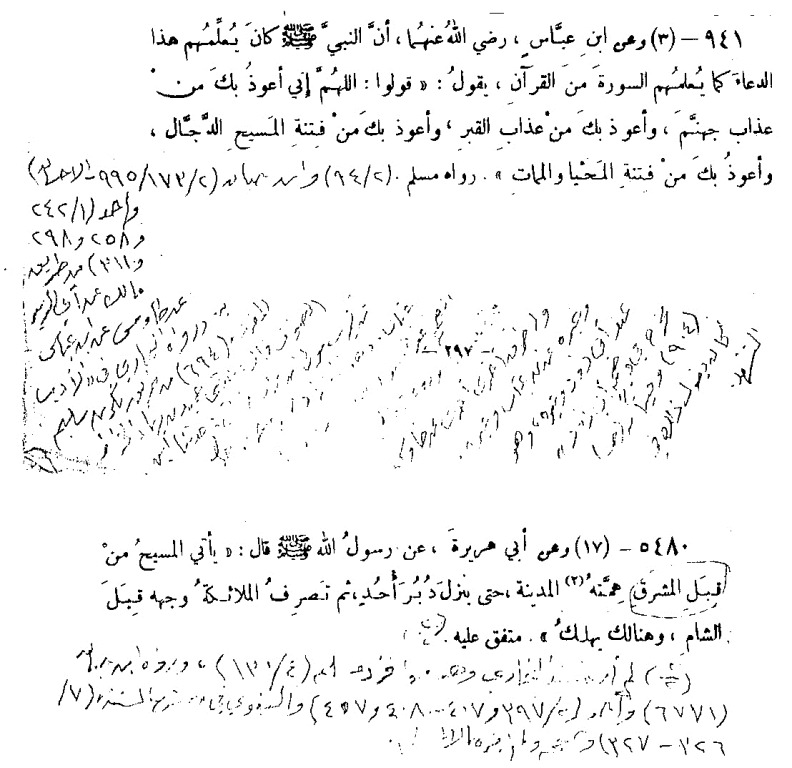
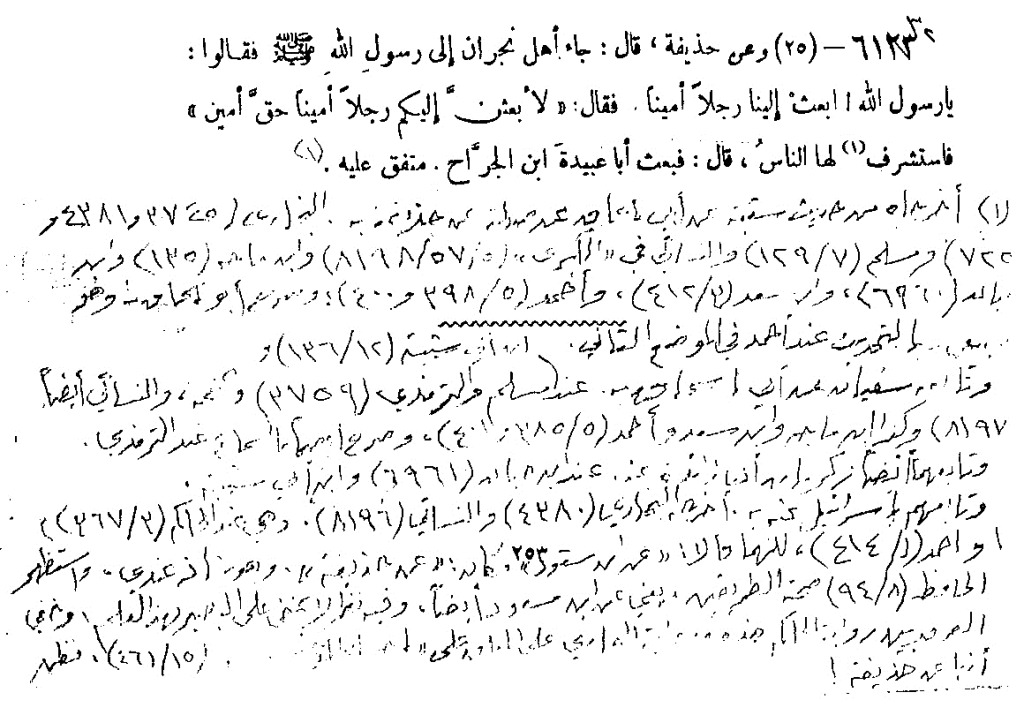
Examples of Shaikh al-Albaani’s handwriting …


Click on an image to see a larger version

A line of poetry

Zamakhsharee

Example of his hadith checking from the book Hidaayatur-Ruwaah

Hidaayatur-Ruwaah 1

Another example of his hadith checking from the same book

Hidaayatur-Ruwaah 2

The following are examples of some of the Shaikh’s commentary, corrections and checking on one of the prints of Ibn Hibbaan …

IH 2

IH 3

IH 4