The Albaani Site

Translation from the Works of the Reviver of this Century

Category: The Shaikh’s Biography

The Scholar’s Praise of Al-Albaani


فَمَا عَسَى أَنْ يَقُولَ الشِّعْرُ فِي رَجُلٍ
يَدْعُوهُ حَتَّى عِدَاهُ نَاصِرَ الدِّينِ
وأَيُّ ضَيْرٍ إِذَا فَرْدٌ تَجَاهَلَهُ
وَقَدْ فَشَا فَضْلُهُ بَيْنَ الْمَلايِيْنِ

So what can poetry say about a man,
Whose enemies even call him ‘The Aider of the Religion!’ [Naasirud-Deen]
And what harm is there if an individual ignores him,
When his excellence has spread amongst the millions!

Al-Majdhoob

What They Said

“The Allaamah, the Shaikh, the Faqih, Abdul-Aziz ibn Baaz, may Allaah the Most High have mercy on him, said about Shaikh al-Albaani, ‘I have not seen under the surface of the sky a scholar of hadith in this time of ours like the Allaamah, Muhammad Naaasirud-Deen al-Albaani.’

And his eminence was asked about the saying of the Prophet, صلى الله عليه وسلمم, “Indeed, for this nation, at the beginning of every one hundred years, Allaah sends someone who will revive its religion for it.” [Abu Dawud, Shaikh Al-Abaani declared it to be authentic]. So he asked, “Who is the reviver [mujaddid] of this century?” So he, may Allaah have mercy upon him, said, “Shaikh Muhammad Naasirud-Deen al-Albaani, he is the reviver of this time in my opinion, and Allaah knows best.”

And he said in his Fatwas (25/71), “Shaikh Naasirud-Deen al-Albaani is from our very special and trustworthy brothers, well-known for his knowledge, excellence, and his care in checking the noble hadiths to see which are authentic and weak.”

And he said, “Shaikh Al-Albaani is well-known as being from the Ahlus-Sunnah wal-Jamaa’ah and from the helpers of the Sunnah, and from the callers to the Sunnah, and from those who strive greatly [mujaahids] in the path of preserving the Sunnah.”

And he said about him in a letter which he wrote and sent on 2/5/1377ah [24/11/1957ce] to Shaikh Abdul-Fattaah al-Imaam, “I’d like that you pass on my greeting of salaam to those around you from the eminent Shaikhs and brothers, and I specifically mention from them our noble brother, and the one we love for the sake of Allaah, the Shaikh, the Allaamah, Muhammad Naasirud-Deen al-Albaani.”

And he said, “The Shaikh is well-known with us for having sound creed [aqidah] and [a sound] biography, and for his continuation in calling to Allaah, the One free of all defects, along with the commendable efforts which he expends in [giving] care and attention to the noble hadiths, clarifying the authentic from the weak and fabricated, and all that he has written concerning that in his wide ranging works; [all of this] is work which is laudable and beneficial to the Muslims. We ask Allaah that He multiples his reward and aids him to continue progressing on this path, and that he couples his efforts with success from Him and prosperity.”

And he said, “And Shaikh al-Albaani, may Allaah grant him success, is well-known with us for having a sound creed and good biography, and aiding the madhhab of the Pious Predecessors and embracing it.”

And he said, “From our trustworthy, well-known brothers, from our good brothers, our companion and our brother, the Allaamah, the Shaikh, Muhammad Naasirud-Deen–and he is from the revivers [mujaddideen].”

And Shaikh Ibn Baaz along with his brothers, the Shaikhs from the The Standing Committee for Scholarly Research and Issuing Religious Verdicts, and they are the eminent shaikhs: Abdullaah ibn Qu’ood, Abdullaah ibn Ghudayaan, Abdur-Razzaaq al-Afeefi, said, “The man is well-known with us for knowledge, excellence, venerating the Sunnah and serving it, aiding the madhhab of Ahlus-Sunnah wal-Jamaa’ah in warning against bigotry and blind following, and his books are beneficial.” This occurs in the 12th volume from the Fatwas of The Standing Committee for Scholarly Research and Issuing Religious Verdicts, p. 224.

The Standing Committee for Scholarly Research and Issuing Religious Verdicts said, “As for the book Silsilah al-Ahadith ad-Da’eefah wal-Mawdoo’ah, then its author [i.e., Shaikh Albaani] is well-versed/read in hadith, strong in its critique and in passing judgement concerning its authenticity or weakness, and at times he has mistakes.”

And in one of Shaikh Ibn Baaz’s lessons, Shaikh al-Albaani’s checking of a hadith from his book Irwaa ul-Ghaleel was read to him, so when the person who was reading it out aloud finished, Shaikh Ibn Baaz, may Allaah have mercy on him, said, “If hadith checking [takhrij] is not like this, then there is none.”

The Allaamah, the one having expansive and abundant knowledge [al-bahr], the Shaikh, Muhammad al-Ameen ash-Shanqeetee, may Allaah have mercy upon him, the one who had no comparison in his time in the field of tafseer and language–used to honour and revere Shaikh al-Albaani to a very great extent such that as soon as he would see Shaikh al-Albaani passing by while he was giving his lesson in the Prophet’s Mosque in Medinah, Shaikh ash-Shanqeetee would cut off his lesson and get up and give salaam to the Shaikh, out of respect for him.

The Allaamah, the Shaikh, Muhibbud-Deen al-Khateeb, may Allaah have mercy on him, said about Shaikh al-Albaani, “From the callers to the Sunnah and those who gave their life working to revive it, and he is our distant brother, the Shaikh, Abu Abdur-Rahmaan Muhammad Naasirud-Deen Nooh Najaati al-Albaani.”

The Allaamah, the Shaikh, Muhammad Ibn Ibrahim Aal ash-Shaikh [the Mufti of Saudi Arabia before Shaikh Ibn Baaz] may Allaah have mercy on him, said, “And he is a companion of the Sunnah, an advocate for the truth, battling against the people of falsehood.”

The Allaamah, the Faqeeh, the Shaikh, Muhammad Ibn Saalih al-Uthaymeen, may Allaah have mercy upon him, said, “That which I know about the Shaikh through the times I met him, and they were few, is that he was extremely eager to act upon the Sunnah, and to fight innovations, whether they were in matters of creed or action.”

He also said, “I came to know this about him through what I read from his works, and that he has a copious amount of knowledge in hadith, their chains of narrations and the understanding taken from them, and that Allaah has benefitted many people through what he has written, as regards knowledge, methodology and turning to the science of hadith, and this is a great benefit for the Muslims, and all praise is due to Allaah.”

And he said, “As for verifying and checking, then how excellent he is [for you to recourse to].”

And one time he saw a cassette on which was written, “By the Muhaddith of Syria Muhammad Naasirud-Deen al-Albaani.” So he said, “Rather the muhaddith of this age.”

And Shaikh Abdus-Samad Sharafud-Deen, one of the major scholars of India and the Shaikh of the Ahlul-Hadith there, may Allaah the Most High have mercy on him, said in a letter he wrote to him, “… and an inquiry has reached Shaikh Ubaidullaah ar-Rahmaani, the Shaikh of the Islamic University, i.e., the Salafi University in Banaras [India], from the Scientific Research and Religious Edicts Committee [Daar Al-Iftaa] in Riyaad from the Kingdom of Saudi Arabia, about a hadith unusual in its wording and meaning, having a close connection to this age of ours–so the opinion of those present here from the scholars was united that the greatest scholar of the prophetic sayings in this time be referred to, and indeed that is Shaikh al-Albaani, the learned scholar [rabbaani, i.e., pious scholars who practice what they preach].”

The Allaamah, the Muhaddith, Hammaad al-Ansaaree, may Allaah the Most High have mercy on him described him as, “… possessing expansive knowledge in the science of hadith.” And in the year 1400ah [1979ce] the King Faisal Foundation wrote to Hammaad al-Ansaaree asking him who he nominates for the King Faisal Award for the Science of Hadith and its fields. So Shaikh Hammaad wrote to them saying that he nominates the Shaikh, the Allaamah, Muhammad Naasirud-Deen al-Albaani. His son, Abdul-Awwal, mentioned this in Al-Majmoo fee tarjumah Waalidihi (2/598), and in it there also occurs, “My father said, ‘Al-Albaani used to be a hanafi, then he entered in to the [study of] the science of hadith until he reached its peak …”

And he said, “Shaikh al-Albaani studied knowledge fully.”

The Allaamah, the Shaikh, the Specialist [in many fields], Bakr Abu Zaid, may Allaah the Most High have mercy on him said in At-Tahdheer min Mukhtasaraat as-Saabooni fit-Tafsir, p. 41, “The manifestation of the knowledge of al-Albaani in the eyes of the people of knowledge, his aiding the Sunnah and the creed of the Pious Predecessors is an affair which none except an ignorant enemy disputes.”

And one time Shaikh Ahmad Shaakir and Shaikh al-Albaani were mentioned so he said about them, “The two venerable Shaikhs.”

And Shaikh Zaid ibn Abdul-Aziz al-Fayyaad, may Allaah have mercy on him, said, “Shaikh Muhammad Naasirud-Deen al-Albaani is from the distinguished, eminent authorities of this time, who devoted his attention to the sayings of the Prophet, صلى الله عليه وسلم [hadith], and their paths of narration and narrators, and their grading in terms of authenticity or weakness–and this is lofty work, from the best of what hours are spent on and effort expended for. And he is like the other scholars in that they are correct and [also] make mistakes, but it is befitting that his excellence be known due to his devotion to this great [branch of] knowledge, and that he be thanked for his concern and care for it, and I ask Allaah to grant us and him success, and [to also grant it] to the scholars of the Muslims and [all the] Muslims in general.”

The Allaamah, the Muhaddith, our Shaikh Abdul-Muhsin al-Abbaad, may Allaah, the Most High, protect him and allow us to enjoy his company [his knowledge etc., by giving him a long life], said, “And al-Albaani is a magnificent scholar who served the Sunnah, and his creed [aqidah] is good and defaming him is not allowed.”

And he said, “Indeed he is the one all will miss, the great, famous scholar, the Shaikh Muhammad Naasirud-Deen al-Albaani, may Allaah have mercy on him and forgive him. He has colossal efforts in serving the Sunnah, and in giving attention to the sayings of the Prophet of Allaah, صلى الله عليه وسلم, clarifying the sources of those sayings and the books they are mentioned in, [also] clarifying their grade as to whether they are authentic or weak. His service to the Sunnah is well-known and he defended the creed of the Pious Predecessors and their methodology vigorously, no student of knowledge can suffice himself without referring back to his books and written works, for indeed they contain ample good, and in them is abundant knowledge, his written works are numerous and great, and most libraries will not be devoid of his books, or will at least have some of them, and he paid great attention to researching, writing, and referring back to the speech of the scholars and benefitting from them, and the passing away of scholars such as this is, in all reality, [the cause of] a great deficiency in the Muslims, and a calamity and a breach in the [affairs of the] religion.”

And he said, “Indeed these two scholars, i.e., Ibn Baaz and al-Albaani, are from the great scholars, [both] experts and verifiers, who paid exceptional care [to the affairs of religion] and who had very high aims. Each one of them had major efforts in aqidah, great good came about at their hands, and great benefit came to Islaam and the Muslims because of them, so may Allaah reward them with the best of rewards, and forgive them both, and overlook their faults.”

And he said, “So indeed he, in truth, is from the unrivalled scholars of this time, and [is from those] who expended great efforts in serving the Sunnah of al-Mustafaa, صلى الله عليه وسلم.”

And the Shaikh, the Allaamah, the Aider of the Sunnah, Humood ibn Abdullaah at-Tuwaijiri, may Allaah the Most High have mercy on him, said, “Al-Albaani now is an eminent authority on the Sunnah, slandering him is helping to slander the Sunnah.”

And when the King Faisal Award for Service to Islaam was mentioned to Shaikh Humood, he said, “Indeed Shaikh Naasir is the most deserving of those who receive it, due to his service for the Sunnah.”

And the Shaikh, the Allaamah, Abdul-Aziz Aal ash-Shaikh, the Mufti of the Kingdom of Saudi Arabia, may Allaah protect him, described him saying, “He aided the Sunnah in this age.” Shaikh Saalih ibn Fawzaan al-Fawzaan described him in the same way.

And the noble Shaikh, the Allaamah, Saalih ibn Abdul-Aziz Aal ash-Shaikh, may Allaah protect him said, “There is no doubt that the loss of the Allaamah Muhammad Naasirud-Deen al-Albaani is a calamity, for he was one of the eminent authorities of the Ummah, and one of its hadith scholars [muhaddith], and through them, Allaah, the Majestic and Most High, protects this religion and spreads the Sunnah.

And he also said, “Indeed the late Shaikh has huge achievements in aiding the Salafi creed and the methodology of the people of hadith, along with major, numerous works in serving the Sunnah, distinguishing the authentic sayings of the Prophet from the weak, صلى الله عليه وسلم. And his effect on the Islamic world has been enormous and he is regarded as one of the scholars of the Ummah due to his great and illustrious achievements.”

The Allaamah, the Muhaddith, the Shaikh, Ahmad Mu’abbad Abdul-Kareem, may Allaah the Most High protect him: I [i.e., Shaikh Mashhoor] heard him saying in the house of Shaikh Faalih as-Sagheer in Riyad after midday prayer on Monday 13/11/1327 which corresponds to 4/12/2007, “When I was in secondary school in 1958 I used to follow what the Shaikh, the Allaamah, al-Albaani would say about weak hadith in Al-Wa’ee al-Islaami al-Kuwaytiyyah. And at that time no one else had raised their head with this knowledge except for al-Albaani and Ahmad Shaakir.” And on the same day but in another sitting he said, “When I went to Jordan with Shaikh Mahmood al-Meerah we wanted to meet [Shaikh al-Albaani], in fact we requested that we visit Shaikh al-Albaani, but we were prevented from doing so.” And he said, “I was waiting for Shaikh al-Albaani to come to Riyad to get some treatment. So that I would get to meet the Shaikh, I was in constant contact with Shaikh Waleed ar-Rashoodee, the one who obtained the order for Shaikh al-Albaani to be allowed to receive treatment. But [in the end] the Shaikh never came!”

And the noble Shaikh Abdullaah ibn Abdur-Rahmaan al-Bassaam, a teacher at the Haram Mosque in Makkah and a member of the Committee of Major Scholars, may Allaah have mercy on him, said, “Today he is from the Imaams of this time. He exerted himself, his efforts and [spent] his wealth in service of the Sunnah.”

And the Shaikh of the Hanbalees, the Allaamah, Abdullaah ibn Abdul-Aziz ibn Aqeel said in Fathul-Jaleel, pp. 155-156, about Shaikh al-Albaani, “Al-Albaani is our Shaikh and teacher …”

And he was asked which books of today’s scholars should be read, so he mentioned a group of them and said, “And the books of Shaikh al-Albaani, and we hold that he is from the Imaams of the Sunnah, and from the major scholars of hadith [muhaddith], and he served hadith in a major way through his [written] works.” And then he was asked, “Some of them say, ‘Hadith can be taken from him but not fiqh.’” So he said, “It does not harm Shaikh al-Albaani if they say this, [it does not harm him if] one, two, ten or a hundred [people say this]. Shaikh al-Albaani is a scholar and his legacy is present and printed, mistakes do not harm him, is there anyone who doesn’t make a mistake? Is there anyone who doesn’t have mistakes and faults or errors? Perfection is for Allaah, the Blessed and Most High, and the just one is he who takes the good deeds of a person and the bad into consideration. How many books did he author? They come to a hundred.”

And when I [i.e., Shaikh Mashhoor] met Shaikh Ibn Aqeel in Ramadaan in 1428ah [September 2007ce] in Makkah al-Mukarramah I asked him about those who accuse Shaikh al-Albaani of having Irjaa, so he emphatically rejected that and said, “These people have no source and nothing to rely upon for what they say.” And in another sitting he said, “What is wrong with them that they accuse Shaikh al-Albaani of having Irjaa, here he is openly declaring that actions are part of eemaan!”

And Shaikh Abdullaah ibn Sulaimaan al-Manee, the head of the Court of Cassation in Makkah and a member of the Committee of Major Scholars said, “The Muslims have been stricken with the loss of a great scholar from the Salafees, who played a strong role fighting innovations and misguidance and refuting its people with the Book of Allaah and the Sunnah of His Messenger. Let alone the prudent checkings and verifications his excellence had [written] in the path of purifying the Sunnah and making clear its authentic from its weak.”

And the noble Muhaddith, the explainer of Sunan an-Nisaa’ee, Shaikh Muhammad Ali Aadam, the Ethiopian [who is in Makkah now] said about al-Albaani, “And he has great authority in being acquainted with hadiths, the authentic from the weak, as his priceless books bear witness to, few are the ones who can come close to him in this time, [a time] in which ignorance about this noble branch of knowledge has become predominant.”

And I [i.e., Shaikh Mashhoor] heard Shaikh Fadl Ilaahi Dhaheer [Ihsaan Ilaahi Dhaheer’s brother] say in Riyad on the 13/11/1427ah [December 2006ce], “I saw light on the face of Shaikh al-Albaani.”

Shaikh Ahmad bin Yahyaa an-Najmee, said, “Shaikh Muhammad Naasirud-Deen al-Albaani, the great hadith scholar [muhaddith], the famous scholar, author of beneficial works and valuable checkings, who settled in Syria, was Salafi in creed, and expended great efforts in checking and verifying [hadiths] which none can match, so may Allaah reward him with good.”

And Shaikh Muhammad ibn Lutfee as-Sabbaagh, may Allaah protect him said, “The Allaamah, the great scholar of hadith [muhaddith], the greatest scholar of hadith in this time, he devoted his life to serving the pure Sunnah, teaching, writing, checking and verifying.”

Shaikh Abdul-Kareem Zaidaan, may Allaah protect him said, “The muhaddith of this time, the Ustaadh, Muhammad Naasirud-Deen al-Albaani.”

Shaikh Muhammad Haamid al-Faqee said, “The Salafi brother, the great researcher, the Shaikh, Naasirud-Deen.”

And Shaikh Muqbil ibn Haadi al-Waadi’ee said, may Allaah have mercy on him, said, “As for what follows: then I have been asked time and again about Shaikh Naasirud-Deen al-Albaani, may Allaah protect him, so I say, as many of the Salaf would say when asked about someone who is greater in worth than the one asked, “I should not be asked about so and so! He should be asked about me …” Indeed no match can be found for Shaikh Muhammad Naasirud-Deen al-Albaani, may Allaah the Most High, protect him, in [the field of] the science of hadith. And through his knowledge and books Allaah has [caused the Muslims to] benefit many, many times more than what those [people] zealous for Islaam have done upon [their] ignorance, the people of revolutions and [the people who want to] overthrow [governments]. And that which I believe and which I hold to be religion before Allaah is that the Shaikh Muhammad Naasirud-Deen al-Albaani, may Allaah protect him, is from the revivers which the [following] saying of the Prophet, صلى الله عليه وسلم, applies to, “Indeed, for this nation, at the beginning of every one hundred years, Allaah sends someone who will revive its religion for it.” Reported by Abu Dawud and al-Iraaqi and others declared it to be authentic. [So] when you come to know that the Shaikh, may Allaah protect him, has no match in the knowledge of the Sunnah, what then do you think his rank is in understanding the texts? That which I know about him is that his understanding of the texts is like that of our major scholars of today, nevertheless I say as Imaam Maalik, may Allaah have mercy on him, said, “Everyone has their saying accepted and rejected, except for the companion of this grave,” i.e., the Prophet of Allaah, صلى الله عليه وسلم.”

Dr. Ameen al-Misree, may Allaah have mercy on him, past head of postgraduate studies at the Islamic University, said, “From the irritable things of this world is that the likes of us, those with doctorates, should be chosen to teach [the science of] hadith at the university when there is someone more worthy of that than us, someone whose students we are not even worthy of being in this knowledge, but [alas] such is the system and convention.” And Dr. Ameen al-Misree, may Allaah have mercy on him, used to always declare that Shaikh al-Albaani had more right and was more deserving of that position than him, and he would regard himself as a student of his.

And the Shaikh, the historian, the genealogist, Hamad al-Jaasir, may Allaah the Most High have mercy on him, said, “And I have come to know, in the city of Damascus, a number of great [people], those concerned with verifying the [Islamic] heritage … just as I knew Shaikh Naasirud-Deen al-Albaani through the many times I frequented the Dhaahiriyyah Library, for he was always there, and had written many of its indexes, and had excavated its rare manuscripts, and at the same time he used to work repairing watches, he had a small shop close to the door of the Amawi Mosque.”

And Shaikh Muhammad Tayyib Awkeej al-Yawsenri, teacher of tafseer, hadith and fiqh at the College of Theology at Ankara University in Turkey, and in the Higher Islamic Institute in the city of Konya , wrote a number of letters to the Shaikh in which he showed his admiration of the Shaikh and to ask him some questions. From them was a letter he wrote on the 7th Sha’baan , 1389ah [19th October 1969ce], saying, “His honourable eminence, the Allaamah, the great researcher, the eminent teacher, the respected Abu Abdur-Rahmaan Muhammad Naasirud-Deen al-Albaani, may Allaah protect him from all adversity, and benefit us with his knowledge, my esteemed teacher … I congratulate you on this great success of yours in the field of knowledge, may Allaah increase the likes of you in the Islamic world, I would love to be able to attain all of your priceless works, so if you could please ask your publishers to send them to me at my address, with thanks in advance.”

And Shaikh Ahmad Madhhar, head of At-Tamuddan al-Islaami in Damascus, was impressed by Shaikh al-Albaani’s knowledge and opened up the avenue to spread many of his calm, critical, articles in the magazine, not caring about the desire of many people who were against that, and he said, “Damascus recognised its greatest scholar of hadith in the Allaamah Badarud-Deen al-Husaini, then when Allaah caused him to die, the land was left void of an Imaam to whom attention could be turned in the science of hadith–except for an Arnaa’ooti youth, raised upon knowledge and piety, and who [indeed] was true to his name [i.e., Naasirud-Deen, ‘Aider of the Religion’], the Ustaadh Muhammad Naasirud-Deen al-Albaani, known among the youths for his service to hadith and its sciences, and they gathered around him and he became well-known among them, and through his eloquence and his Arabic tongue, and the charm of his speech and the quality of his debates, he was able to appropriate an elite group [of people] to take from him and study with him.”

And the Shaikh, the Faqeeh, Muhammad al-Ameen, BuKhubzah, al-Hasani, al-Maghribi, said, “… I bear witness with the utmost truth and impartiality, and Allaah is the witness to what I say, that I have not seen amongst those of the scholars who I have met, and they are many, and from whom I took, anyone like Shaikh Muhammad Naasirud-Deen ibn Nooh Najaati al-Albaani al-Arnaa’ooti, in terms of his knowledge, his sincerity, his research in the sciences of hadith and its intricate details, his fairness in his research and debates, in addition to his behaviour which is similar to that of the Pious Predecessors [Salaf as-Saalih], I say this and I do not ascribe piety to anyone over and above what Allaah knows [about his true reality].”

Shaikh Muhammad Amaan ibn Alee al-Jaamee, may Allaah have mercy on him, said, “I have mentioned a number of times that I love Shaikh Naasirud-Deen al-Albaani and I hold him in high esteem, and truly, I ask Allaah to bear witness and then I ask all of you who are present to bear witness that I love his eminence, Shaikh Naasirud-Deen al-Albaani and I hold him in great esteem, and [that I hold] that he is from the people of knowledge and from the major scholars of hadith. So it is obligatory that we love the people of hadith and the people of knowledge, the people of excellence, we love and respect them.”

And Shaikh Saalih ibn Abdullaah ibn Humayyid [Imaam of the Haram] wrote to him saying, “The venerable father, the Muhaddith of Syria, in fact, the Muhaddith of the world in his time …”

And Shaikh Abu Abdur-Rahmaan ibn Aqeel adh-Dhaahiri wrote to him saying, “Our father, the Shaikh Muhammad Naasirud-Deen al-Albaani, the one who is revered due to his knowledge and his firmness …”

And Shaikh As-Sayyid Saabiq wrote to him saying, “The scholar, the one who acts upon his knowledge, the scholar of hadith [muhaddith], the teacher …”

Here is a scan of the certificate of the King Faisal International Prize awarded to Shaikh al-Albaani in 1999:
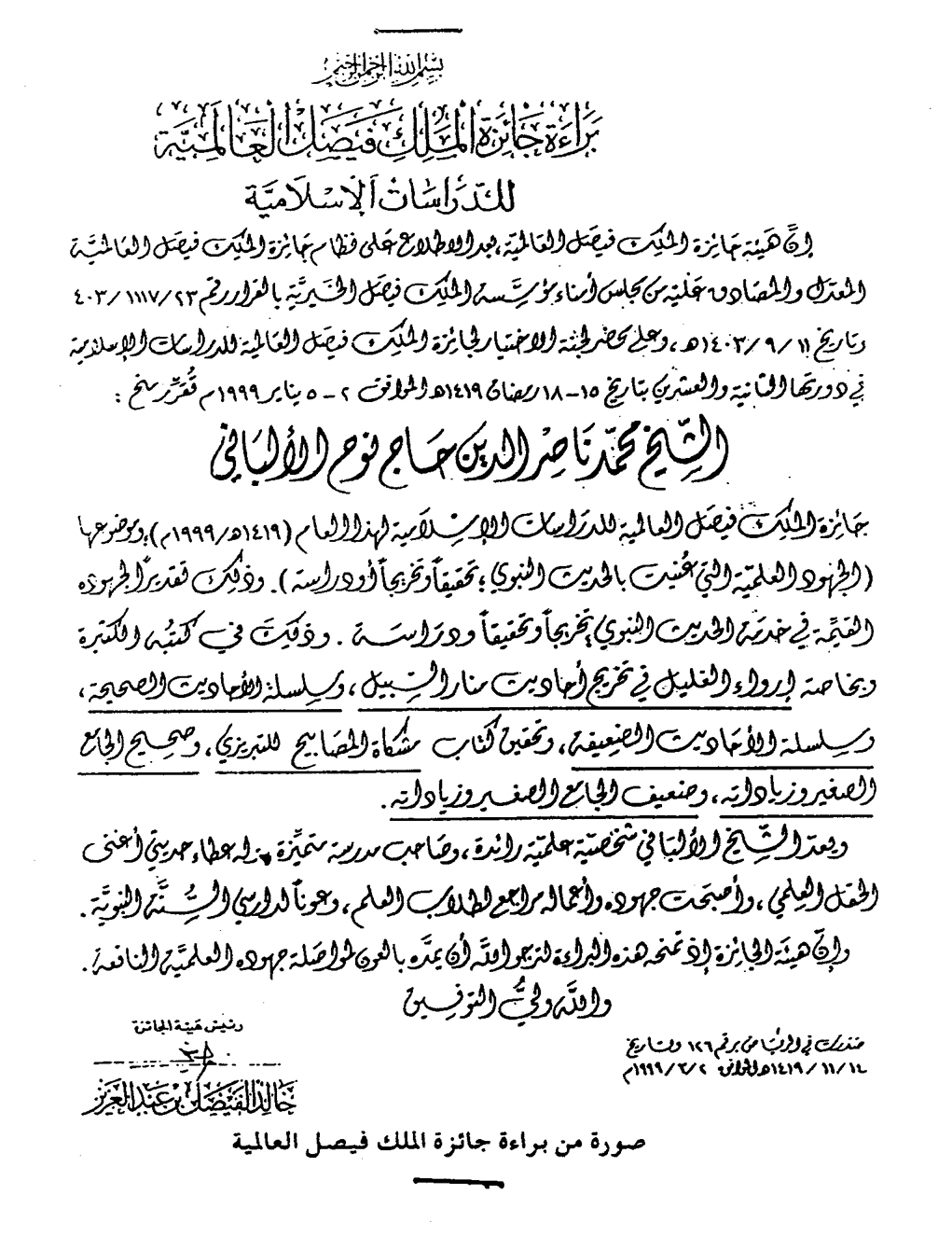
Compiled from Juhood al-Imaam al-Albaani, Naasirus-Sunnah wad-Deen, fee Biyaani Aqeedatis-Salaf as-Saaliheen fil-Eemaani billaahi Rabbil-Aalameen, of Ahmad Saalih Hussain al-Jabboori, with an introduction by Shaikh Mashhoor ibn Hasan Aal Salmaan, pp. 18-25, and Al-Imaam al-Albaani, Duroos, wa Mawaaqif, wa Ibar, of Abdul-Aziz ibn Muhammad Abdullaah as-Sadhaan, pp. 217-228.
Shaikh Al-Albaani’s Life | Questions and Answers | E-Book


الحمد لله الذي بنعمته تتم الصالحات

Shaikh al-Albaani’s Life | Questions and Answers … The End


His Imprisonment

Then al-Huwaini asked the Shaikh about the circumstances surrounding his imprisonment in Damascus two times?

Al-Albaani: One of those times was when Jewish planes struck Damascus, so what seems apparent is that the state feared that the Shaikhs might start a revolution, so as a precautionary measure they arrested all the Shaikhs.

Then Shaikh al-Albaani said while he was laughing, “And I don’t know how they regarded me to be from among the Shaikhs this time.”

The second time was when the secret service called me in and said, “What is your opinion about the rulers of today?” So I said to them, “I don’t know them.” They said, “What is your opinion about the system of the ruler, do you support it?” I said, “No.” They said, “Why?” I said, “Because it is against Islaam.”

They took me in a car transferring me from place to place and then put me in police headquarters in order to transfer me–to where, I did not know. A person from my people, an Arnaa’ooti, passed by me and asked why I was present there so I told him about the situation, and he left. He went and asked about the place to which I was about to be transferred and then came back to me and said, “They have decided to expel you to al-Hasakah,” i.e., [an area in the] north-east [corner of] Syria.

So I asked him to go to my son in the shop and tell him to bring my bag to me in which he should place a copy of Sahih Muslim, a sharpener, a pencil, an eraser etc., and that he should meet me here, and that if he does not, then he should meet me at the place where the cars leave for Aleppo.

So the man went to my son who then hurriedly came and brought everything that I had asked for and met me at the place where the vehicles depart just as it was reversing getting ready to go. He climbed on heading towards me and gave me salaam, hugged me and bid me farewell, and then it left with us for Aleppo, and from Aleppo to al-Hasakah.

There is a new, very large and towering prison in al-Hasakah. They placed me in an area which was very long and full of Muslims from Hizb at-Tahrir, the head of them used to attend my lessons in Aleppo, i.e., he was a Salafi and then he turned towards Hizb at-Tahrir. I said to myself, “Many a calamity is beneficial,” [for] I was in constant debate with this group, day and night–but I had brought my provisions with me and wanted to start work but the lamp [where I was] was attached to the ceiling which was very high, so I did not benefit from its light whatsoever.

So I spoke to this companion of ours who used to be a Salafi, his name was Shaikh Mustafaa, and, unfortunately, he had spent about two years in the prison. Due to him having spent such a long time there, some companionship had developed between him and the warden, and it seemed as though the prison warden had some [positive] natural disposition [in character], even though he was a Ba’athist. He indeed used to respond positively to Shaikh Mustafaa and with this group of Muslims and would help them as much as he was able to. They would eat together, sharing their food, and I did so with them too.

The point is that I needed some electricity [i.e., a way of getting more light to be able to read], so Shaikh Mustafaa spoke to the prison warden saying to him, “Shaikh al-Albaani is a student of knowledge and wants to study, because he brought his books with him.” So the warden said to him, “We will bring him what he needs but on his account.” So I told them this was fine and good, he would bring what I needed and I would pay.

So [as a result] the lamp was brought down from the top of the ceiling to the top of my head, totally above it–so I never felt any loneliness in the prison whatsoever, just as Ibn Taymiyyah said, “My imprisonment is my solitude.”

Then al-Huwaini asked the Shaikh about his works which he had finished and those he was still working on and about his methodology in authoring some of those works and he finally asked him to give him some knowledge-based advice so the Shaikh gave him some and encouraged him to fear Allaah, the Mighty and Majestic, and finished off by saying:

“I hope that you are given even more tawfeeq [from Allaah].”

The End


Hope you guys enjoyed it as much as I did.

And the translation was finished after Ishaa on the 11th of Jumaada 1 which corresponds to the 15th April, 2011. And all praise is due to Allaah through whose Blessing righteous actions are completed.

Shaikh al-Albaani’s Life | Questions and Answers … 13


His Migration to Jordan and the Secret Service

Al-Huwaini: In some of your books you mentioned in general terms your entrance into Amman, Jordan and then your return to Syria once again due to some powerful circumstances. We’d like to know about this situation.

Al-Albaani: I used to live there in a small, modest house, and was searching for [a piece of] land upon which to build a house, so I chose this piece and started to build. Our brothers were very eager for me to start giving them a lesson, as had been the case before I had settled here. I used to come [to Jordan from Syria] every month, or every other month or every third month–depending on my circumstances, and would give them lessons in the house of Shaikh Ahmad Atiyyah. I would also visit Zarqa and give some lessons there. This was my habit before I settled here.

When I [actually] moved there I became busy with building a house … we [finally] did finish building it and moved in, and all praise is due to Allaah. We used to hold the lesson on the roof of Shaikh Ahmad’s house here not the previous one in which I would give the lesson. The roof filled up with people even though it was large, and the lessons were on Riyaad as-Saaliheen [and would last] for about three quarters of an hour and then questions and answers.

The third lesson had hardly come when the secret service turned up behind me. I had prayed dhuhr in Noor Mosque along with my older brother whose name is Muhammad Naaji Abu Ahmad and that day my son, Abdul-Musowwir, was also with me. I was going up the stairs and my brother was behind me and then my son when someone said to my brother, “Are you so and so?” So I turned around and said, “I am so and so.” So he said, “We need you for a while.”

They took me to the secret service and asked me for my ID and asked me about my work and so on. Then someone else came in and it seemed as though he was senior in rank and said to me, “O Shaikh, your presence in this city here is not wanted.”

So I said to him, “Why? For I have been living here for one year now, and not only this, but in fact I bought a piece of land with the permission of the state, and not only this, but I built a home on it with the permission of the state, and not only this, but I got married to one of its women [too].”

So the senior one among them consulted with another and then left.

They then transferred me to another room and questioned me again. After which they took me downstairs with a soldier and put me in a military car and started to take me from place to place until they took me somewhere where there was a group of people, and judging by their faces most of them were base people, i.e., criminals, and they had their belongings with them. Close to them was an army vehicle so I realised that they were about to be transported, and in one of the centres which they had taken me to, one of the people there had said, “They now want to expel you to Syria.”

Then the sergeant came and said, “Come on them, O Youth, get on.” I was the last of them and refused to get on saying to the sergeant, “I do not want to go to Syria,” even though my exit from Syria was totally normal [i.e. the Shaikh had not fled Syria for doing something wrong etc.], and this is a point which many people are ignorant of, because a few months after I had left, the Syrian Revolution had taken place. After I had settled here [i.e., in Jordan] I didn’t think it a good idea to go back to Syria.

So the sergeant lied to me and said, “We will not take you to Syria, we’re taking you to Erbil instead.” Then they took us in the car to the Jordanian-Syrian border and handed me over to a Jordanian officer, who then permitted me to go to the Syrian border and [once] in Syria they questioned me and so I mentioned the story to them. They gave me a piece of paper which had a note [written] on it, saying, “You must report to the Syrian Secret Service after three days.”

When I went to my brother’s house there and stayed there for two nights I consulted with my brothers: should I go to the Syrian Secret Service or should I leave Syria? So all opinions were unanimous in that I should not go to the Secret Service. They said, “Because you do not know what they [might] do to you.” So based upon this I made my decision and travelled to Lebanon.

I remained there for six months approximately and then one of our brothers from the Emirates came and he had a pass to allow me entry into the Emirates and [so] I spent a few months there.

Then one of our brothers here like Abu Maalik [Muhammad Ibrahim Shaqrah] and others made an effort and got in touch with those in authority [in Jordan] until they were able to take the matter to the King [telling him] that the Shaikh is not a revolutionary and nor is he a political person–he is only a person of knowledge. And they presented two boxes full of [my] books to the Chief Minister and said to him, “This is the Shaikh.” And so those in authority allowed me to enter.

So this is how it was, this is the story you asked about.

Al-Huwaini asked the Shaikh about his reason for leaving Syria [to go to Jordan in the first place] and how it happened?

Al-Albaani: Leaving Syria was a natural matter, a plan for the future, i.e., I had made a plan for myself, saying, “I must withdraw myself from the people in whatever remains from my life, and dedicate what remains from it to complete my projects,” or some of my projects at least. Because as you know in Syria I used to travel widely: from Damascus to Homs, to Hama, to Aleppo, to Idlib, to Latakia. So I didn’t want to become busy with the people such that I would not be able to complete my knowledge-based projects.

So I said [to myself], “I will go to a country where I am not well-known.”  But the reality turned out to be the total opposite, and this is as it is said in some of the Israaeeliyyat narrations [i.e., narrations from the People of the Book], “My servant wants [something], and I want something, and nothing will happen except that which I want,” and this is true without doubt.

So I came for this purpose so that I could live far away from being referred back to and [from being asked] questions and so on, and to devote myself to knowledge, so my departure [from Syria] was totally normal.

Al-Imaam al-Albaani, Hayaatuhu, Da’watuhu, Juhooduhoo fee Khidmatis-Sunnah, of Muhammad Bayyoomi, pp. 23-25.

Shaikh al-Albaani’s Life | Questions and Answers … 12


The following post is from the same book we are going through but occurs later and is not part of the questions and answers section but is connected to the previous post about the Shaikh’s time at Medinah, so I thought I would add it here.


“In their biographies of Shaikh al-Albaani, the two Shaikhs, Eed Abbaasi and Ali Khashaan said, ‘Due to that continued effort and the tawfiq that Allaah, the Most High, gave him, many beneficial works [authored by the Shaikh] in the fields of hadith, fiqh, creed and others came to light which show the people of knowledge and excellence what Allaah had bestowed upon him from correct understanding, abundant knowledge, exceptional expertise in the field of hadith and its sciences and narrators, along with a sound knowledge-based methodology making the Book and the Sunnah the judge and scale for everything, taking guidance from the understanding of the Pious Predecessors and their way in understanding and deriving rulings.

That [same] methodology which many researchers and verifiers from the people of knowledge [before him] tread upon, especially the Shaikh of Islaam Ibn Taymiyyah, his students, and whoever followed them in that.

All of this made the Shaikh a distinguished and renowned authority that the people of knowledge would refer back to. People supervising institutes of knowledge appreciated his worth, something which made those in charge of the Islamic University in Medinah al-Munawwarah when it was established–and at the head of them the Shaikh, the Allaamah, Muhammad ibn Ibrahim Aali-Shaikh, the Principal of the Islamic University and the Mufti of the Kingdom of Saudi Arabia at that time–choose Shaikh al-Albaani to take up the teaching of hadith and it sciences, during which he was an example of earnestness and hard work, to the extent that he would sit with the students on the sand during the breaks between lectures and some teachers would pass by him while he was sitting on the sand and would say, “This is the real lesson–not the one you just came of it or the one you will go back to [inside].”

The Shaikh would do that whereas the other teachers would head to the staff room and have some dates or tea and coffee, and this is from the Grace of Allaah which He gives to whoever He pleases.

And maybe this habit of his and his sincerity was something which led some people to become jealous of him, amongst whom were some of the people of knowledge, due to the affection and love the students had for him and how they would present themselves to him at the university and outside it during the trips which the university would supervise.

The Shaikh’s relationship with the students was that of friend with a friend, without formality, and not like [the relationship] between a teacher and his student, for he wiped out formality which would [normally] prolong matters and replaced it with trust and brotherhood.

He said, “In my car I would take with me whichever students I happened to meet on the way to the university and also back to Medinah.  So at all times, my car would be full of them, going and coming.”

The desire of the students to be with the Shaikh and their love for him and the fact that they felt as though there was no difference between them and their teacher reached such an extent that one day after having given his lectures the Shaikh went to the [university’s] administration and left his car outside the building and entered. Then it so happened that Ustaadh Muhammad ibn Abdul-Wahhaab al-Bannaa wanted to go to the city, so he came out [of the building] with Shaikh Al-Albaani heading to Shaikh Al-Albaani’s car so that he could take him with him–only to find that Shaikh al-Albaani’s car was [already] full of students! So when the students saw Shaikh al-Bannaa, one of them was compelled to get out for him, and this is how it was.

And when he would enter the university in the morning you would hardly be able to see his car due to the multitude of students gathered around it, giving the Shaikh salaam, asking him questions and benefitting from him.

The Plans of the Malicious and Spiteful Ones

All of these things which we just mentioned when put together stirred up those teachers at the university who were malicious and spiteful, so they plotted against him and reported him to the university administration fabricating false accusations against him, bearing false witness against him and slander, conspiring and machinating against him. And they forgot Allaah, the Most High, and the [fact that all will have to] stand before Him, on the Day when nothing will be hidden from Him, the Most High.

So the administration terminated his contract.

The Shaikh bore the accusations and slander against him, saying, “Sufficient for us is Allaah, and He is the Best Disposer of affairs,” and Allaah wills and chooses, and none can repel His Will, the One free and far removed from all defects.

So the Shaikh was satisfied with Allaah’s Decree with a believing and truthful soul, in fact he was happy because Allaah had blessed him to be able to understand complex issues and Islamic problems such that he returned [to Syria] with an even greater fervour to research and investigate those things which would be of benefit to the Muslims in many different fields of knowledge from the pure Sharee’ah, which he had been kept away from while he had to teach at the university.

[When all of this happened] Shaikh Abdul-Aziz ibn Baaz said some important words to Shaikh al-Albaani, consoling him, he said, “Wherever you are, you will fulfil the obligatory duties of calling to Allaah, there is no difference to you [whether you are here or there].” And that is because he knew of the strength of Shaikh al-Albaani’s faith in Allaah, the Most Great, his vast knowledge and his patience in the face of calamities.

And maybe this explains why Shaikh al-Albaani would so often repeat the supplication of Abu Bakr as-Siddeeq, may Allaah be pleased with him, “O Allaah! Do not hold me to account for what they say, and make me better than what they think, and forgive me concerning those things they do not know about.”

Al-Imaam al-Albaani, Hayaatuhu, Da’watuhu, Juhooduhoo fee Khidmatis-Sunnah, of Muhammad Bayyoomi, pp. 115-117.

Shaikh al-Albaani’s Life | Questions and Answers … 11


How was Al-Albaani chosen to teach at Medinah University?

Al-Huwaini: How were you chosen to teach at the Islamic University of Medinah? Because the norm is that one needs a doctorate to teach academic study [at university]?

Al-Albaani: This is the first time that I’ve been asked this question. What I recall now are two things. The first is that the university was new to university level teaching [only recently having been established], especially in Saudi, this is the first reason.

The second is the reputation of some of the books [that I authored] and the satisfaction of the people [i.e., scholars etc.,] with them, and [also], from what seems apparent to me, their appreciation of the books as they deserved to be appreciated–this is what caused them to send for me.

I didn’t ask and I wouldn’t ask–and I [have] Iived like this, and all praise is due to Allaah, not requesting any job, for since childhood I would earn my daily sustenance through the labour of my own hands and the sweat of my own forehead.

At this time a request came to me from Shaikh Muhammad ibn Ibrahim who was then the Mufti of the Kingdom [of Saudi Arabia, i.e.,the Mufti before Ibn Baaz], and he was the Principal of the university, asking me to agree to teach hadith sciences at Medinah University which would soon open its doors.

I took the counsel of some of my brothers there whose understanding and knowledge I trusted, so one of them said to me, “Try it for a year, if you enjoy teaching [there] you can carry on with them for as long as it’s written for you.” And the reality was that when I went there I found a truly wonderful climate, that was ready and willing to, firstly, accept the call and, secondly, the academic methodology which I was naturally predisposed to and continued upon.

How would Al-Albaani interact with his Students at
Medinah University?

My story at the university, in my opinion, was something that happened rarely with someone who was a teacher of a subject there–for I was with the students as though I was one of them, and there are [different] situations which may make this reality clearer for you.

For example, when my class would finish and it was break time, the [normal] habit of the lecturers was to go to the staff room and sit there for the length of the break, drinking tea or coffee and talking about different things.

As for me, I would turn away from all of that, and would leave the lesson [heading to] to the courtyard and I would sit there on the sand–and the students who I had been teaching only a few minutes earlier would gather [around me], and students from all [other] years [too], because this sitting was in the open.

I would give them some guidance and advice and answer some questions. This was how I spent all of the years I taught at the university.

And I recall very well that someone who in university language was called an assistant professor, passed by me [while I was sitting outside] one day and said, “As-Salaamu alaikum.” So I replied, “Wa alaikum salaam.”

He then said, “You know, O Shaikh, the real lesson–this is it.”

Because the students were free [and open] in this sitting, as for the official lesson [in class], even though it is true that I was very liberal with them, yet even then there have to be limits and restrictions. This was a way that was unique to Al-Albaani from amongst all of the other teachers at the university.

There were other good results too, for example, when Al-Albaani would enter the university a few minutes before the lesson, the students would gather round the car, until it would be lost among them and couldn’t be seen, every one of them would try to beat his brother in order to direct a question to me. And when I would leave [at the end of the day], they would again compete to sit in the car with me in order to seize the opportunity.

This was my habit when coming or going–I would never stop anyone from sitting in my car, so it was always full of students, coming and going.

This situation produced an amazing and great deal of love in the hearts of the students for Al-Albaani, add to that the fact that something came to them which they had not heard before: a teacher of tafseer, fiqh, usool relating hadith to them which was relevant to their lessons so the [other] teachers themselves started to hear a new language, “O teacher, who narrated this hadith? Is its chain of narration authentic?”

And I remember an event that occurred very well, the teacher of usool, i.e., usool al-fiqh, quoted the hadith of Mu’aadh ibn Jabal, “O Muaadh! With what will you judge …” he brought this hadith to the students using it as a proof for qiyaas, this occurred in the lesson of our brother Abdur-Rahmaan Abdul-Khaaliq, he was in the third year, so he said to him, “O teacher, is this hadith authentic?” He replied, “Yes.” He said, “We heard Shaikh al-Albaani say that it is a munkar hadith.” I do not know what his answer was but he was not pleased with what this student had said.

After a few days this Shaikh, the teacher of usoolal-fiqh, came to my house and said to me, “It has reached me that you say that this hadith is munkar [i.e., not authentic]?” I replied, “Yes.” He said, “Have you written anything about this hadith?” I said, “Yes, in ‘Silsilah al-Ahadith ad-Da’eefah,’ in the second volume,” and it had not been printed in those days. He said, “Can I have a look at it?” So I showed it to him, and [in it] I had mentioned all of its paths of narration and had clarified its baseless defects.

Then lo and behold in another lesson [of his] he reconfirmed [what he had first said] to the students that the hadith was authentic and that Shaikh al-Albaani himself had brought different paths of narration for it which strengthened it–whereas those paths of narration did nothing except add invalidity to invalidity.

So situations like this, and this very uncommon display at the university where the students would gather around me stirred up the wrath of the teachers so they wrote directly to the Mufti, and Allaah knows best, or to the King, and made it seem to them that I was setting up a faction or group and that it was feared that I might do something.

The third year ended and so I returned to Damascus to spend the summer vacation there. In those days Shaikh Ibn Baaz, may Allaah reward him with good, was the Assistant Principal. A week or two before I returned to Medinah he wrote to me, and I remember very well that one of my children, Abdul-Lateef, had to complete one of his courses so I sent him ahead of me so that he could take his exam. And he was then shocked by the letter from Shaikh Ibn Baaz which stated that he [i.e., Ibn Baaz] had received a letter from the Mufti that there was no need to renew the contract with Shaikh al-Albaani this year.

For this reason my connection with the university ended, and Shaikh Ibn Baaz, may Allaah reward with him good, wrote a good word to me, saying, “The likes of you, whichever situation he is in, will fulfil what is obligatory upon him.”

In summary, I was requested to teach there, it seems as though this was because they were not strictly applying the rules of universities and because they needed a person whose knowledge and creed they could trust at one and the same time. So for this [reason] and that, they appointed me to teach …

Al-Imaam al-Albaani, Hayaatuhu, Da’watuhu, Juhooduhoo fee Khidmatis-Sunnah, of Muhammad Bayyoomi, pp. 30-33.

Shaikh al-Albaani’s Life | Questions and Answers … 10


Translated by Ahmed Abu Turaab

Al-Huwaini: You mentioned before that that you rented a house in Damascus to give lessons in. What was the methodology that you followed at that time? Would you read through a book or were they general lessons?

Al-Albaani: I remember that the first thing that I taught the students was from Ibn al-Qayyim’s Zaad al-Ma’aad fee Hadyi Khairil-Ibaad. I would read a part of the book to them and then comment on it [from memory] based upon some previous knowledge that I had [concerning it] or from notes that I would prepare before I would give the lesson. In those days the lesson was from three quarters of an hour to an hour long, then after that there would be half an hour to answer questions.

After I finished the first volume of Zaad al-Ma’aad, I think, and Allaah knows best, if I have not forgotten, they requested that I teach them the book Ar-Rawdah an-Nadiyyah Sharh Ad-Durar al-Bahiyyah, because the reality is that [Ibn al-Qayyim’s book] Zaad al-Ma’aad is a knowledge-based book–not all students can handle it, whereas Ar-Rawdah an-Nadiyyah’s subject matter is condensed. So I did teach them the entire book, from its start to its end.

Later, I think, came the turn of At-Targheeb wat-Tarheeb, and there was an academic exertion behind these lessons: the principle regarding them would be preparation, from the results of which was [the commentary on Zaad al-Ma’aaad called] At-Ta’leeqaat al-Jiyaad alaa Zaad al-Ma’aad, the first volume, and At-Ta’leeq ar-Ragheeb ’alat-Targheeb wat-Tarheeb. For it was from my nature not to teach them a hadith until I had ascertained its authenticity and made sure of the understanding [fiqh] or meaning intended by it. This is how I would give lessons there …

Someone at the gathering asked: O Shaikh! Through your constant visits to the Dhaahiriyyah Library, who do you know from the students of knowledge at that time who were serious and striving from your contemporaries?

Shaikh al-Albaani: I, unfortunately, never used to see anyone constantly visiting the Dhaahiriyyah Library, not from the students, neither from the Shaikhs, nor any doctors [i.e., those holding PhDs]. But Shaikh Abdul-Qaadir al-Arnaa’oot would be there, he was ok …

Al-Huwaini: Regarding [Ibn Taymiyyah’s] book, Iqtidaa as-Siraat al-Mustaqeem, did you teach it?

Al-Albaani: I taught parts of it, not all of it.

Al-Huwaini asked Shaikh al-Albaani about Shaikh Muhammad Bahjatul-Baitaar: was he from your ranks or from those who came before you?

Al-Albaani: He was from those who came before [me].

Al-Huwaini: Did you take any knowledge from him?

Al-Albaani: No, but there used to be lessons on literature which the great and well-known authors of that time in Damascus would attend, members of the Arabic Scientific Academy in Damascus, from them for example was Ustaadh Izzud-Deen at-Tanookhi, may Allaah have mercy on him, and others like Mustafaa ash-Shihaab.

They would gather and study the book al-Himaasah of Abu Tamaam. The specialist among them, like at-Tanookhi, was the one who would give the commentary, explanation and clarification. So I and a friend of mine who has passed away to the Mercy of Allaah, his name was Munir Abu Abdullaah, we would go to this sitting successively in order to strengthen [our] Arabic, and to learn something of its ethics.

From the members of this sitting was Shaikh Bahjatul-Baitaar, but I did not [sit with him specifically and] learn anything from him..

Al-Huwaini: Did you meet al-Kawthari?

Al-Albaani: No. I do not know him except from what he left behind.

Al-Huwaini: He was a contemporary of yours?

Al-Albaani: Yes but he was in Egypt and I was in Damascus. I did go to Egypt and he was alive …

Al-Imaam al-Albaani, Hayaatuhu, Da’watuhu, Juhooduhoo fee Khidmatis-Sunnah, of Muhammad Bayyoomi, pp. 28-30.

Shaikh al-Albaani’s Life | Questions and Answers … 9


Translated by Ahmed Abu Turaab

The Special Room that Al-Albaani was Given at
the Dhaahiriyyah Library

Al-Huwaini: One of the things that I read about you in your books is that you were allocated a special room in the Dhaahiriyyah Library. How did you get to that level, bearing in mind that such a thing can be quite difficult [to obtain] in Islamic countries?

Al-Albaani: I don’t recall very well now [the reason], it was either because the administration at the Dhaahiriyyah Library felt that I was a person in love with knowledge for I used to sit in the general [reading] area and say to Abu Mahdi, “Give me, and of course he would, such and such book,” i.e., the manuscript, and I would hardly have finished with it when I would request a second book and a third and a fourth …

At times I would have a [whole] pile of manuscripts on the table. This table was for four people, two [to sit] on one side and two on the other. Due to this, no student would be able to sit down at the table along with me. And without doubt there was some objection from the students [due to this], especially at exam times.

So it was as though the administration found a solution to the problem. They had a dark room [there] which was not good enough to place firewood in, so they suggested it to me … and put me in this room, placing in it whatever books I needed for reference so that I would not overburden the employees there [by saying], “Bring such and such book … take this book [back] …” They even left some manuscripts with me [in the room].

This is the first possibility [as to why they gave me the room], and it is the most likely in my opinion, since this was a long time ago.

Al-Albaani Alone Being Allowed to enter the Dhaahiriyyah Library at any time of the Day or Night

The second possibility was that the College of Sharee’ah at the Syrian University held a number of meetings in which they decided to establish the core for a hadith encyclopaedia. And with sadness I say: they couldn’t find anyone amongst their doctors who could undertake this task. So they sent for me to confer on the topic. I met with them at the university and they presented their idea to me and requested that I work on this curriculum that they had drawn up.

After exchanging views on the topic I agreed with them that I would work four hours a day for them and the remaining hours would be for my personal work–on the condition that I be given permission to enter the Dhaahiriyyah Library at whatever time of day or night I wanted. So I said to them, “If the administration at the library agrees to that, I will give you four hours every day.” They replied saying that they would speak to the person in charge there.

So one day Mustafaa as-Subaa’ee or Muhammad al-Mubaarak came, I don’t recall exactly, and they went up to see the manager and spoke to him about the topic and then sent for me and said, “We have come to an agreement with the manager and he will order the caretaker that every time you come he will open the gate for you.”

In this way I gave them four hours a day, so I would work on a project on the hadiths of trading.

The point is that at this time I cannot be totally sure either way, as to whether they made this room available to me for this reason or before that … what I think is more probable is that they gave me the special permission to enter whenever I wanted, at any time of day or night …

So this is the story of the room which I alone was given to the exclusion of all the other people who would come there.

Al-Imaam al-Albaani, Hayaatuhu, Da’watuhu, Juhooduhoo fee Khidmatis-Sunnah, of Muhammad Bayyoomi, pp. 26-29.

Shaikh al-Albaani’s Life | Questions and Answers … 8


The Story of the Lost Paper

Al-Huwaini asked the Shaikh about the Story of the Lost Paper?

Al-Albaani: The reality is that I got an ailment in my eyes, when I would look at a white wall it would be as though I could see flies moving. When I took myself to the optician he said, “This is what we call the flying fly,” and this was an expression he used referring to a very fine blood vessel which had deteriorated and from which an extremely fine drop of blood had come out onto the eye–and that was what I could see coming and going.

The doctor asked me, “What work do you do?”

I told him, “I’m a watch repairer.”

He said, “This is due to exhausting [yourself].”

I explained my situation to him, that I was a watch repairer and that I would [also] research a lot, so he asked me to take a six month break. I went back to my shop and started to sit there: not doing anything, not in my job, nor reading or researching.

A week or two passed by and boredom started to set in, so I started to entice myself and justify to myself using many different reasons [as to what I could do]. Then an idea came to mind which was that there were a group of different treatises in the Dhaahiriyyah Library, one of which was The Dispraise of Idle Amusement [Dhamm al-Malaahi] by Ibn Abid-Dunyaa, so I thought to myself that I could ask the transcribers there to copy out this manuscript, and that by the time they finish copying, I, maybe, would have gathered up and regained some of the health of my eyes and the rest [they required].

So I went to the Dhaahiriyyah Library and requested the copyist transcribe the treatise, and so he started. When he got half way through he came to me saying that there was a gap in the manuscript, that there was something lacking.  I went to the library and had a look at the manuscript and there was indeed something missing, so I told him, “Carry on as you are doing … and Allaah creates that which you do not know.” He finished copying out the manuscript, and it was as they say … my unconscious mind was working day and night [trying to figure out] where this missing part could be. So I hypothesised that when [all the different individual] manuscript treatises were gathered together to be put into this volume, maybe a page or two from this [particular] treatise fell out and were then later added to a different volume [of manuscript treatises].

And so there would be no path [to find it] except by searching through the collection present in the Dhaahiriyyah Library.

The manuscripts in the Dhaahiriyyah Library were arranged according to subject as is the general [classification] system [used in libraries] … except that there were about one hundred and fifty volumes entitled Majaamee [collections], and it was a befitting title, because every volume contained a number of [different] books, differing in the way they had been arranged and in their classification and topic, for this reason they had been put under the title majaamee [collections].

So I said to myself that I would start with these majaamee, and so I did.

One of the things which made the search easier was that just as these volumes differed in their topics and authors they also differed in the type of paper [they were written on]. So you would find some large [pieces] and some small, some white and others gray, and at times [you would find some that were] blue, and so on. All of this made the way to search easier for me, so I started with the first volume, then the second and third, I don’t remember exactly. Then all of a sudden I came across the title of the book [that I was looking for, The Dispraise of Idle Amusement]—and by Allaah, it is an important book—but it was the second part that I found, if it had been the first the matter would have been over. So when I would find the second or third parts I would leave them and carry on, after [going through] a number of volumes I came across the first part of one of those [other] treatises [that I had come across in earlier volumes], so I lamented myself and was regretful, saying, “Would that I had written down the title and number [showing exactly where I had found] the second part and this first part.” I learnt a lesson and began to record anything that interested me, even if it was not complete.

And you will note here that I was [initially] doing one thing when I began to do something else: I was searching for the lost paper whereas now I had started to record the titles of what can be regarded as treasures, even if they [i.e., the manuscripts] were incomplete. What is important is that I finished going through the one hundred and fifty volumes but I did not come across the lost paper in the volumes [of the books of] hadith, but I left with huge benefit in terms of knowledge. So I said to myself, “You must complete this journey you are upon and that search for the lost paper.”

The number of volumes of hadith books with us in the Dhaahiriyyah Library are more than five hundred so I began to search, and here the search for the lost paper was much easier, because the majaamee were small in size as for the [books of] hadith they were bigger, and the lost paper was small [so it would be easier to find], but [in reality] I had [now] entered into searching for something different, which was the acquisition of the important topics from these priceless books.

So I started to take down the titles, even if the book was a large volume, recording it on my scratch paper—and I finished going through five hundred volumes without coming across the lost paper.

And as they say here in Syria, “Without [giving you] a long biography …” i.e., in short I went through every single manuscript in the Dhaahiriyyah Library, and I was hoping that it might be in [the section of books on] such and such topics, maybe, since it was a mistake that had occurred in a volume [somewhere in the library], so I started to look through the books of biographies [seerah], the books of history, literature, books on Sufism, i.e., every branch of knowledge that had manuscripts [I looked through]. And Allaah, the Mighty and Majestic, facilitated this search for me, [whereas it would] normally not have been easy except for someone officially employed [by the library] and specially assigned to the task.

He facilitated it to such an extent that I would put a ladder up to the treasures, because there were shelves there that were high and could not be reached by hand, so I would stand on the ladder. The shelf was about a metre in width, I would take a book from here [i.e., this end] and finish there [at the other end], all while I was on the ladder. When I would find something precious I would come down and record it, and then continue on my journey. In this way I went through the entire library without finding the lost paper. But I felt that it was I who was the winner: I gained hundreds of names and book titles from those priceless works. In the end, I knew that they had something that was called ‘Disht’, and that was a term for stacked up papers which no one [ever] went to or stretched their hands toward. So I said to the specialist librarian—and he was someone whom Allaah had facilitated to help me in my knowledge-based matters and was someone who would respond positively to me—“O Abu Mahdi! Where can the ‘disht’ [collections] be found?” So he showed me the two or three collections. So I started to search through these jumbled up papers and did not find anything, but I did find treasures: among them [the fact that] with us in the Dhaahiriyyah Library are two copies of the Musnad of ash-Shihaab of al-Qudaa’ee, both of which had parts missing. One of these copies was the eastern one and the other the western copy. The script in the western copy was very beautiful and had been given careful attention by some of the preservers of hadith [huffaadh], the people of hadith, and written next to many of these hadiths if not all were [things like: a] weak [hadith], [a] fabricated [hadith] and so on, but the first fascicle of it was missing. All of a sudden, while going through this disht I was taken aback to find the missing part of the western copy [of the Musnad of ash-Shihaab], and with that a priceless manuscript was completed. So I took it with great delight and exhilaration and went to the manager responsible for the manuscripts and said to him, “This part is from the disht and this is the book which you have written down with you in the index as being from an unknown source, its author is unknown and nor is it known what the book is about. [Now] here is the book and this is the author …” but he paid no attention to that, because he, as they say here in Syria, “Everyone sings about his own Layla …” [i.e., each to his own]: this research was of importance to me but not him. Then days and years went by and our brother Abdul-Majid as-Salafi printed the book from this self-same manuscript. And so that you know the [differing] nature of people … the Musnad of ash-Shihaab by al-Qudaa’ee was published by the printers in which Shu’ayb [al-Arnaa’oot] worked, i.e., Mu’assasah ar-Risaalah and on this manuscript for history I had written, “Drawn out from the disht collection by Naasir,” [i.e., Al-Albaani himself] I only wrote ‘Naasir,’ but what did he do? He put a piece of paper on it and covered this fact and now you can find a copy of this main title page from this book in the manuscript copy of the Musnad of ash-Shihaab which our brother Hamdi checked but this knowledge-based reality is wiped out [i.e., that Shaikh al-Albaani was the one who found it after all that hard work]. What makes him do that? You know the answer.

The point is that these are the priceless things that I gained through this research, in the end I gave up hope of finding the lost paper, but I never regretted it, since what I acquired was more than I could have imagined. What is important is that later I went back to the names that I had written down of those works and their authors and so wrote them out again on cards, arranging them in order of the names of the authors, listing every work that the author had written.

Then after I finished listing the names of the authors I arranged the works in alphabetical order, and from that came the index of the chosen manuscripts from the Dhaahiriyyah Library.

Then the final stage came and it was the blessed fruition of that initial effort: I started to read these manuscripts, extracting the hadith benefits from them with their chains of narration [something] which I have with me now, and it is what helps to provide me with [what I need] for my knowledge-based projects in about forty volumes, in it are the hadiths which I took from these manuscripts with their chains of narrations, arranged in alphabetical order to make them easier to refer back to. So this is a summary of the story of the lost paper.

Al-Imaam al-Albaani, Hayaatuhu, Da’watuhu, Juhooduhoo fee Khidmatis-Sunnah, of Muhammad Bayyoomi, pp. 22-26.

Here is the other version of the same story translated in an earlier post: http://www.shaikhalbaani.wordpress.com/2011/03/10/the-shaikhs-life-in-his-own-words-16/

Shaikh al-Albaani’s Life | Questions and Answers … 7


Shaikh al-Albaani when he got Married

Someone at the gathering asked the Shaikh whether his father gave him any financial assistance after that or any other type of assistance?

So Shaikh Al-Albaani replied: I got married through my own efforts, I got married and my father did not get involved, nor did he visit me, nor congratulate me, nor ask Allaah to bless me. He would only come to the shop sometimes—but he would not enter.

But maybe he said something later which may be an expiation for the madhhab-based enmity which he showed to me. He said to me one time, “I do not deny that I have benefited from you,” and I was his youngest son, and I know this very well about him, that he did [indeed] benefit. Because he, like the other Shaikhs, used to go to the mosques in which there were graves and I used to say to him, “This, O my father, is not allowed, and in this is such and such …” Likewise [he benefitted] as regards which hadiths were authentic and weak. So he did indeed benefit but his age and his social standing in the Arnaa’ooti community … it didn’t give him the chance to be pleased with his son who was regarded as a deviant in front of the masses. So this is something from the story of the beginning of my seeking knowledge, and then my independence in it.

The point is that the Al-Manaar magazine was the thing that opened the path for me to become engaged in the science of hadith.

Al-Huwaini: But the first thing you actually authored was Ar-Rawd an-Nadeer?

Al-Albaani: Yes, that was the first thing I authored, because what I had copied from al-Mughnee and the commentary I wrote on it is not something which can be called the first thing I authored.

Then al-Huwaini asked the Shaikh about his method in compiling Ar-Rawd an-Nadeer?

So Shaikh Al-Albaani replied: My method was that I gathered the hadiths of every Companion under his name, just like [the way it is done] in musnads. But I increased in that which is common in the musnad collections by arranging the hadiths of every Companion in alphabetical order and so here it took on a new quality. Then after I finished, I added all of the hadiths together and made a general index in alphabetical order. This is how I arranged it.

Was al-Albaani disobedient to his Father?

Al-Huwaini: As regards your father, did he carry on with this alienation towards you until the end of his life?

Al-Albaani: I said to you: he would come to me in the shop and give salaam but would not enter it.

Al-Huwaini: But, our Shaikh, isn’t this regarded as disobedience [towards the parents]?

Shaikh al-Albaani started to laugh and then said: Some prejudiced people may think that, in fact, they openly say it, but, without doubt, it is not possible for a scholar in the world to say, “Preferring the Sunnah in opposition to the school of thought of the father is regarded as disobedience of the parents.” Because in the eyes of the scholars disobedience of the parents is opposing the father … opposing his orders and rebelling against him without there being any ijtihaad behind that opposition, without the ijtihaad being the incentive to follow the Book and the Sunnah. So I do not think that any fair individual will regard this has disobedience [of the parents] for if not, then Ibrahim, عليه السلام, would be [regarded] as having been disobedient to his father. Of course, someone may say: that was [an issue] of disbelief and monotheism [tawhid]. So I say: yes, but this too was [a matter] of the Sunnah or blind-following, so it is not permissible.

Then al-Huwaini asked the Shaikh how he would gather between his job and seeking knowledge?

Al-Albaani: This is something, and all praise is due to Allaah, which Allaah, the Mighty and Majestic, granted success in and gave me the ability to do.

As I said: when I would be with my father in the shop I would take advantage of any free time, when there would be no work in his shop, [so] I would go to the market, to that Egyptian to scour through whatever books he had. Later, I became totally free when I got my own shop. And it seems as though our Lord, the Mighty and Majestic, instilled in me a natural inclination towards being satisfied [with little/or whatever Allaah gives you], especially when I set up my own shop and built my own house, and so I was free from having to pay the rent for the shop and house.

And I said to you just now: that when I left my father[’s house] and became independent in my own shop and work, ‘And the Generous One [i.e., Allaah, al-Kareem] said, ‘Take …’” my customers increased in number, and so due to that [such funds became available that] I was able to buy a piece of land … a modest house so I became free from having to pay rent. Then some more [finance] became available and some of them borrowed me a goodly loan and so I bought a piece of land … and was content and nothing remained except that with which I could support/feed myself, my wife and then my children.

How many a hours a day would he work in his Shop?

For this reason when I got this independence, I would work in the shop for one or two hours, up to eight or nine o’clock [in the morning] when the Dhaahiriyyah Library would open its doors. So I would close the door [to my shop] and make my way to the Library, [and spend] three hours at the very least [there] before Dhuhr. Then I would pray dhuhr in it in congregation with some of the other people who would visit the library. So when it would close its doors, I would go to my shop and work there for about half an hour or an hour until it was lunch time and then I would go home.

I had bought a bicycle and would ride it [home], and for history I say: it was the first time that the people of Damascus saw a Shaikh in a white turban riding a bicycle …

In those days I used to wear a turban based upon the previous line of thinking of the madhhabs, and some of the weak or rather fabricated hadiths such as, “Praying with a turban is seventy times better than praying without one.” I also used to wear a jubba, but with time I came to know that Allaah had not sent down any authority for these customs, so away went the jubba and the turban, and I started to wear what the people would wear.

The point is: I would be content with a little amount of work, spending all of my time in the Dhaahiriyyah Library. Then one time when working in the shop a Palestinian man who had emigrated to Damascus got to know me, and he suggested that his son work with me so that he could learn the profession. So this also aided me … a bit more time became available for me through that. In this manner, I gave a lot of time to study knowledge and to study [whatever was in] the Dhaahiriyyah Library.

Likewise, from the things that Allaah made easy for me were some of the bookshops which would sell books to the public … they would lend me [those books] that I did not have, I would take a book or two or more than that from the[se] bookshops and would keep them with me in the shop, until when the person who had loaned me the book would have no more remaining copies [in his shop] and somebody had come who wanted to buy the copy that I had, he would send news to me and so I would send the book to him.

[At times] a book would remain with me for years, no one would ask for it, especially [the books on] the science of hadith, as you know, it was an abandoned subject. So the Dhaahiriyyah Library, the Al-Qusaybaati Library and the Arabic Haashimi Library, were also from the reasons which Allaah made subservient for me until I benefitted from their books as if I owned them.

Al-Imaam al-Albaani, Hayaatuhu, Da’watuhu, Juhooduhoo fee Khidmatis-Sunnah, of Muhammad Bayyoomi, pp. 19-22, with editing.

Shaikh al-Albaani’s Life | Questions and Answers … 6


Al-Albaani and his father

Al-Huwaini: Did you secretly confide in your father?

Al-Albaani: No, [I confided] in al-Burhaani. [So] he said, “Write down the things that you have come across.” So I wrote them down and presented them to him, they came to about three or four pages. The time then, as far as I can remember, was the month of Ramadaan, so when I gave him the papers he said to me, “Inshaa Allaah, I’ll give you the answer after Eed.

Then [when the time came] after Eed, he said to me, “All of this that you have written and gathered has no value.” Astonished, I replied, “Why?” He said, “Because these books which you quoted from are books which are not reliable in our view. The books which are reliable with us are Maraaqi al-Falaah and Haashiyah Ibn Aabideen only.”

I had quoted to him from Mubaarik al-Azhaar Sharh Mashaariq al-Anwaar of Ibn Malik and he was a Hanafi, and from Mirqaah al-Mafaatih Sharh Mishkaah al-Masaabih of Mulla Ali al-Qaari, and he [too] was a Hanafi, and other texts along with them, but he cast them aside as you would a date-stone, and said, “These have no value.” Even though I had gathered hadiths for him but he didn’t bother with them and paid them no mind, and said, “Our reference in the religion are only the books of fiqh and not the books of hadith,” and my father’s stance was the same and so that was the nucleus which led [me to write] my book Warning the One who Prostrates from Taking the Graves as Mosques. [This is the book we are going through on the blog]

And I do not want my actions to oppose what I say, so as long as it had become clear to me that prayer in mosques built upon graves was not correct, then for sure I would not go with my father to the Bani Umayyah mosque again, and this, naturally, irritated and angered him, but he kept it to himself.

The Issue of the Second Congregational Prayer in the Mosque

Another issue came up in which I opposed the people and it was concerning performing a second congregational prayer in the mosque. The mosque which my father lived next to was called Jaami at-Tawbah and Shaikh Burhaani was the Imaam there. Since my father lived next to it, whenever Shaikh Sa’eed [i.e., Burhaani] would be absent he would appoint my father to lead [the prayer] on his behalf. There were two prayer niches [mihraabs] and two Imaams [in this mosque], a Hanafi Imaam who was Burhaani, and a Shaafi’ee Imaam who would [often] be absent.

Al-Huwaini: Two congregational prayers at the same time?

Al-Albaani: No. I wanted to say to you that during the [time of the] Ottoman Empire, the Hanafi Imaam would lead the prayer before the Shaafi’ee Imaam whether it was in the biggest mosque, i.e., the Amawi Mosque, or in any other mosque, like the Tawbah mosque and other than it.

Then when Shaikh Taajud-Deen took leadership of the [religious affairs of the] Syrian Republic, and he was the son of Shaikh Badrud-Deen al-Husaini who was well-known for being a scholar of hadith, he–since he followed the Shaafi’ee school of thought–issued an order that the Shaafi’ee Imaam should pray before the Hanafi Imaam. And so this order was executed, as is the natural course of events, by the ruler as they say, he executed it in every mosque, included amongst them was Masjid at-Tawbah, and so the Shaafi’ee Imaam would pray before Burhaani, who was Hanafi.

So when I had gained some understanding and had come to know that the second congregational prayer has no basis in the Sunnah, I began to pray behind the Shaafi’ee Imaam, [who was] the first Imaam, and this opposition caused the most severe tension on the part of my father. Firstly, because it opposed his school of thought [madhhab] and secondly, because it opposed his actions, because he would delay his prayer so that he could pray with the Hanafi Imaam, Burhaani. But he was going his way, and I was going mine.

Then Burhaani travelled for Hajj or Umrah, I don’t recall exactly, and so appointed my father to pray in his place–but I would not pray behind him, because there was no difference in my eyes between Burhaani and my father since both of them would delay [the time of] the first congregational prayer [jamaa’ah]. So I would leave my father to pray the second prayer, and I would pray with the first Imaam.

Al-Albaani’s Father Giving Him the Choice to Stay or Leave

Then later the time came where [there was], as they say, calamity upon calamity.  It so happened that my father had to be away for a day or two and so he requested that I [lead] the prayer on his behalf, i.e., the second congregational prayer, so I refused and said to him, “You know my opinion in the matter, and it is very difficult for me to change my opinion.” A number of issues came up which ignited his fury against me.

So one day while we were having dinner he said to me in a clear Arabic tongue, after he spoke about the situation that he and I were living in as regards my opposition to him, he said, “Either there is agreement or separation.” So I said to him, “Give me three days to think about the situation.” He replied, “You have that.”

So I came with the answer, i.e., that since you have given me the choice, then I choose to live far from you so that I do not trouble or upset you because of my opposition to your school of thought.

And so it was.

I left him and I did not own a single dinar or dirham [i.e., not a penny]. And I remember very well that he gave me twenty-five Syrian liras only when I left his house.

But during all this time I had established a nucleus of Salafi brothers. One of them had a store where he would sell grain, wheat, barley and beans and so on, and it was in the same place where I had rented my shop, so he borrowed me two hundred Syrian liras so that I could rent it.

My father used to have some old [watch repairing] equipment which he would not use and had no need of so he gave it to me. So I started to work independently and from the Favours of Allaah upon me was that I was very precise in my work and honest in it and so the number of customers increased, and, as they say in Syria, “And the Generous One said, ‘Take.’”

Al-Huwaini: So our Shaikh, you were about twenty-three years old when this happened?

Al-Albaani: Yes, I was over twenty, because I have a book with me which I refer to sometimes called, Ar-Rawd an-Nadeer fee Tarteeb wa Takhrij Mu’jam at-Tabaraani as-Saghir, my age when I finished it was about twenty-one or twenty-two.

So what is meant is that I became independent in my work and thinking there, and we would hold lessons in the night with some of the brothers. Later, when the scope of da’wah increased we rented out a place, and would give lessons in hadith there: about the understanding [fiqh] of hadith, hadith terminology, and so on.

Al-Imaam al-Albaani, Hayaatuhu, Da’watuhu, Juhooduhoo fee Khidmatis-Sunnah, of Muhammad Bayyoomi, pp. 16-19.

Shaikh al-Albaani’s Life | Questions and Answers … 5


Al-Albaani and his father debating while they worked
in his father’s shop

Al-Huwaini: Did your father notice that you had turned to [the study of] the science of hadith and its like?

Al-Albaani: Naturally, he had a very negative effect, but Allaah, the Mighty and Majestic, made me stand firm. What used to happen in reality, and thanks are for Allaah, the Mighty and Majestic, for the sittings He decreed for me in his shop and for [the fact that I] learnt my father’s profession such that he and I would work and debate [at the same time]–me [debating] with what would appear to me [to be the truth] from the Sunnah and the hadith, and him with what he had studied in Istanbul and other places, study in which he had spent a long time.

So when we would debate I would do so with the hadith and the Sunnah and he would say [i.e., debate with], ‘The madhhab.’ And when such research would become unbearable–and I had a lot of endurance for it, add to that the fact that I was a youth and he was middle-aged, an old man [shaikh] rather–he would say, “The science of hadith is the profession of the bankrupt!” May Allaah have mercy on him and forgive us and him.

Most of our time in the shop was like this, [spent] debating. And by continuing to study the Sunnah and the hadith the common mistakes of the people and the Shaikhs of the time became clear to me.

From all of my brothers I was the one son who would always go with his father to the mosque.

And from his habits, may Allaah have mercy upon him, was to go and pray in the Bani Umayyah mosque, and he was influenced by some of the sayings and narrations in the books of the Hanafis regarding the excellence of prayer in the Bani Umayyah mosque. From them, for example, is what occurs in the last book from the books which the Hanafis rely upon, Haashiyah Ibn Aabideen, in it he mentioned [a narration] from Sufyaan ath-Thawri that prayer in the Bani Umayyah mosque is equivalent to seventy thousand prayers.

I could not conceive of such excellence for a mosque such as it which was made after the Prophet, عليه الصلاة والسلام, and I was, instinctively, not prepared to accept this exaggeration regarding its excellence.

Then days turned into years, and my research and study led me to study the biggest known [collection] on Islamic history, ‘The History of Damascus,’ by Ibn Asaakir, and this narration is present in, ‘The Commentary of Ibn Aabideen,’ in [the section about] the excellence of the Amawi mosque attributed back to Ibn Asaakir, and this is how the learned people of the end of time are, it satisfies them that the hadith is just attributed [to someone], even Ibn Asaakir, so that the narration can become, as the masses say, ‘An established hadith.’

So when I became sure of this, and naturally, this was years later [and by then] the time had come when I was studying all of the manuscripts in the Dhaahiriyyah library. And when, through my research and study I came to [the book], ‘The History of Damascus’ of Ibn Asaakir, I read all of it[1]—and that which was present from it in the library was seventeen volumes, each one was huge, I came across this narration [i.e., regarding the excellence of the mosque of Bani Umayyah], and behold, its chain of narration was darkness upon darkness.

So I said [to myself]: Subhaanallaah, how these scholars of fiqh, due to their negligence of studying hadith, report a narration, which, firstly, if attributing to him is correct then [still] in the science of hadith it is a mu’adal[2] narration. So what is the case when attributing the narration back to him is darkness upon darkness, so for this reason they do bad whereas they intend to do good.

Then I had a look at the story of the burial of Yahya, عليه والسلام, or the presumed grave of Yahya, عليه السلام, in the Bani Umayyah mosque, I read that in the history of Ibn Asaakir too. The important thing is that the research led me to the conclusion that praying in the Bani Umayyah mosque was not allowed.

So I wanted to get the opinion of some of the Shaikhs, from them my father and Shaikh al-Burhaani, so one day I [think] maybe [it was ] Dhuhr I prayed with him and Allaah knows best, I secretly confided in him that it had become clear to me that praying in a mosque in which there is a grave was not correct …

Al-Imaam al-Albaani, Hayaatuhu, Da’watuhu, Juhooduhoo fee Khidmatis-Sunnah, of Muhammad Bayyoomi, pp. 14-16.


[1] Bayyoomi’s footnote: And this shows the very high resolve of Shaikh al-Albaani, may Allaah have mercy upon him, for this history of Ibn Asaakir has now been printed in seventy-four volumes, and it is well known that reading through a manuscript is much, much harder than reading a printed book.

[2] Trans. note: A mu’adal narration is one in which two or more people in a row are missing from the chain of narration.

Shaikh al-Albaani’s Life | Questions and Answers … 4


Translated by Ahmed Abu Turaab

What was Al-Albaani doing in his teens?

Al-Huwaini: What year was this, when you started to read the magazine, Al-Manaar?

Al-Albaani: Less than twenty, it is possible that [I was] seventeen or eighteen or the like. So I started to write until I had arranged [part of] the first volume when I had an idea which was that I was a beginner in seeking knowledge, secondly I was a foreigner, an Albanian–[and so] many times I would come across sayings of the Prophet, صلى الله عليه وسلم, which I would not understand or some Arabic words which would be obscure and vague to me–words which I later came to realise were from [that special category of word] which occur in hadiths and are problematic/difficult to understand [i.e., gharibul-hadith].

So I said [to myself]: why don’t I use some of the books which are in my possession or in my father’s library to explain these words which I find difficult to understand? So I did that but I had just begun to make some notes when I started to blame myself and regard what I had done as something disagreeable. Because now the first volume seemed to be unorganised: the first part of it had no [such] commentary but the second part did, and this disparity did not please me. So I cancelled what I did and started all over again, commenting and explaining from the beginning of the book when the need arose.

In this manner the first volume was completed and then I started the second. [Until in the end] the difference in commentary between the first volume and the last volumes was clearly apparent. For in the first volume you will see that most pages only have a little commentary but after that the complete opposite is true: you could see one line [of main text] at the top and below it would be [nothing but] footnotes, written in a very fine script.

In Syria we had two types of writing pen: that which was for writing Arabic and the other for writing French, they would call the latter ‘the French pen’ because it had a very fine nib. So I would write the commentary in Arabic with the French pen to distinguish it from the main text, so you would find all of the page full of this minute writing and at the top [you would see] a line or two [of the main text for which the commentary was written] with the Arabian pen and so on.

Bearing in mind that I felt that I benefitted greatly from this revision in making up for this deficiency which I used to feel due to, firstly, being a beginner in seeking knowledge, and secondly, due to my foreignness.

So I benefitted from this work greatly, greatly indeed, and it is present with me, and all praise is due to Allaah, as a remnant of that work.[1]


[1] Shaikh Muhammad al-Majdhoob said, “And the Shaikh showed me the work he did on that copy. And behold I came face to face with three volumes [which contained] four parts and whose pages reached two thousand and twelve in number, made up of two different types of handwriting. The first was normal whereas the second was fine, [and is] the one he used to write his commentary or corrections in the footnotes area. By Allaah, it is an effort which the people of high resolve from the people of knowledge today would lack the strength for, let alone the university graduates who have no firm will to give them the patience to check, verify and pursue [such matters].

Then what is the case when you add to that the fact that the Shaikh was not more than twenty years old? So there is no doubt that this colossal effort in writing those volumes, while using all those means of verification which were available to this youth at that time, had the greatest effect on him becoming accustomed to this kind of academic endeavour. For it, even though he was [still] not entirely satisfied with it in its complete form, had opened up the way for him to progress to a higher level in this field.

So through such a life and that development, and those problems that he faced, it seems to me [that the presence of] other hidden factors also steadily directed this youth to that path. To make him, in the end, one of the great aiders of the pure Sunnah in the lands of Syria.” Ulamaa wa mufikkiroon (1/292).

Al-Imaam al-Albaani, Hayaatuhu, Da’watuhu, Juhooduhoo fee Khidmatis-Sunnah, of Muhammad Bayyoomi, pp. 12-14.

Shaikh al-Albaani’s Life | Questions and Answers … 3


Learning from his Father

Al-Huwaini: I asked Shaikh Shu’aib al-Arnaa’oot about some things and then he ended up saying, “I used to go to Shaikh Nooh (i.e., Shaikh al-Albaani’s father) but Shaikh Naasir would not be present at our sittings.”

Al-Albaani: I never used to attend those lessons which he is referring to. But we used to have a private lesson with my father with two other Arnaa’ooti youths one of whose names was Abdur-Raheem Zainul-Aabideen and he is still alive, the other has passed away and we used to read Al-Qadoori in hanafi fiqh to him, likewise we read Al-Maraah in morphology to him and we finished reciting the Quraan to him.

So this does not mean that we did not read to him, for I would not attend at the time he was attending just as the opposite [conclusion] is not binding–for he never used to attend these particular lessons of ours with my father, [but this does not mean] that he never sat with my father, this is not binding.

Al-Albaani Leaving the Hanafi Madhhab to Study Hadith
and the time he was too poor to buy a Book

Al-Huwaini: There is a matter here which draws one’s attention: how did you turn to hadith and such, bearing in mind that some of what you have said and what Shaikh Shu’aib said [shows] that your father was a Hanafi, he would revere the Hanafi school of thought greatly?

Al-Albaani: That is from the blessings of Allaah. But as for the reason then it is as is said, “When Allaah intends a matter He facilitates the means for it.” So I truly was living in an atmosphere of bigoted Hanafism. My father, especially among the Arnaa’oots, was regarded as the most knowledgeable of them in Hanafi fiqh, he was the one they would recourse and refer back to.

When I finished elementary school and studied as I have previously detailed with some of the Shaikhs, I would have a very great desire to want to read as a hobby. But reading [those things]–as would seem to one looking in on it–that contained no benefit, indeed which could even have an adverse effect. But later on the effect of this reading became clear in my language for it had strengthened my oral skills. What is peculiar is that I was infatuated with reading modern day fiction works which were known as hiwaayaat [leisure reading/books that are read as a hobby], especially the stories of the American thief famous as Arsene Lupin. So I was truly infatuated with reading this type of story and narrative.

Then I found myself moving to the second stage which perhaps was better than the first, and it was studying Arabic stories, even though [most of them] were fiction. So for example I read A Thousand Arabian Nights, I read the story of Antar ibn Shaddaad, the story of Salaah ad-Deen al-Ayyoobi, a story of resoluteness and valiant champions, and so on. I was extremely captivated by such types of perusal and reading, and then from the perfectness of Allaah’s Plan and His Kindness to me was that when I changed my profession and accompanied my father I came across a lot of free time.

We would split the time [we’d sit] in the shop. So he would go [to it] in the morning and I would go with him [and he would stay there] until he prayed dhuhr, then after he had prayed it he would go home to relax and I would remain in the shop until he returned [which would be] after asr. We were both workers and sometimes I would come across a lot of spare time, there would be hours and I would not [have to] repair any watches, so I would ask his permission to go out … and to where? This was also from Allaah’s granting of success to me [that] I would go to the Amawi masjid and would give the people some general lessons, and I was influenced as regards ideology: some of it was correct, in what became apparent to me later, and some of it was incorrect.

That which was incorrect was connected to two points: blind following and Sufism. Then in this free time during which I would leave my father’s shop, Allaah ordained [that I meet] an Egyptian man who would buy books left by people who had passed away and then [sell them and] put them on display in front of a shop of his [which was] in the direction of the western door of the Amawi mosque. So I would pass by the stack of books which he would pile up outside his small shop, turning over the pages, and I would find whatever I wanted from those narrations, and I would loan the book from him for some money, read it and then return it and so on.

One day I found some issues of the magazine ‘Al-Mannar’ with him, and I remember very well that I read a chapter in it by as-Sayyid Rashid Rida, may Allaah have mercy upon him, speaking about the merits of al-Ghazaali’s book Al-Ihyaa and he [also] criticised it from some angles, likes its Sufism, for example, and the weak and baseless hadiths that were in it. In this regard he mentioned that Abul-Fadl Zainul-Aabidin al-Iraaqi had a book which he authored about Al-Ihyaa in which he checked its hadiths, distinguishing between its authentic and weak ones and he called it, Al-Mughni an Hamlil-Asfaar fil-Asfaar fee Takhrij maa fil-Ihyaa minal-Akhbaar.

So I began to greatly yearn for this book, I went to the market asking after it like someone infatuated and madly in love [aashiq] [saying], “Where is this book?” Until I found it with one of them and it was in four volumes, the print of al-Baabi al-Halabi, on soft, yellow paper.

But I was poor like my father and could not afford to buy a book such as it, so I came to an agreement with its owner that I would loan it from him, I don’t recall now [whether it was] for a year or less or more, so I did, I took the book and was almost about to fly out of joy. I went to the shop and I would take advantage of the time when my father was away so I could be alone with my book.  I made a plan to copy it out and so I started to do so. I bought some paper and got a ‘mistarah’–and this refers to cardboard that had parallel lines on it.

Al-Imaam al-Albaani, Hayaatuhu, Da’watuhu, Juhooduhoo fee Khidmatis-Sunnah, of Muhammad Bayyoomi, pp. 10-12.

Shaikh al-Albaani’s Life | Questions and Answers … 2


Al-Albaani the Carpenter

Al-Huwaini: After you finished your study why didn’t you go on to complete your academic education, i.e., secondary education and so on?

Al-Albaani: I didn’t increase upon my elementary education, and the reason for that goes back to my father. Perhaps this was a shot in the dark on his behalf [but a successful one at that], since what I witnessed later was that if I had continued in that line of education I wouldn’t have been able to do the study that I do. Since it is true that formal education makes it easy for someone who wants to progress in great strides in academic research, yet it is very rare to find this in those who do graduate.

My father, may Allaah have mercy upon him, had a bad opinion about the government schools, and he had a right to, since they would not teach anything from the Sharee’ah except its outline and not its reality [i.e., skim its surface]. For this reason he didn’t send me to a preparatory school, for example, which in those days was known as secondary school in Syria.

Due to that I started to study Hanafi fiqh and morphology [sarf] with my father; and with another Shaikh whose name was Shaikh Sa’eed Burhaani, and it became apparent to me later that he was a Sufi, a follower of a tariqah, I studied some Hanafi fiqh with this Shaikh, specifically [the book] Maraaqi al-Falaah Sharh Nurul-Eedaah. I also studied some books of Arabic grammar and modern day rhetoric with him using some books of contemporary writers.

I finished reading the Quran to my father with tajwid and at the same time I was pursuing work as a carpenter, that which these days is called Arabic carpentry. I finished learning [it] from two carpenters, one of them was my maternal uncle whose name was Ismaa’eel, may Allaah have mercy upon him, I worked with him for two years. The other was a Syrian known as Abu Muhammad who I also worked with for two years. Most of my work with them centred around repairing and restoring old houses, since old houses in Syria were made from wood and bricks. Over time and with rain, snow and such, parts of the floors would collapse and would require someone [specialising] in Arabic carpentry to come and fix them so I would go with them.

Most of the time in winter  we would not be able to do any work whatsoever, so I would pass by my father who was working as a watch repairer.  One day he said to me, when I had returned from my two [carpentry] instructors and he could tell that there was no work because it was an overcast and cloudy day, he said, “It looks as though there’s no work today.”

I replied, “Yes, no work.”

So he said, “What do you think, I feel that this profession [i.e., carpentry] isn’t easy nor is it a profession. What do you think about working with me?”

I said to him, “As you wish.”

He said, “Come on then, climb up!” His shop was raised off the ground since he used to fear that damp would set in, and so from that day I stuck to him until I learnt the profession from him and then opened up my own shop.

Al-Imaam al-Albaani, Hayaatuhu, Da’watuhu, Juhooduhoo fee Khidmatis-Sunnah, of Muhammad Bayyoomi, pp. 9-10.

Shaikh al-Albaani’s Life | Questions and Answers … 1


There is a book entitled, Imaam al-Albaani, His Life, His Call, and His Efforts in the Service of the Sunnah by Muhammad Bayyoomi.  In it he has transcribed five cassette recordings of questions that were put to Shaikh al-Albaani concerning his life.  Yes, you’ve guessed it, it was a bit too tempting not to go for translating this even though we finished the other ‘Shaikh’s Life in his Own Words.’  Bi idhnillaah wa
tawfeeqihi,
I’ll try to post some translations from this book here along with the other ongoing project, Taking Graves as Mosques.  Here’s the first post.


His Birth and Migration


Al-Huwaini: O Shaikh, what is your date of birth?

Al-Albaani: I do not have in my possession that which can be relied upon as regards the date except what is known as a birth certificate, or ID or the passport–in it the year 1914ce is recorded.

Al-Huwaini: Were you born in Damascus or Albania?

Al-Albaani: I was born in Ashkodera [Shkodër] which in those days was the capital of Albania, [then] in the days of that revolutionary Ahmed Zogu the capital was moved to Tirana. I was born in Ashkodera, Albania.

Al-Huwaini: The story of your entry into Damascus, Syria with your father, was it because of some persecution, for example, or something else?

Al-Albaani: It was not because of any persecution but in al-Jawndhar there was the control of that Ahmed Zogu, [who was intent] on ruling the country. For no sooner had he settled into position than he started to impose European legislative laws on the populace. So he started to make things difficult on those women wearing the hijab, and made it obligatory for the police and the army to wear the hat–the thing which forebode evil in the opinion of my father, may Allaah have mercy on him. For this reason he decided to migrate with his family [in the general direction of] Syria, and Damascus specifically, because he had read many hadiths concerning the excellence of Syria in general and Damascus in particular. Even though it is known, or we came to know later, that the hadiths regarding the merits of Syria range from being authentic, hasan, weak and fabricated–but the general idea is true and had taken hold of him, may Allaah have mercy on him, and for this reason he decided to migrate when he came to that opinion . This was the reason for the migration, so there was no immediate pressure [which made us leave].

Al-Huwaini: How old were you when you migrated?

Al-Albaani: What I recall is that when I settled in Damascus I was nine years old.


Learning Arabic as a Child

Al-Huwaini: Did you speak Arabic at the time?

Al-Albaani: I never knew anything from the Arabic language, in fact I never even knew any of the letters of the Arabic alphabet since there was not much attention on the part of my father, may Allaah have mercy on him, to teach us [that], despite the fact that he was the Imaam of a mosque, and even the Shaikh of a madrassah.

When we came to Damascus, we didn’t know anything about reading or writing and as they say here in Syria, “We couldn’t tell the difference between the letter alif and the naftiyyah [even though both are straight].” The naftiyyah is a long stick which the Shaikh in the madrassah would reach out with and use if he wanted to hit the last boy who [was sitting at the end and] was playing around.

The madrassah there was a private one owned by a charitable organisation called the Charitable Relief Organisation and it was there that I started my education. And naturally, because I was mixing with the students there, my acquisition of the Arabic language or to be exact, the Syrian dialect, was stronger than those who were not students at the madrassah. And I remember well that, apparently, because I was older than the other elementary students in the madrassah I completed the first and second years in one year, and so [at the end] I obtained my elementary certificate in four years. And it seems as though Allaah, the Mighty and Majestic, had instilled in me a natural love for the Arabic language. And it was this love that was the real reason, after the Grace of Allaah, that I was [a] distinguished [student] and that I surpassed my Syrian classmates in the Arabic language and such.

I also remember very well that when the grammar teacher would write a sentence or a line of poetry on the slate and would ask the students to grammatically parse the syntax [i’raab] of a sentence or line of poetry–the last person he would ask would be al-Albaani. In those days I was known as ‘al-Arnaa’oot.’ As for the word ‘al-Albaani’ then [I started to use it] when I graduated from the madrassah and began to author. For the word ‘al-Arnaa’oot’ is similar to the term ‘Arab,’ in that just as the Arabs are divided into tribes, there being among them the Egyptian, the Syrian, the Hijaazi … and so on, then in the same way the ‘al-Arnaa’oot’ are also divided into Albanians, Serbians from Yugoslavia, Bosniaks [Bosnians]. Thus, the words ‘al-Arnaa’oot’ and al-Albaani have generalities and specifics in meaning–al-Albaani is more specific than [the general term] al-Arnaa’oot.

So the grammar teacher would make me the very last student he would ask when all other students had failed to parse the sentence, he would call me [saying], “Yes, O Arnaa’oot, what do you say?” And I would hit the target with one word [or sentence] and so he would then start to shame the Syrians because of me saying, “Isn’t it a shame on you? This is an Arnaa’ootee [i.e, you are Arab speakers and he isn’t].”

So this was from Allaah’s Grace upon me.”

Al-Imaam al-Albaani, Hayaatuhu, Da’watuhu, Juhooduhoo fee Khidmatis-Sunnah, of Muhammad Bayyoomi, pp. 7-9.

The Shaikh’s Life in His Own Words | E-Book


الحمد لله الذي بنعمته تتم الصالحات

The Shaikh’s Life in his Own Words … The End


A Final Summary

The compiler of the book, Esaam Moosaa Haadi, said, “I came across a summary of the biography of our Shaikh al-Albaani, may Allaah have mercy upon him, which he penned down with his own hand in as-Saheehah, no. 3203 of the manuscript [it was a manuscript at the time Esaam Haadi wrote these words, Trans. note], so I wanted to finish this small book by quoting it here.

The Shaikh, may Allaah have mercy upon him, said, “And concerning this it is fitting that I say for the record and as thanks to my father, may Allaah the Most High, have mercy upon him:

And likewise in the hadith [Esaam Haadi’s footnote: i.e., the hadith,There will be migration after migration.  So the best of the people of the earth are the ones who stick to the place Ibrahim migrated to.” Reported by Abu Daawud, no. 2482] there are glad-tidings for us, my father’s family, [since he] migrated with his family from Ashkodera which was the then capital of Albania; fleeing with his religion from the uprising of Ahmed Zogu, whose heart Allaah caused to go astray, who had started to do to the Muslims of Albania the same thing his predecessor Ataturk had done in Turkey.

Due to this migration of his to Damascus in Syria, I reaped [such blessings], by the Grace and Mercy of Allaah, that I cannot thank my Lord such as is rightly due to Him even if I were to live as long as Noah, عليه السلام.  For it was there that I firstly learned the Syrian Arabic dialect and after that classical Arabic which was what enabled me to know correct monotheism [tawhid] which most of the Arabs around me were ignorant of, let alone my family and people, except for a few of them.

Then Allaah granted me the ability, through His Favour and Blessings without the direction of anyone else, to study hadith and the Sunnah, its principles and fiqh [understanding] this was after having finished school and after having studied parts of Hanafi fiqh along with the tools for study such as grammar, morphology and rhetoric with my father and some other Shaikhs.

Then I started to call my brothers and friends to the correction of the creed, and then abandonment of bigotry towards the schools of thought [madhhabs], warning them against weak and fabricated hadith, encouraging them to revive the authentic Sunnah which the elite among them had killed off.  A result of that was the establishment of the two eed prayers in the musallaa in Damascus, then our brothers in Aleppo revived it, then [it was also revived] in other cities in Syria and this sunnah continued to spread until some of our brothers in Amman in Jordan revived it there too. [Transl. note: the English translation of Shaikh al-Albaani’s book on praying the Eed prayer in the musallaa can be found here: Eed prayer in the Musallaa].

I also warned the people from building mosques on graves and then praying in them, and authored my book concerning that, entitled, ‘A Warning to the One who Prostrates from taking Graves as Mosques.’ And I shocked the people of my nation and new home with that which they had not heard before: I stopped praying in the Amawi mosque at a time when some of my relatives used to go to it specifically believing that the grave of Yahyaa was in it!  In the course of that I met with, from both relatives and others, that which every caller to the Truth meets with, not fearing for Allaah’s sake the blame of the blamers.

I authored some works about some of the bigoted ignoramuses and was imprisoned two times due to the slander that they spread to the nationalistic, Ba’athist rulers and because I had proclaimed when asked, “I do not support the current rule since it opposes Islaam …’ and that turned out to be good for me and for the spreading of my call.

And Allaah has made it easy for me to go out to many Syrian and Arab cities calling to tawhid and the Sunnah, and then [also] to European cities.  While focusing on the fact that there is no way for salvation for the Muslims from the colonialisation, humiliation and ignominy that has afflicted them, that there is no benefit in the Islamic groups and political sects–except by clinging to the authentic Sunnah upon the methodology of the Pious Predecessors, may Allaah be pleased with them all.  Not by following what the people today are upon whether in matters of creed, fiqh or outlook.

So Allaah caused to benefit from that whatever and whoever from His righteous servants that He wanted to.  This became manifestly apparent in their creed, worship, the way they would build their mosques, their appearance and clothes–something which every just scholar will bear witness to and none will dispute except a spiteful one or a charlatan.

For this I hope that Allaah will forgive me all of my sins and that He will write the reward for that for my father and mother, and all praise is due to Allaah through whose blessings righteous actions are completed.

“My Lord!  Inspire and bestow upon me the power and ability that I may be grateful for Your Favours which You have bestowed on me and on my parents, and that I may do righteous good deeds that will please You, and admit me by Your Mercy among Your righteous slaves.” Lord, “… make my off-spring good. Truly, I have turned to You in repentance, and truly, I am one of the Muslims (submitting to Your Will).”


Translators Note: There follow five pages where the compiler lists the books the Shaikh authored, I have left that out here and maybe we can mention a more updated list in the future since some of the books listed have been printed whereas they were in manuscript form at the time the book was put together.  After listing the books, the compiler, Esaam Moosaa Haadi says:

“And this is the last of what I was able to gather about his biography.  O Allaah!  Send your Prayers upon Muhammad and his family and all of his Companions.

Written by:
Esaam Moosaa Haadi
Amman, Jordan
Wednesday, 1st Jumaadi al-Aakhirah, 1421 which corresponds to 30th August 2000 ce.”


And the translation was finished on Sunday, 13th March, 2011.

I hope whoever read this was able to benefit from it and grasped an understanding, a glimpse, of how much the Shaikh loved the Sunnah and how hard he tried to study and propagate it.

The Shaikh’s Life in his Own Words … 18


Our Call

1) To return to the Book and the authentic Sunnah, understanding it according to the methodology of the Pious Predecessors, may Allaah be pleased with them all.

2) To inform and make the Muslims acquainted with their religion of Truth, calling them to practising what it instructs and orders, to adorn themselves with its virtues and manners which will ensure that they earn the pleasure of Allaah, and will make happiness and glory a reality for them.

3) Warning the Muslims from associating partners with Allaah (shirk) in all its forms, from innovations and foreign ideologies, from munkar and fabricated hadiths which have disfigured the beauty of Islaam and has prevented the Muslims from progressing.

4) Reviving free Islamic thinking within the boundaries of the principles of Islaam, removing that rigid thinking which has pervaded and taken hold of the intellects of many of the Muslims and distanced them from the pure Islamic sources.

5) Striving to revive an Islamic way of life, establishing an Islamic society implementing the law of Allaah on earth. This is our call, and we call all the Muslims to support this trust that will raise them and spread the abiding message of Islaam.

Purification and Cultivation

From an ideological and knowledge-based perspective I regard the situation of the Muslims to be better than that of thirty to forty years ago. A quarter of a century ago we used to complain about the lack of Muslims studying modern sciences, it was what the reformers used to talk about.

Then the result of this movement was that the next generation turned to these sciences but at the same time almost totally turned away from the other side, and I mean by that the Islamic sciences, and that has many dangers on the fate of that generation.

As for the remedy to this predicament, then I believe that it rests on two points: purification and cultivation. By purification I mean cleansing Islaam from every thing foreign and all defects. The way to achieve that is firstly to purify the Sunnah from the fabricated and weak things that have penetrated it, and then to interpret the Quraan based upon this authentic Sunnah and the understanding and thinking of the Pious Predecessors.

By that I do not mean that we stop as regards tafseer at the limit the Salaf reached, but rather that we adhere to their methodology in tafseer, and in doing so there is a unity of direction and an obstruction to becoming separated.

This purification that I am referring to includes purifying that which has reached us as regards Islamic sciences and ideologies, so that we eject everything from it which opposes the sound methodology. It also includes purifying the Islamic ideology from all foreign defects which have crept into the ideology of present day Muslims by way of western education, especially the philosophy and educational training and skills,  fields through which it is possible to inject a great amount of poison into the Islamic ideology.

By cultivation I mean nurturing a generation upon the correct, authentic Islamic creed taken from the Book and the Sunnah. I make special mention of the nurturing of young children upon worship without excessive talk about the material benefits of worship as some do. So if such material benefits must be mentioned then they should be the last thing that it is fitting to mention.

I do not forget to mention Islamic legislation here, what I see fit is that this subject should be studied upon the foundation of complete submission to the order of Allaah and total trust in His Wisdom without too much mention of its material benefits, and by so doing the student is provided with an invincibility from all plots and an immunity from all poison.

Concerning this, I recall the incident of the Treaty of Hudaybiyyah and the importance of submitting to the judgement of Allaah and His Messenger.

His Eagerness to Implement the Sunnah

When I performed umrah during Ramadaan last year I went up to the top floor of the building in Madeenah in which I had gone to visit one of my friends to check the time for sunset since I was fasting. So the call to prayer was not given except thirteen minutes after sunset! As for Jeddah, then I went to the top of the building in which one of my in-laws lived so the sun had hardly set when I [immediately] heard the call to prayer and so I thanked Allaah for that.

Some of the Sunnahs he revived

The Sermon of Need (Khutbatul-Haajah):

Then Allaah, the Most High, granted me the ability such that I started using this khutbah in my lessons and my books, and I was able to spread it in the Islamic world through the treatise I wrote concerning it.  Many of those who loved the Sunnah responded to it, and all praise is for Allaah, especially the khateebs [preachers] in the mosques, since it had been abandoned before that.

Praying the Eed prayer in the Musallaa

From that was that the prayer of the two eeds was established in an outside area [musallaa] in Damascus, then our brothers in Aleppo revived it there, and then in other cities in Syria, and this Sunnah continued to spread until some of our brothers in Amman, Jordan revived it there too.

A funny story yet sad at the same time

I led the people in prayer for Fajr prayer on a Friday once in one of the villages of az-Zubdaani.  So after reciting al-Faatihah I read what I was able to from Surah al-Kahf [the Cave], because my memorisation of Surah as-Sajdah was not firm.  So when I said the takbir [i.e., Allaahu Akbar] for the bowing [rukoo] all of the people went straight into prostration!  Since they thought that I had in fact said the takbir for the prostration for recitation which occurs in Surah Sajdah [since the normal Imaam would read that Surah and that is what they were used to.]  But those who were immediately behind me noticed that I was bowing so they got up and joined me in that.

As for the ones who were behind the minbar and who could not see me, they remained in prostration until they heard me say, “Allaah has heard the one who praises him …” [Sami’allaahu liman hamidah] and so they broke their prayer and a clamour broke loose.  After I made the tasleem [i.e., said salaam to end the prayer] I admonished and reminded them of the obligation upon them to have khushoo [humility] in the prayer and to pay attention to what is being recited to them from the aayaat of [the Book of Allaah] and that their attention is not distracted in it to [their worldly things such as] farming or milking the animals!

Hayaatul-Allaamah al-Albaani, rahimahullaah, bi qalamihi, pp. 41-46.

The Shaikh’s Life in his Own Words … 17


Al-Albaani and Abdul-Fattaah Abu Ghuddah

“I first met Shaikh Abdul-Fattaah Abu Ghuddah in his city, Aleppo, more than twenty years ago approximately.  I realised that he was a man who was bigoted towards the Hanafi madhhab such that he blindly followed it when in his mosque in Aleppo he agreed to the permissibility of treating someone with alcohol under the supervision of a skilled, Muslim doctor.

So I said to him, “This is not enough.  The doctor must also be well-acquainted with the Sunnah.  For in the Sunnah, for example, alcohol has been described as being a disease and not a cure.  So how can a Muslim doctor who knows the Sharee’ah prescribe a cure which the Prophet, صلى الله عليه وسلم, described as being a disease?!”

So he said, “Perhaps the hadith is weak or not authentic!”  I replied, “How can it be when it is in Sahih Muslim?”  So he said, “We will go back and check it to make sure.”

So one of the people who was present and he was a friend to both parties in the debate said, “So when you do check and find out that it is authentic, will you act upon it or what the madhhab says?”

So he replied, “The madhhab!

Al-Albaani and the Preacher [Khateeb]

An incident regarding a khateeb is funny and yet will make one cry at the same time, it is befitting that it is mentioned due to the lesson that can be learnt from it.

A few years ago one of the khateebs from a mosque in Damascus came to me, and he was an exhorter and preacher who would travel to different places [to admonish and remind the people].  He mentioned to me that he had written a book in which he had gathered hadiths that he had taken from the books of the Sunnah and that he had requested an affluent brother to assist him in getting the book printed.  That brother said to him “If Ustaadh Naasirud-Deen al-Albaani agrees that the book should be printed then I will help you.”  Then this preacher asked for my agreement but I refused saying I would not do so until I had a taken look at the book.  So he sent the book to me.

When I went through it I found things in it that were strange and deplorable.  From this was that he attributed the saying of Eesaa, عليه السلام, which Maalik mentioned to Sahih Muslim saying it was from the narrations of Abu Hurairah attributed back to the Prophet, صلى الله عليه وسلم, that he, صلى الله عليه وسلم, said, “Eesaa said …”!

When I saw this I was extremely astonished since I was sure that no such hadith even existed in the Sahih of Imaam Muslim nor in any of the other six books–except for the first sentence from it which is reported in Sunan at-Tirmidhee from the hadith of Ibn Umar with a weak chain of narration, as I have clarified in Silsilah al-Ahaadith ad-Da’eefah, no. 924 or after that.

So I phoned him and told him my opinion about the book and the criticisms and faults that were in it, the strongest being the attribution of the narration of Eesaa, عليه السلام, to the Prophet, صلى الله عليه وسلم.  Then I asked him, “Where did you get this from?”  So he went quiet for a moment and then said, “Wait for a second until I bring the book.”  Then he said to me, and how shocking and alarming what he said was, “Imaam Maalik is the one who attributed the hadith to Sahih Muslim in the book of Virtue and Maintaining Ties of Kinship …” and so on.  So I said to him, “What is this O Shaikh!  Don’t you know that there is a huge gap between Muslim and Maalik, that Muslim came after Maalik; that from the Shaikhs of Muslim is Imaam Ahmad, and from the Shaikhs of Imaam Ahmad is Imaam ash-Shaafi’ee and from the Shaikhs of ash-Shaafi’ee is Maalik?  So how can Maalik attribute this hadith to Muslim when he passed away years before him?!”

So he went quiet in bewilderment and said some words from which I understood that he was saying that Maalik made this statement in his book Al-Muwatta!  I said, “This is impossible and I will study the issue and clarify the reality to you, if Allaah, the Most High, so wills.”

So I went to Al-Maktabah adh-Dhaahiriyyah and reviewed [Imaam Maalik’s book] Al-Muwatta with the checking of Muhammad Fu’aad Abdul-Baaqi and it was then that the reason for this foul mistake was uncovered which bred a mistake worse than it!  Due to the ignorance of people regarding hadith and their lack of diligence and caution concerning it even in the schools and colleges of Sharee’ah.

Al-Albaani and Those Envious of Him

So there is nothing for me but to seek refuge from their evil just as our Lord has ordered us in His Book, “Say: ‘I seek refuge with the Lord of the daybreak.  From the evil of what He has created.  And from the evil of the darkening (night) as it comes with its darkness; (or the moon as it sets or goes away).  And from the evil of the blowers in knots [i.e., those who practice magic].  And from the evil of the envier when he envies.’”  And I hope for my reward from Allaah for this calamity which these transgressing oppressors brought my way.  Allaah’s Aid is sought, and there is neither might nor power except with the Permission of Allaah, Allah Alone is Sufficient for me, and He is the Best Disposer of affairs..

His Lack of Concern at what the People say if he knew the Truth was on his side

The obligation of transmitting knowledge and the forbiddance of hiding it is what leads me not to care whether the people are pleased or outraged.

The Harm he came across in Amman

My house was raided by the secret services and searched extensively for seven hours or more.  They seized approximately sixty letters that were from different Islamic countries and others.  They also seized a number of cassettes of mine and of other students of knowledge on the grounds that they were looking for weapons and explosives!  And Allaah’s Aid is sought.

Hayaatul-Allaamah al-Albaani, rahimahullaah, bi qalamihi, pp. 38-41.

The Shaikh’s Life in his Own Words … 16


The Story of the Lost Paper

“I had been suffering from a mild eye ailment for over twelve years so an eye specialist advised me to give them some rest and stop reading, writing and working (repairing watches) for six months.

I heeded his advice initially, leaving all of those things for two weeks approximately–then my soul started to entice me, pushing me to do something during this tedious recess, something which would not, in my opinion, go against what the doctor had advised.  I recalled a manuscript I had seen in the library entitled Dhammul-Malaahee of Ibn Abid-Dunyaa which according to my knowledge had not been printed at that time.  So I said to myself, ‘What harm is there in getting someone to copy it out for me?  And by the time the manuscript would be copied out and the time to check this copy against the original would come round, a reasonable amount of time would have passed for my eyes to have rested.  And this would not demand an amount of effort which would compromise my health situation, and then I could check it at my own pace after that, verifying its hadiths and then we could print it, all in stages so that I would not overburden myself!’

When the person assigned to copy out the manuscript had reached half way he informed me that there was a missing part.  I told him to continue copying it out until he finishes it, and then we would compare it to the original.  [When he had finished] I checked and ascertained that there indeed was a missing part like he had indicated.  I estimated it to be about four pages long.

I began to ponder over it and how I could come by it? This manuscript was kept in one volume amongst many which were stored in the library in the section entitle Majaamee.  Each of these volumes on the whole had numerous treatises and books within it, with differing hand-writing, topics and paper different in both colour and size.  So I said to myself, ‘Maybe the manuscript compiler accidentally bound it in one of these other volumes.’  Thus I flung myself into searching for it in sequence with untold enthusiasm and energy.

And I forgot–or I made myself forget–the ailment in my eyes!  So whenever I remembered it I was never short of justifications to continue, like saying that this research would not adversely affect [the eye rest] since there was no writing or strenuous reading involved!

I had gone through only a few manuscripts when my attention was drawn to the titles of some of the treatises and works by famous scholars and well-known preservers of hadith.  So I would stop at them, search them, study them, wishing that they would be copied out and checked and then printed.  But most times I would find them to be missing parts and chapters, so I would find the second and not the first for example, and would thus not record them in my index.  I continued searching for the lost paper, but in vain, until finally I completed going through all of the volumes that were in the Majaamee section and which totalled 152.

Moreover, during this search I had started to pen down the titles of some of the books that had appealed to me and what encouraged me in that was the fact that during the search I had come across some of the missing parts of manuscripts that I had not recorded before [due to them having been deficient, and now that the missing parts had been found and the manuscript was complete he could record their names].

Since I could not find the lost paper among the aforementioned volumes, I said to myself, ‘Perhaps it was wrongly placed in one of the volumes of the books of hadith collections, stacked in the library under the hadith section!’  Thus I started to go through this section, volume by volume, until I went through them all without finding the lost paper.  Yet I recorded [in my index] as many names of treatises and books as Allaah, the Most High, willed.

In this way I continued to justify and entice myself by saying that I would come across the lost paper.  So in the search for it I would go from looking in the volumes and treatises of one branch of knowledge to the next—until I had gone through all of the manuscripts kept at the library, which numbered approximately ten thousand—but still I never found the lost paper.

Yet I never despaired.

For there was a section in the library where stacks and piles of papers and various scrapbooks were kept, the origins of which were not known–so I started to go through them, carefully and precisely, but [again] without success.

It was then that I began to believe that I may not be able to find the lost paper.

Yet after thinking about this situation I found that because of it Allaah, the Blessed and Most High, had opened a towering gateway of knowledge for me, which I had been ignorant of just as others like me had.  [And this was the fact that] the Dhaahiryyah Library [in Damascus] contains a treasure of books and treatises in various branches of beneficial knowledge which our forefathers, may Allaah, the Most High, have mercy on them, left for us, and that it has rare manuscripts which most likely cannot be found in other libraries across the world and which have still not been printed to this day.

So when this [reality of the value of material in the library] became clear to me and was established in my heart, I resumed the study of all of the library’s manuscripts, from the first to the last.  For the second time.

[This time round I did so] in light of the experience I had gained from my previous search where I had [only] recorded selections [that I had chosen] from the books–now I started to record every single thing that [I came across which] was associated with the knowledge of the science of hadith.  Not coming upon the minutest detail except that I recorded it, even if it came from one [stray] piece of paper from a book or volume whose origin was not known.

It was as though Allaah, the Blessed and Most High, was preparing me through all of this for the third and final stage which was the actual study of these books, a detailed study, [so that I could] pull out from them the Prophetic sayings along with their chains of narration and paths, and [any] other benefits.

This index was the result of individual effort, a personal drive, from someone who was not employed at the library or assigned to it, and as such the necessary aids to review the manuscripts, study them and search the parts of them that were unknown were not available as would have been the case for someone who was employed by the library or assigned to do such a job by the administration.

So it was only natural that I face some hardship during that research–and there were days that came by me where I would have to perch up a ladder, and then climb up it and stay there for hours on end in that very spot to study it [as] quickly [as was possible].  So when I would choose something from it which I would want to study and scrutinise deeply, I would ask the librarian to take it down for me to the desk …”

Hayaatul-Allaamah al-Albaani, rahimahullaah, bi qalamihi, pp. 34-37.

The Shaikh’s Life in his Own Words … 15


His Following the Book and the Sunnah and Abandoning Blind Following

“When I laid down this methodology for myself, i.e., holding fast to the authentic Sunnah, and implemented it in this and other books which will soon spread among the people, if Allaah so wills, I was upon certain knowledge that it would not please all groups and sects.  Rather that some if not most of them would direct their verbal attacks at me along with their written reproach.  And there is no problem in that, since I know that pleasing the people is an unattainable goal, and that, “Whoever pleases the people through the displeasure of Allaah will be left by Allaah in the trust of the people,” as the Prophet, صلى الله عليه وسلم, said.  How excellent was the saying of the one who said, “And I will never be safe from the abusive saying, even if I were in a cave on a rugged mountain; and who is it that can escape from the people safe and sound, even if he disappeared between the wings of an eagle.”

So it is sufficient for me that I hold this to be the most upright path which Allaah, the Most High, ordered the believers with and which Muhammad, the Chief of the Prophets clarified, and which the Pious Predecessors from the Companions, their students and those who followed them, traversed upon.  Included among them are the four Imaams to whose schools of thought the majority of Muslims associate themselves today.  All of them were in agreement concerning the obligation of sticking to the Sunnah and returning to it and abandoning every statement that opposed it, no matter how great the one who made it was since his, صلى الله عليه وسلم. stature is greater, his path more upright.  Thus, I followed their guidance and their footsteps, implementing their orders to stick to the sayings of the Prophet, صلى الله عليه وسلم. even if the hadith opposed what they [themselves] said.  These orders had the greatest impact in my perusal of this straight way and my turning away from blind following.  So may Allaah, the Most High, reward them with good on my behalf [for the benefit I received from them].

His taking books as his company and companions

So I say: Never!  These judgements are not off-handed, but are the fruits of devoting myself to this noble branch of knowledge and specialising in it for more than half a century for the sake of Allaah, the Blessed and Most High–full of interest and desire and painstaking effort to acquire it, made successful by His permission, the Mighty and Majestic.  Toiling day and night, with a broad ranging, precise and rare pursuance of the texts of hadiths, their wordings and paths from numerous books where those hadiths are mentioned with their chains of narrations; such as books of Quranic exegesis [tafsir], biographies, history, heart softening narrations and abstinence from the world, not to mention the books which are specific to hadiths, whether manuscripts or in other forms.  And nothing proves this more than ‘the story of the lost paper’ which I mentioned in the introduction to my book, ‘The Index of Manuscripts of the Dhaahiriyyah Library,’ which the Arabic Academy of Damascus printed, so refer to it [for this story] (pp. 4-7), for in it is a testimony and a lesson for one who will take heed. [Translators note: this story will follow in the next post, inshaa Allaah].

Part of this is that Allaah gave me the opportunity, through His Grace and Bounty, to accompany hundreds, rather thousands of the people of knowledge and excellence in different fields; enjoying their company all those blessed years, such gatherings whose worth and pleasure none can know except those who have experienced it themselves.  And the one who said the following [lines of poetry] about them has spoken the truth:

“We have sitting companions whose speech we never tire of; wise, trustworthy whether they are present or not; benefitting us with their knowledge, knowledge of what has passed by; intellectual, disciplined and of sound opinion; without fear of any commotion  or evil companionship; not fearing from them an [evil] tongue or a [striking] hand; so if you said, ‘[They are] dead!’  You would not have lied; and if you said, ‘[They are] alive!’ You would not be disproved.”

I have not ceased to take from their knowledge and pick from their fruits–especially the people of hadith and narrations [Ahlul-Hadith wal-athar] from them such that, with Allaah’s Bounty and granting of success, I was able to gather thousands of hadith and narrations, [along with their] paths and chains of narration, weak and very weak chains, [and this was] something which was a great help in recognising their defects and differentiating between the authentic and the weak from them.  So the result of all this were those books I authored which I spent numerous years upon.”

Hayaatul-Allaamah al-Albaani, rahimahullaah, bi qalamihi, pp. 31-34.

The Shaikh’s Life in his Own Words … 14


His Advice to the Ummah

“I advise the Ummah to return to holding firm to its religion, the Book of its Lord, and the authentic Sunnah of it’s Prophet, acting upon it in all aspects of life, shrouding itself in its excellence and manners, and that it judges everything that it takes as religion against the Book of Allaah and the Sunnah of His Messenger, holding firm to what agrees with them both and disregarding whatever opposes them.  Since the affair is as the great Imaam Maalik ibn Anas, the Imaam of the place of hijrah [i.e., Medinah] said, “Whoever introduces an innovation into Islaam believing it to be good, has assumed that Muhammad, صلى الله عليه وسلم, betrayed [his delivery of] the Message.  Read the saying of Allaah, the Mighty and Majestic, ‘This day, I have perfected your religion for you, completed My Favour upon you, and have chosen for you Islaam as your religion.’  And the latter part of this nation will not be rectified except by that which rectified its first part.

Al-Albaani was not the head of any Sect or Group

The article [an article written by a minister in one of the Emirates and which was then circulated in a number of newspapers like Al-Bayaan and which threw many accusations against the Salafis (compiler’s footnote)]  did not  suffice with this allegation [alone], but rather added another to it, which related to me personally and which was more manifest in its falsehood than its previous allegations, so it mentioned, “And a person by the name of Naassirud-Deen al-Albaani heads it.”

So this is a lie and total falsehood, and everyone who knows me personally bears witness to that.  For verily my  devotion to authoring written works and checking and verifying for more than half a century comes between me and this alleged headship.  And this would have been if my soul inclined towards that, then how can it be when it is in direct opposition to my natural disposition which inclines to a knowledge-based approach?!

The Musnad of Abu Ya’laa.

“… Then I completed reading it in its entirety.”

I found the second volume of it in the general library in Ribat, I read it and benefitted from it and that was during my first journey to Morocco at the end of the fourth month in the year 1396 [1976 ce].

Praying the Istikhaara Prayer when making a Judgement on a hadith

So [concerning the hadith in question] I prayed to Allaah, the Most High, for guidance [Istikhaarah] and then placed it here [i.e., in his book As-Saheehah] due to its being strengthened when all of its varying paths of narration are taken into consideration.”

 Hayaatul-Allaamah al-Albaani, rahimahullaah, bi qalamihi, pp. 28-30.

The Shaikh’s Life in his Own Words … 13


His Perseverance and Fortitude in Seeking Knowledge

Indeed from the blessings of Allaah upon me is that since more than ten years ago I had gathered thousands of hadiths in more than forty volumes, all referenced to their numerous sources.  I wrote them down in my own handwriting from hundreds of preserved manuscripts in a number of different well-known libraries, such as the Maktabah adh-Dhaahiriyyah in Damascus, the Al-Awqaaf al-Islaamiyyah library in Aleppo, the Maktabah al-Mahmoodiyyah in the Prophet’s Mosque in Medinah, Aarif Hikmah’s library in Medinah al-Munawwarah, and other libraries which contained priceless books on hadith, on benefits, seerah, history, and biographies–things which have still not been printed to this day.  So every time that I would have to research the chain of narration of a hadith in the book Al-Jaami as-Sagheer or its additions, I would return to these volumes, which were organised alphabetically, and I would find the hadith in them with its chain of narration referenced back to the same source that Suyooti himself and other than him had sourced it to.

And it is from this that the secret becomes apparent to whoever among the scholars comes across some of my books in the various knowledge-based subjects–when they see that despite its size,  just one work such as the Prophet’s Prayer Described, صلى الله عليه وسلم, used scores of manuscripts of books that most people have not even been able to discover the names of, let alone read and become acquainted with the hadiths, the chains of narrations, wording, and supporting narrations that they contain!

In the same way Allaah made it easy for me to compile a detailed index, composed of everything that is in this well-established library, from the books of hadith in their varying forms, like the Musnads, the collections, selections, benefits, treatises of hadith collected by a specific scholar, biographies and others.

Pointing out therein that which has not been mentioned in the [official] index of the library to this day, and I arranged this index based upon the names of the authors, in alphabetical order.  I did the same with their actual works, arranging them in this order under the name of each author, writing a very brief biography mentioning in it the date of birth, death and whether he was trustworthy or weak as a narrator and so on.  Finally at the end I placed a general index including all of the books also arranged in alphabetical order.

The most important of the knowledge-based projects that I have is what I have called, ‘Bringing the Sunnah to the Ummah.’  I intended therein to gather all that I could that was authentic form the sayings of the Prophet, صلى الله عليه وسلم, in one book, upon the methodology of the scholars of hadith and their knowledge-based principles in differentiating between those narrations that are authentic and weak.  I ask Allaah, the Mighty and Majestic, that he makes its realisation easy for me.

For verily I spent my youth on it, as I did my middle years, and I am completing it, even now, during my old age, all the while asking Allaah, magnificent in His Loftiness, that I be from among those concerning whom the Prophet, صلى الله عليه وسلم, said, ‘The best of you are those who live long and who excel in good deeds,’ hoping from Him, the Majestic in His Glory, that I be granted a good ending, and death upon eemaan.

[Translators note: The following paragraph is a completion of the one above which was not included in the book we are going through: “And in conclusion [to the volume he was writing about[, it has not deluded me that I give my thanks and gratitude to my eldest daughter, Umm Abdullaah, who facilitated the proof reading of this volume, and drew ones attention to matters that any author can overlook, let alone one who has reached eighty years of age; things such as missing out a word or sentence, or drawing ones attention to places where hadith checking has been repeated, or where I did not complete a discussion concerning it and so on, so may Allaah reward her on my behalf with the best of rewards.  Likewise the brother Ali [Hasan] al-Halabi, I have benefitted form the notes he wrote on my handwritten original, and some of it he wrote scores of years ago, others he had written on the draft copy that he had had the opportunity to take a look at.  So he, and all others who played a part in getting this volume published under the supervision of my brother-in-law, Nidhaam Sakjahaa, the owner of Al-Maktabah al-Islaamiyah in Jordan, have my deepest gratitude and thanks.”]

His Goal in Life

In reality, my entire goal in this life–after [aiming to] fulfil the actions and rights that Allaah has made obligatory upon me–is nothing but trying to acquaint the Muslims by way of study, lectures and books that I write, with the authentic biography of the Prophet, صلى الله عليه وسلم, [authentic] from every angle as much as I am able to do.  And to encourage them to take it as the singular example for them to follow as Allaah [Himself] encouraged them to do in His, the Most High’s, saying, “Indeed in the Messenger of Allaah you have a good example to follow for he who hopes in (the Meeting with) Allah and the Last Day and remembers Allah much.”

And therein lies the key to their happiness in this life and the next.”

Hayaatul-Allaamah al-Albaani, rahimahullaah, bi qalamihi, pp. 22-28.

The Shaikh’s Life in his Own Words … 12


Examples of his Patience

I caused myself to go hungry at the end of 1379 [1959 ce] for forty consecutive days–I did not eat any food during those days whatsoever, nothing but water entered my stomach.  That was in the desire to be cured from certain ailments, and [at the end of it] I was [indeed] cured from some but not others.  Before doing this I had sought a cure with some doctors for close to ten years without any apparent benefit.  I took away two tangible benefits from this forced hunger:

The first: the ability of a person to endure hunger for such a long period of time in opposition to what many people think.

The other: that going hungry can help in curing obesity related ailments as Ibn al-Qayyim, may Allaah have mercy upon him, mentioned, just as it can help with other illnesses as many people have [tried and] experienced.  Yet it does not help with all illnesses and with all body types, in contrast to what the author of the book, ‘Seeking Cures through Fasting,’ a European author, claimed.  And over all those endowed with knowledge is the All-Knowing.

His Father asking him about a Hadith

So I saw fit that I should speak about it, clarifying its defects–especially when the closest of people to me had asked me about it, and that was none other than my father, may Allaah have mercy upon him, and reward him on my behalf with the best of rewards.

Shaikh Mustafaa az-Zarqaa asking him about Hadiths

And this hadith was one of those that the noble teacher Mustafaa az-Zarqaa presented to me, desiring that I verify and check it, and this was on the 15th of the Islamic month of Jumaada ath-Thaani, 1371 which corresponds to the 12th of March, 1952.

His Journeys in Search of Knowledge

Egypt
During the short time that I spent in Cairo and Alexandria it was only possible for me to meet but a few of the people of knowledge and excellence, for example, the author of Islamic works Muhibbud-Deen al-Khateeb, Ustaadh Muhammad al-Ghazaali [who the Shaikh went on to refute later, translators note], Shaikh Abdur-Razzaaq Afeefi and Shaikh Abdul-Aziz ar-Raashid.

While I was in Cairo I would go–every time the opportunity presented itself–to Daar al-Kutub al-Misriyyah to study the manuscripts of the books of hadith there.  I did the same when I left it and went to Alexandria, going to its library known as Al-Maktabah al-Baladiyyah, and I received copious and important benefits from both of these libraries.  From this second library, I copied out with my own hand a treatise of al-Haafidh Ibn Hajr al-Asqalaani in which he checked and verified the hadiths which al-Haafidh al-Qizweeni brought in the book Masaabih as-Sunnah and he judged therein that they were fabricated.

Aleppo
For many years one of my habits had been that I would travel to Aleppo for a week every month, spending it, or the great majority of it, in its only library there which is full of manuscripts, called Maltabah al-Awqaaf al-Islaamiyyah.  So I would spend hours there every day studying its manuscripts, copying what was of importance from it for my knowledge-based projects.  In addition to that I would also study the Sunnah and its sciences with some of those who desired knowledge, giving them a number of lessons every week [that I was there].

His Journey to Baital-Maqdis [Jerusalem]

And I travelled to Jerusalem for the first time on the 23rd of the Islamic month of Jumaada al-Awwal, 1385 [September 1965 ce], when the governments of Jordan and Syria agreed to allow their residents to travel freely between both countries without a passport.  So I seized the opportunity and travelled and prayed in the Al-Aqsaa mosque.  I visited the Rock, just to see it, since it has no [specific] excellence [mentioned] in the light of the Sharee’ah, in contrast to what the majority of the people think and what the government advocates.

Spain
In the month of Rajab, 1392 which corresponds to August, 1972 [he travelled to] Andalus when he was called to attend a conference for the unity of Muslim students held in Granada.

Morocco
My first journey to Morocco was at the end of the fourth month [Rabee ath-Thaani] in the year 1396 [1976 ce].

Qatr
In the blessed month of Ramadaan in 1392 [1972 ce, I travelled to Qatr] and in early Rabee al-Awwal in the year 1402 [1982].

His Second Journey to the Emirates
I returned to it on the 29th of March 1985 with official permission, numbered 1094/i, then I left on the 5th of April 1985 as is recorded in my passport with number 284024 sr/77.

Hayaatul-Allaamah al-Albaani, rahimahullaah, bi qalamihi, pp. 22-26.

The Shaikh’s Life in his Own Words … 11


His Justice and Fairness

So may Allaah have mercy on a servant who points out my mistake to me and guides me to my faults, since it is easy for me–with Allaah’s permission and his granting of success–to take back any mistake whose fault is made clear to me, and my books which are printed for the first time and the corrections that are made therein [in later editions]  are the greatest witness to that.

And would that the people who refute us inform us of such benefits [i.e., corrections] so that we could return to the correct opinion [in any matter where we are mistaken], whilst acknowledging their excellence and giving them thanks.  And the infallible one is the one who Allaah, the Mighty and Majestic, grants infallibility to.

Al-Albaani’s Methodology Regarding Hadith Classification

It is befitting that I mention that I do not blindly follow anyone when giving a verdict about those hadiths.  Rather I follow the knowledge-based rules that the People of Hadith [Ahlul-Hadith] laid down, and which they traversed upon when issuing verdicts concerning hadith, as to whether they are authentic or weak.  And that was during a time when the Islamic way of life and knowledge was flourishing.  I hope from Allaah, the One free of all defects and the Most High, that I have been given the ability [tawfiq] to follow that way, and to show it, or even part of it, to the Muslims in a practical way, hoping that from the Muslim youth there will be those who renew implementation of these principles, principles which are from the most precise of what methodological, scientific thought has seen throughout the differing ages of mankind, as a group of orientalists and others like them from the opposition have borne witness to.  And of old it was said, “Excellence is what the enemy bears witness to.”

The Importance of time with Al-Albaani

I turned away from refuting it a second time, desiring to save time thereby.

His Methodology in Organising the Hadiths in his two Collections of Hadith Named As-Silsilah and Ad-Da’eefah

And I did not follow a specific order when compiling the hadiths, rather [I listed them] as I came across them.

Hayaatul-Allaamah al-Albaani, rahimahullaah, bi qalamihi, pp. 21-22.

The Shaikh’s Life in his Own Words … 10


The Succession of Calamites that Befell the Shaikh
While in Lebanon

“Despite the fact that during that [i.e., checking the book Bidaayatus-Sool] I suddenly received the disturbing news of the death of my older brother, Naaji Abu Ahmad during the Hajj season, I continued the book’s completion while asking Allaah to have mercy upon him, seeking patience through its completion.  For he died and he was the best of my brothers, the most sincere to me, the one who responded with the most vigour to my call, had the most concern for it and enthusiasm in calling to it, so may Allaah be greatly merciful to him and grant us, all of my brothers, his children, grand-children and in-laws patience during this calamity that has befallen them, and may He make us good followers to an excellent predecessor, and raise us all with him under the banner of the Leader of the children of Aadam, sallallaahu alaihi wa sallam, “But only one who comes to Allaah with a sound heart.” To Allaah we belong and to Him we shall return.  O Allaah!  Recompense me for this calamity and replace it with something better.  O Allaah!  Forgive Abu Ahmad and raise his ranks among those who are guided, make his offspring from the righteous, forgive us and him, O Lord of the Worlds, expand his grave for him and fill it with light!

[Our Shaikh said in his book Talkhees Ahkaam al-Janaa’iz p. 24, “My older brother Muhammad Naaji Abu Ahmad passed away during the Hajj season of last year (1401) upon a righteous action inshaa Allaah, at the Jamaraat while he was sitting with some of his friends who were also performing Hajj.  One of them later mentioned to me that someone sitting with him had offered him a cup of tea with his left hand, so he said to him, “My brother, give it to me with your right hand and do not oppose the Sunnah,” or words to that effect–and then he passed away straight after he said that.  May Allaah have mercy on him and gather us and him with, “… the prophets, the steadfast affirmers of truth, the martyrs and the righteous, and how excellent are these as companions!””]

His Escape from being Killed in Beirut

Trials, tribulation and murder for no reason still continued (i.e., in Lebanon) until my family and I were almost about to become another of its casualties through bullets that some snipers had fired at us from war-torn buildings on the 2nd of Safar 1399 [January 1979 ce].  My car was struck in three places and the hits were on the verge of being fatal but Allaah kept us safe such that we did not receive a single wound to our bodies whatsoever, and all praise is due to Allaah through whose blessings righteous actions are completed.

Migrating from Beirut to the Emirates

Allaah decreed for me that I travel from Beirut to Sharjah to one of our brothers there, and he took me in as a guest in his home, may Allaah reward him with good.”

Hayaatul-Allaamah al-Albaani, rahimahullaah, bi qalamihi, pp. 19-20.

The Shaikh’s Life in his Own Words … 9


His Sudden Departure from Amman back to Damascus
and then to Lebanon

“It was while I was preparing for the third lesson that I was shocked to hear of that which forced me–in such a manner that I had no choice whatsoever–but to leave Amman and my dependents therein since it was no longer possible for me to stay there.  Thus I travelled back to my first place of migration, Damascus, and that was during a Wednesday afternoon, the 19th of the month of Shawwaal, 1401 [August 1981 ce].  I arrived there at night in an extremely bleak and sombre state, imploring and beseeching Allaah, the Most High, to avert the evil that has been decreed and also the plots of the enemies.

I remained there for two nights and in the third, after seeking counsel and praying for guidance [istikhaarah], I travelled to Beirut with great caution and fear due to what was known of the great trials and tribulations there and the wanton killings.  The route to Beirut was surrounded by danger but Allaah, the Blessed and Most High, saved me and made it easy.  I arrived at Beirut during the first third of the night, heading to the house of a dear brother of mine, a devoted, close friend who received me with his well-known kindness, manners and hospitality, and who who took me in as a respected and honoured guest, may Allaah reward him with good.

When I settled down in his house and my mind was no longer preoccupied with the difficulties of travelling, it was only natural that I [should] seize the opportunity of this sudden isolation, thus I turned all of my attention to studying and reading in his populous, rich library that was full of books and rare manuscripts, it contained most of the resources that I needed and many others that I did not have in my library in Damascus.

I asked him to show me the catalogue of the manuscripts and photocopied material that were in his hands and which he had written down on cards.  He responded to that with an open heart and righteous Islamic manners that were well-known about him.  May Allaah reward him with good.”

Hayaatul-Allaamah al-Albaani, rahimahullaah, bi qalamihi, pp. 18-19.

[Translators note: It was as a result of this journey that the Shaikh completed his book, Raf’ul-Astaar]

The Shaikh’s Life in his Own Words … 8


His Migration from Damascus to Amman, Jordan

“Indeed Allaah, through his wisdom, has made a reason for everything and an appointed term for every affair, and He has decreed everything in a most excellent way.  Part of which was that I migrated with my family from Damascus in Syria to Amman [in Jordan], at the beginning of Ramadaan in the year 1400 [1980 ce].  So I undertook the steps to building a house there which I could betake myself to for as long as I was alive and Allaah, through his great favour and grace, made its completion easy.  I began to live there after a lot of hard work and an illness affected me as a result of the effort I put in from purchasing the land, putting down the foundations and [finally] building the house, and I still suffer from it a little, and all praise is due to Allaah in every condition and all praise is due to Allaah through whose blessings righteous actions are completed.  So it was natural that this would divert me from what I was used to doing in Damascus [where I had been] devoting myself to knowledge both studying and teaching, writing and checking – especially since my personal library was still in Damascus for I had not been able to have it transferred to Amman due to well known difficulties and obstacles.  I would console myself daily and wish for it, saying [to myself] that very soon the water will return to its course, but how often the winds flow [in directions] opposite to that which the sailors long for.  For as soon as some of our brothers in Jordan realised that I had settled at home they started to request that I resume the lectures that I used to give them in the years gone by before I migrated to Amman–since I used to travel to it every month or two, giving them a lesson or two on each journey.  They persisted in their request and so even though I had not decided to give any lectures so that I could spend what remained of my energy and life to complete some of my knowledge-based projects–and how many there are–I saw that I had to fulfil their good [natured] request and desire.  So I promised good to them and told them that I would give them a lesson every Thursday after Maghrib prayer in the house of one of our noble brothers whose house was close to mine.

That was realised, by the Permission of Allaah, and I gave them the first and then the second lesson from the book Riyaad as-Saaliheen of Imaam an-Nawawee, and I answered some of their many questions after the lesson, questions which showed their extreme desire for knowledge and to become acquainted with the Sunnah.”

Hayaatul-Allaamah al-Albaani, rahimahullaah, bi qalamihi, pp. 16-18.

The Shaikh’s Life in his Own Words … 7


Appointed as a Lecturer at Medinah University

“I was a lecturer in the Science of Hadith at the Islamic University [in Medinah], from 1381 [1961 ce] to the end of 1383 [1963 ce].

In my car I would take with me whichever students I happened to meet on the way to the university and also back to Medinah.  So at all times, my car would be full of them, going and coming.”

His Shaikhs Benefitting from Him

“As for our Shaikhs today, then they are heedless of this legislated ruling.  Many of them will intend to go and pray in mosques such as this [i.e., mosques with graves in them or built on graves etc.].  I used to go with some of them to pray with them at the grave of Shaikh Ibn Arabi – when I was young and when I had not yet understood the Sunnah! Then when I learnt of the prohibition of that I discussed it with this Shaikh [who I used to go with] many times until Allaah, the Most High, guided him and he refrained from praying there.  He would later acknowledge that and would thank me saying that I was a reason for him being guided.  May Allaah, the Most High, have mercy on him and forgive him.

And all praise is due to Allaah who guided us and we would not have been guided were it not for the fact that Allaah guided us.”

What he would say when Praised

He would repeat the supplication of Abu Bakr, the Truthful, “O Allaah!  Do not hold me to account for what they say.  And make me better than what they think.  And forgive me that which they do not know.”

Hayaatul-Allaamah al-Albaani, rahimahullaah, bi qalamihi, pp. 15-16.